Global shipping industry braces for lower consumer spending, higher carbon taxes
Asia’s outlook is brighter as manufacturers continue to diversify supply chains, say industry observers

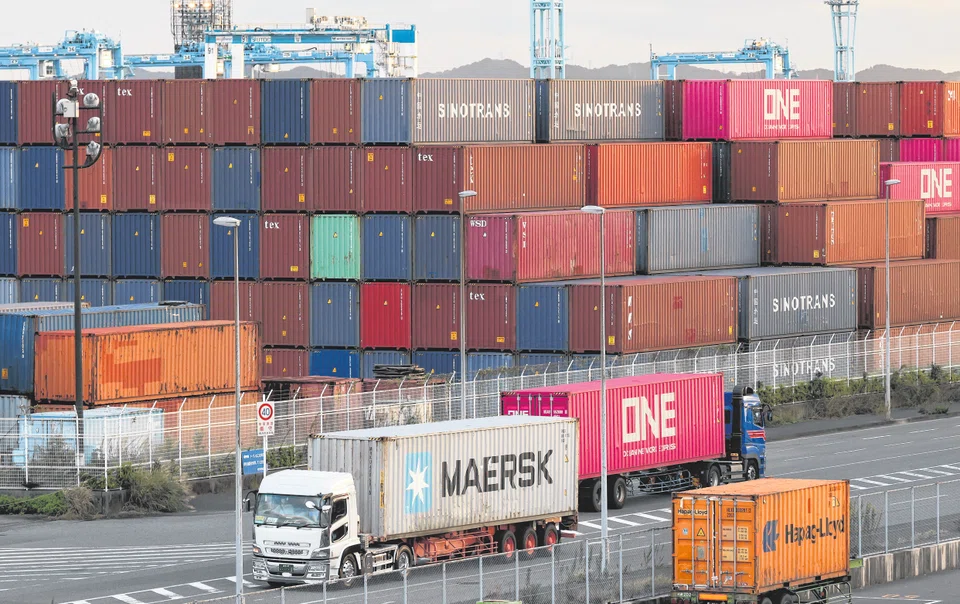
HAVING weathered rough conditions in 2023, the global shipping industry is likely to still face choppy waters in 2024 as the post-Covid boom continues to unwind.
Industry observers said adverse macroeconomic conditions – including reduced consumer spending, high interest rates and inflation – could keep demand low, while a lingering oversupply of containers and ships will whittle down profits.
The Baltic and International Maritime Council (Bimco) expects the current weakening trend in the industry, which began in 2022 and took hold in 2023, to continue in 2024 and 2025.
In a double whammy for the industry, 2024 will also be the year decarbonisation efforts bite. Companies will need to grapple with carbon taxes in the short term and sustainability strategies in the long term.
Asia, however, could be a bright spot, as manufacturers with operations in China seek safe harbours elsewhere.
Racing from peak to trough
As the world emerged from the pandemic and demand started to recover from mid-2021, the post-Covid shipping boom fed large profits – spurring companies to order more ships and containers.
Yet, demand did not meet expectations. There has been an oversupply of shipping capacity this year that kept prices and profits low – and this is set to continue in 2024.
As the year draws to a close, shipping prices continue to weaken. For the week of Dec 7, the Drewry World Container Index was down 32 per cent year on year at US$1,461 – though this was still 2.9 per cent above the average rate of S$1,420 in pre-pandemic 2019.
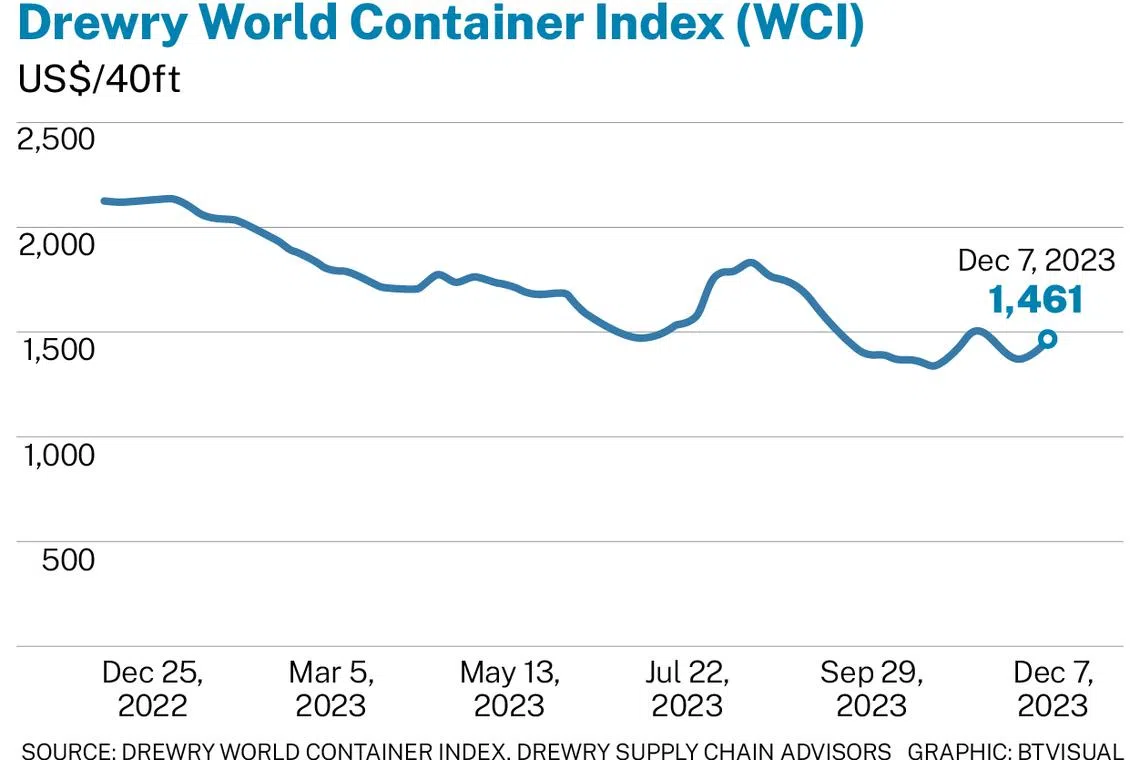
For the year to Dec 7, the average composite index was US$1,677. This is 37.2 per cent lower than the 10-year average of US$2,672.


Even as prices slump, previously ordered ships are being delivered. Bimco forecasts shipping fleets will grow at an average annual rate of 8.4 per cent between 2023 and 2025.
Industry observers said that as a result, carriers could have trouble breaking even.
Steve Saxon, partner at consultancy McKinsey & Company, said the “significant oversupply” of new ships could drive prices down to marginal cost levels. He added that shipping companies are now back to the pattern of the last decade – low profits that are insufficient to cover the cost of capital.
Stephen Ly, vice-president for South-east Asia at logistics company CH Robinson, said that with supply growth projected to hit 9 per cent and demand growth below 2 per cent in 2024, it would be difficult for ocean freight rates to increase, or even stay above break-even levels if carriers do not address the imbalance.
He said some carriers are already cutting supply through blank sailings (skipping ports or journeys) and slow steaming (travelling more slowly) and will continue to do so in 2024. This will mean instability in shipping schedules and longer transit times.
Optimism in South-east Asia
In Asia, the picture is somewhat brighter as China-based manufacturers move to strengthen their supply chains after disruptions from Covid-19. Companies are also trying to adjust to tensions between China and the United States.
This may involve “readjusting supply chains to achieve a better balance” across China, South Asia and South-east Asia, particularly by setting up new manufacturing hubs in the latter areas, said Wong Siew Loong, president of logistics player Kuehne+Nagel Asia-Pacific.
Logistics group DP World foresees this trend extending into 2024, said its chief executive officer and managing director for Asia-Pacific Glen Hilton. The company saw “healthy growth” in intra-Asia trade in 2023.
“South-east Asia is a major beneficiary of this trend in the long term, as it will result in rising industrial activities in the region, increased consumer demand and greater inflow of foreign direct investment,” he added.
DP World is among logistics operators expanding in the region to take advantage of this trend, increasing its capacity in Belawan, Indonesia, and starting the construction of a new terminal at Gresik, also in Indonesia. Japanese shipping company Ocean Network Express (ONE), meanwhile, debuted two services between East Asia and South-east Asia.
It’s not easy being green
The big challenge the industry faces is decarbonisation – there is no convincing plan for this, and the economic slowdown will only make the journey harder.
The European Union’s Emissions Trading System (ETS) comes into effect on Jan 1, meaning vessels using EU ports must pay for their carbon pollution.
A typical container vessel travelling from Europe to Asia is expected to pay 810,000 euros (S$1.2 million), estimates marine classification society DNV.
Kuehne+Nagel’s Wong said that for 2024, carriers are “increasingly willing” to pass on those costs to consumers.
Major carriers Hapag-Lloyd, Maersk and CMA CGM have already announced higher per-container fees for green shipping in 2024.
Louis Tang, MD and head of the East Asia region at ONE, said the company has achieved a “more than 50 per cent reduction” of Scope 1 emissions (compared with 2008 figures), from the use of more efficient vessels and operational improvements. The shipping operator will next trial “drop-in” biofuels, which can be mixed with conventional fossil fuels and are compatible with existing ship engines.
McKinsey’s Saxon expects 2024 to be the year “decarbonisation really takes hold”, after the International Maritime Organization published requirements on the 2050 net-zero goal for international shipping this July.
Said Saxon: “Many shipping companies have been holding back in their planning, but 2024 will require them to make a clear decarbonisation plan for the future.”
Decoding Asia newsletter: your guide to navigating Asia in a new global order. Sign up here to get Decoding Asia newsletter. Delivered to your inbox. Free.
Copyright SPH Media. All rights reserved.