Good and bad news on piracy front
Armed attacks at 21-year low; but West Africa remains danger area and waters between Sabah and Philippines hit by rising incidents
THE good news is that piracy and armed robbery at sea has fallen to its lowest levels since 1995, according to a new report from the International Chamber of Commerce's International Maritime Bureau (IMB).
Unfortunately, there are least at two lots of bad news. First, West Africa continues to be a danger area, with increasing numbers of attacks and kidnappings for ransom.
Secondly, in a separate report, the Regional Cooperation Agreement on Combating Piracy and Armed Robbery against Ships in Asia says it is concerned about a spate of incidents involving the abduction of crew from ships while underway in waters off eastern Sabah and southern Philippines, which have occurred since March 2016.
About half of the crew members captured have been released following ransom payments but very worryingly it is suspected that others may have been sold on to the Abu Sayyaf group of Islamist terrorists. Between March and July, there were six abduction incidents in the area, involving five tugs towing barges and one fishing vessel. As well as abducting crew members, the pirates stole items on board the ship, including navigational equipment, and the crew's personal belongings such as mobile phones and laptops. Of the 33 crew members who had been abducted in the six incidents, only 18 have been released.
Nevertheless, the headline figures are getting better. IMB's global piracy report shows 98 incidents in the first half of 2016, compared with 134 for the same period in 2015. When piracy was at its highest and Somali-based pirates posed the biggest threat, in 2010 and 2003, IMB recorded 445 attacks a year.
In the first half of 2016, IMB recorded 72 vessels boarded, five hijackings and a further 12 attempted attacks. Nine ships were fired upon. Sixty-four crew were taken hostage onboard, down from 250 in the same period last year.
"This drop in world piracy is encouraging news. Two main factors are recent improvements around Indonesia, and the continued deterrence of Somali pirates off East Africa," said IMB director Pottengal Mukundan, whose global Piracy Reporting Centre has supported the shipping industry, authorities and navies for 25 years.
"But ships need to stay vigilant, maintain security and report all attacks, as the threat of piracy remains, particularly off Somalia and in the Gulf of Guinea," he warned
But despite these global improvements, kidnappings are on the rise, with 44 crew members captured for ransom in 2016, 24 of them in Nigeria, up from 10 in the first half of 2015.
"In the Gulf of Guinea, rather than oil tankers being hijacked for their cargo, there is an increasing number of incidents of crew being kidnapped for ransom," said Capt Mukundan.
Stuart Edmonston, head of loss prevention at marine insurer UK P&I Club, said: "The Gulf of Guinea is understood to be the most dangerous region in the world for seafarers. A report by Oceans Beyond Piracy revealed that there have been 32 kidnaps for ransom during 2016 in the Gulf of Guinea, surpassing the total number of incidents, 19, recorded by the International Maritime Bureau (IMB) for 2015."
He added: "The increase in kidnapping for ransom has not occurred out of the blue: in 2014, 16% of attacks in the area involved kidnap for ransom; in 2015 it was 28% of attacks. There may be two reasons why kidnapping has increased in late 2015 and has continued to increase in 2016."
According to Mr Edmonston, improved naval patrolling by the Nigerian and other littoral navies may have made cargo theft more difficult and dangerous. Cargo theft, particularly of large amounts of refined oil products, takes time and so criminals have moved to a crime, the kidnap for ransom of ships' crews, where less time is spent on-board vessels, leaving them less exposed to naval patrols. "In addition, it may be that for the time being, the drop in oil prices has made oil theft a less lucrative proposition than kidnapping for ransom."
Unfortunately, things could get worse. Mr Edmonston warned: "There are indications that some kidnappers have such belief in their business model that they are increasing their logistical capacity to take in and hold more hostages, possibly for longer than is now normally the case. There are also signs that their understanding of the 'kidnap market' is evolving - in other words, they may be able to target their attacks with greater precision and demand higher ransoms."
As a result, he cautioned, "shipping companies need not only to protect their vessels, but also to ensure that they can still attract high-quality officers and crews willing to sail in the area".
"This means that crews must understand, but not overestimate, the risks and that they and their families are mentally and physically prepared for an incident. Companies must also be able to demonstrate that they take their duty of care seriously, and that they will be able to act professionally if a kidnap does occur," he said.
More encouraging news has come from Indonesia. IMB's Piracy Reporting Centre has been working closely with the Indonesian authorities to improve security at sea and in ports.
Low-level theft to ships at anchor has been brought down by introducing designated anchorages with improved security. This has contributed to a fall in the number of incidents in Indonesia to 24 in the first six months of 2016, compared with 54 in the same period in 2015.
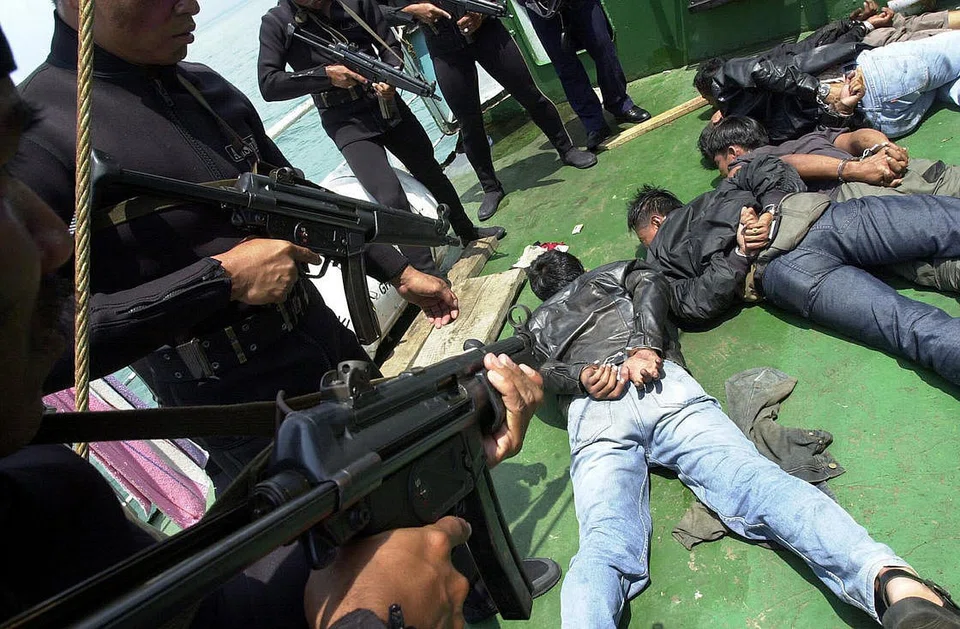
IMB also applauded the Indonesian Navy's prompt response in recovering a hijacked product tanker south of Pulau Serutu, off west Kalimantan in May, saying: "This is exactly the type of robust response required in response to such threats."
Nine pirates were apprehended and the crew of the tanker unharmed.
That is good news, as is the recent conviction of 12 Somali pirates in Mauritius. But really bad news is the crew and armed security team from the Seaman Guard Ohio remain in an Indian jail. Nobody in the shipping industry should sleep while that remains the case.