

Harnessing wind power for shipping looks promising
Serious money is backing sail-assist projects, so some technology may emerge to nudge shipping towards zero carbon
 Add BT as a preferred source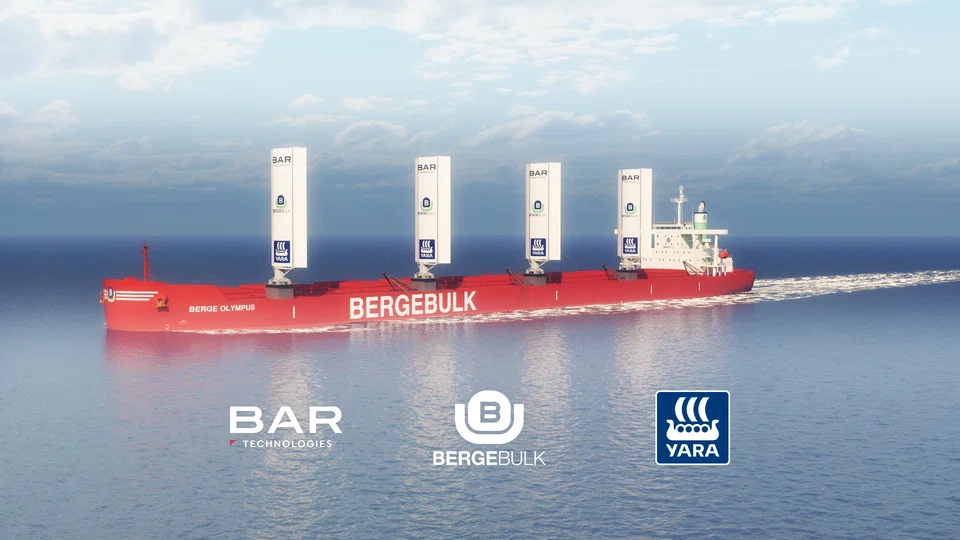
DeeperDive is a beta AI feature. Refer to full articles for the facts.
By David Hughes
THE big challenge facing the shipping industry is how to achieve zero carbon emissions within what is certainly becoming an increasingly tight timeline.
The main long-term potential fuels are generally thought to be hydrogen (in some form), methanol, “green” LNG and ammonia – once these fuels themselves can be produced in a carbon-free way. The continued use of fossil fuels combined with carbon capture is also being seriously explored, as is nuclear power using thorium reactors.
However, it also makes sense to reduce the requirement for fuel as much as possible. One obvious fuel-saving approach is to reduce hull drag through more effective anti-fouling and more efficient design. A lot of effort is being put into this area.
However, one very obvious possibility is to use the plentiful natural resource of the wind. Of course, for most of history, ships were wind-powered. But cheap fossil fuels triggered the transformation from sail to power. The big advantage of steamships and now, by and large, motor vessels, is their relative predictability. Using the wind is not that easy, for it is an unreliable resource. Being becalmed for days or weeks on end does not sit easily with modern “just-in-time” supply chains.
Nevertheless, there have been attempts over the years to make use of the wind to save fuel. Flettner rotors have a long history and are making something of a comeback. Other approaches are being tried. Major bulk carrier operator Berge Bulk has announced that it intends to equip its 210,000 deadweight (dwt) Berge Olympus with four BAR Tech WindWings made by Yara Marine Technologies in the second quarter of 2023.
Navigate Asia in
a new global order
Get the insights delivered to your inbox.
These large, solid wing sails will be up to 50 m high, and are designed to reduce CO2 emissions by as much as 30 per cent through a combination of wind propulsion and route optimisation. Berge Bulk chief executive James Marshall said: “At Berge Bulk, we believe in the results that can be achieved by harnessing wind power. With this groundbreaking technology, the estimated impact on reducing emissions can be at least as significant as transitional fuels. We look forward to continuing our collaboration with BAR Tech and Yara Marine to install the first WindWings on board the Berge Olympus, and for the optimisation needed when deploying such innovative technologies.”
The bulker operator Berge Bulk said the company will be an early adopter of wind-assisted propulsion technology, evaluating a pivotal technology to reduce the emissions of their bulker fleet. It owns and manages a fleet of over 80 vessels, totalling more than 14 million dwt, and ranging from handy-size to cape-size.
Thomas Koniordos, chief executive of Yara Marine Technologies, said: “A successful transition to a lower-carbon future can only be achieved through an inclusive approach. I strongly believe that many valuable solutions deserve greater attention, and wind-assisted propulsion is one of them. This collaboration between Berge Bulk, BAR Technologies and Yara Marine skyrockets the momentum for wind propulsion.”

Well, perhaps it will. It will be interesting to see how this project turns out. The statement from the companies involved doesn’t mention cost or return on investment times.
Nevertheless, BAR Technologies chief executive John Cooper said: “By retrofitting WindWings technology to existing vessels, firms like Berge Bulk can begin to make an immediate impact on decarbonising their fleets, while at the same time seeing significant efficiencies in current fuel use.”
The solid sails system has received approval-in-principle (AiP) from classification society DNV. The AiP relates to the practicality and safety of the technology, and follows a comprehensive assessment of the system’s design specifications, safety and usability considerations, and general applicability to sea-going vessels. It also examines the deployment and functionality of WindWings in operation, its use in extreme weather, and system redundancy.
Another classification society, Lloyd’s Register (LR), has just issued a first-stage AiP for a fully automated, emission-reduction sail technology that can be retrofitted to merchant ships. A 3-year project backed by the UK’s Scottish government and industry players will develop and test Smart Green Shipping’s FastRig technology. It claims to be compatible with up to 40,000 ships currently operating in the merchant fleet; it also claims to be able to deliver at least 20 per cent fuel savings and associated greenhouse gas reductions. It is planning to install a demonstrator on a commercial ship next year.
These 2 projects, and several others also underway, are intended to cut fuel use and complement conventional methods of propulsion. However, an initiative has just been announced in the UK that goes further.
SailLink is described as a new cross-English Channel ferry service specifically for foot passengers, cycle tourists and small groups “looking for a unique travelling experience with sustainable credentials”. It will use purpose-built sailing vessels to take up to a dozen passengers between the attractive and accessible coastal destinations of Dover and Boulogne-Sur-Mer. Tickets have been pegged £85 (S$139.70) for a single trip and £150 for a return one.
The service will be operated by fast commercial sailing catamarans, which will be fitted with electric propulsion for marina access and auxiliary power. Anybody familiar with vagaries of the weather in the Channel may be sceptical about this project and should be allowed a wry smile when the company concedes it “will work with the existing ferry operators to carry passengers, and to maintain ... travel itineraries when weather conditions would make a specific crossing uncomfortable”.
The scope for going back to completely wind-dependent propulsion is in reality is probably very limited. However, there is serious money backing sail-assist projects, and it seems probable that at least some of the technologies being tested will have a role to play in shipping’s pathway to zero carbon.
Decoding Asia newsletter: your guide to navigating Asia in a new global order. Sign up here to get Decoding Asia newsletter. Delivered to your inbox. Free.
Copyright SPH Media. All rights reserved.
TRENDING NOW

Shelving S$5 billion office redevelopment plan proved ‘wise’ as geopolitical risks mount: OCBC chairman

OCBC is said to emerge as lead bidder for HSBC Indonesia assets

Middle East-linked energy supply shocks put Asean Power Grid back in focus

Eurokars Group introduces rental car franchises Enterprise Rent-A-Car, National Car Rental, and Alamo to Singapore

