

Hyundai unveils new humanoid robot to work in its car factories
The South Korean company plans to invest 125 trillion won in South Korea over the next five years
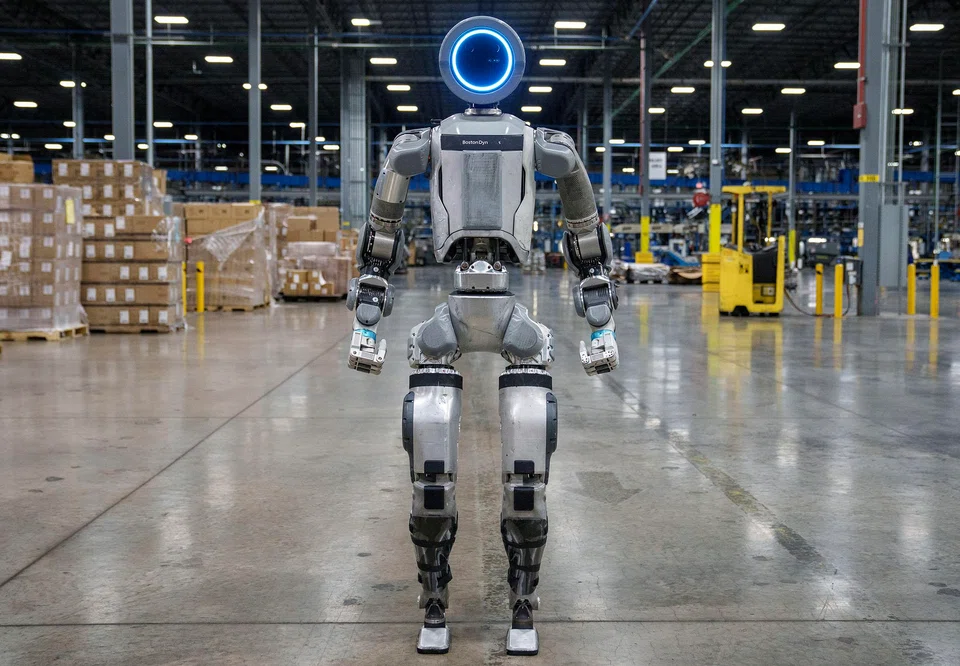
[SEOUL] Hyundai Motor’s Boston Dynamics unit unveiled the latest iteration of a humanoid robot designed to work in the carmaker’s manufacturing plants starting in 2028, including at a factory in Savannah, Georgia.
The Seoul-based manufacturer initially plans to deploy its newest Atlas robot to handle highly repetitive tasks, such as arranging components in the order they are installed in vehicles, before it plugs them into more complex assembly work by 2030, Hyundai said in a statement from the CES technology conference in Las Vegas.
The Atlas humanoid robot features human-scale hands with tactile sensing and fully rotational joints capable of lifting up to 110 pounds (50 kg) and operating in temperatures as low as -4 F (-20 deg C) and as high as 104 F, it said.
Hyundai aims to mass produce as many as 30,000 robots annually at a new facility in the US, part of a broader initiative to meld artificial intelligence (AI) with robotics. The announcement comes after executive chair Chung Euisun said in New Year remarks that his company needs to embrace cutting-edge AI technology to avoid falling behind competitors.
The auto industry has been at the vanguard of efforts to automate more assembly line processes to trim labour costs and bolster worker safety. With AI, carmakers see opportunities for new revenue streams and improving the in-car experience for drivers with innovations such as hands-free operation.
Chinese electric vehicle maker Xpeng last year showed off its Iron humanoid robot to great fanfare, and a surge in shares. Tesla is developing its Optimus robot, which Elon Musk says has the potential to be “the biggest product of all time” and will eventually account for 80 per cent of Tesla’s value. Toyota Motor also has an advanced robotics programme, which in 2024 paired with rival Hyundai to speed development of humanoid robots using AI.
Robots have long been used in simple tasks such as welding and logistics, but companies are now looking for technological breakthroughs that will see robots master more intricate jobs. The rapid development of AI is helping drive bullish bets on the sector, with Goldman Sachs projecting the market for humanoid robots will reach US$38 billion by 2035, while Morgan Stanley expects the sector will hit US$5 trillion by 2050, when there could be more than one billion humanoids in use.
Hyundai launched its Robotics Lab in 2019, then two years later acquired Boston Dynamics, which has had commercial success with a robotic guard dog called Spot and a mobile robotic arm known as Stretch for re-stocking warehouses.
The South Korean company plans to invest 125 trillion won (S$111 billion) in South Korea over the next five years in AI, robotics and other new technologies, and another US$26 billion in the US to 2028.
SEE ALSO

It also plans to strengthen a strategic partnership with Nvidia, leveraging the chip giant’s technology to expedite innovation and improve efficiency. The two companies signed an agreement in October to build a US$3 billion physical AI cluster in South Korea. BLOOMBERG
Decoding Asia newsletter: your guide to navigating Asia in a new global order. Sign up here to get Decoding Asia newsletter. Delivered to your inbox. Free.
Share with us your feedback on BT's products and services
TRENDING NOW

Once staunchly pro-China, Malaysian Chinese businesses are now distancing themselves from Beijing
‘How many will survive?’: Bubble fears arise as China’s humanoid robotics face reality check
Philippine power giant First Gen rebuffs foreign offers, plans up to US$2.6 billion in expansion
Indonesia imposes US$116 million in fines over manipulation of Sinar Mas, Prajogo-linked stocks

