If Uber and Grab merge, it's commuters who lose
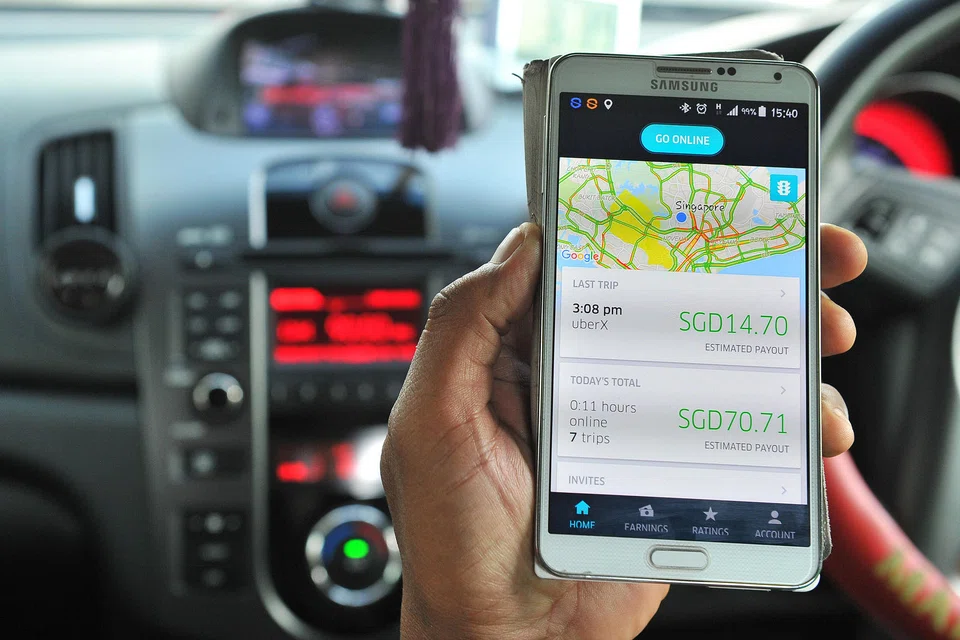
IT'S likely business as usual for now for Singapore-based ride-hailing company Grab - even after Monday's baffling announcement of Uber China's sale to arch foe Didi Chuxing (China's dominant ride-hailing firm) in a deal valuing Uber China at US$7 billion (more than triple the US$2 billion Uber has invested in China since 2013) and the combined company at US$35 billion.
The Uber China-Didi news only points to a tech startup world in constant shift, where anything can happen. Among scenarios still up in the air, higher-valued Uber may merge with Grab to own the South-east Asian market (or roads), or even pick up Grab, if the price is right.
Should either scenario materialise, consumers here will be furious. Since the advent of ride-hailing services in Singapore (most, in fact, originated as taxi-booking apps), consumers have benefited from a contested market. Competition was so keen that Hailo and Easy Taxi had to pull out, and surviving players Uber and Grab have had to slash fares, dangle more incentives, and constantly innovate.
If Uber and Grab were to become one, where's the stimulus to push the envelope and work for users? If Uber buys Grab, does that make Uber (which has time and again said competition always benefits users) a hypocrite? And does that make Grab (which has repeatedly said it's focused on offering the most localised services in South-east Asia) a sellout?
Uber China: a graceful exit?
What we know so far is Uber Technologies is selling its China operations to rival Didi. According to Uber chief Travis Kalanick, Uber and Didi Chuxing have invested billions of dollars in China, where both companies have yet to turn a profit. Mr Kalanick calls the deal a merger, while Didi chief Cheng Wei describes the deal as Didi buying Uber's brand, business and data in the country. Didi will invest US$1 billion in Uber China. Post-deal, Uber China will have a 7 per cent stake in terms of votes, and a 20 per cent stake in terms of economics in the combined company.
Media reports have been quick to call it Didi's victory, and label Uber as yet another US tech company that has failed to make it in China - joining a list that looks laughably like a tech all-star team (think Google, Facebook and Amazon). Some reports have called the deal a win-win, putting an end to an expensive, subsidy- heavy and seemingly unsustainable race between the two players.
But the most alarming of reports are those that theorised the vulnerabilities and eventual demise of other ride-hailing players, including South-east Asia's Grab (valued at S$1.6 billion, according to Fortune), India's Ola (US$5 billion), and the US's Lyft (S$5.5 billion). Didi is said to be worth US$28 billion. And Uber is reportedly miles ahead of the game, with a price tag of US$68 billion.
Grab (which counts Temasek's Vertex Ventures and Japan-based Softbank as its investors) is defiantly positive. In a media statement released shortly after the Uber China-Didi news, Grab chief Anthony Tan hailed the deal as "Didi's success over Uber in China", and one which strengthens Grab's conviction that "rideshare is a local business", and that "local champions will emerge as winners".
Mr Tan added that Grab is committed to building a "large-scale, sustainable" business in South-east Asia, on which it remains focused. Its internationalisation strategy "remains the same as before": to bring roaming availability to users wherever they travel to. This is presumably through its global rideshare alliance with Didi, Ola and Lyft - which was forged last year to let users book rides from each other's apps in all the regions where they operate, in clear anti-Uber fashion.
But now that Didi has buddied up to Uber in China, surely Didi's allegiances are in question? Lyft, Uber's rival in the US, suspects so, saying that over the next few weeks, it will "evaluate" its partnership with Didi. Grab's Mr Tan is more hopeful, telling The Business Times that Didi "remains committed" to its investment and partnership with Grab in South-east Asia. Ola did not comment.
Meanwhile, Uber has emerged stronger, a source close to the deal told BT. The Uber China-Didi "merger" has freed up capital for Uber, which will now double down on product, engineering and people in its other big markets such as South-east Asia and India. As many as 150 engineers could be redeployed from China to these markets, BT has learnt.
Consolidation in South-east Asia?
Speculation is rife of further consolidation in the ride-hailing space, even though the odds of a merger between Uber and Grab in South-east Asia, or an Uber buyout of Grab, are slim, say observers. But Yang Nan, assistant professor at the National University of Singapore (NUS), noted that there is still an outside chance of such a merger and acquisition.
He explained that the deal between Uber China and Didi makes "a world of sense" for both players. "In joint force, they have virtually taken down the dated, gruesome, and much-hated taxi industry in China. With the Chinese regulatory body giving the green light to (ride-hailing), what remains in their way is each other. We'll see a monopoly firm rising."
Prof Yang added that "if Uber arrives at the doorstep of Grab with a nice holding offer that mitigates competition here in Singapore, Grab would take it in a heartbeat". Chu Junhong, associate professor at NUS, agreed that some consolidation is likely to happen, but it may not be soon. "I do not think Uber wants to risk losing the South-east Asia market, after losing the China market."
But Lee Der-Horng, director of the NUS-LTA Transport Research Centre, highlighted that conditions in Singapore and South-east Asia are vastly different from those in China, rendering a "merger" in the region unlikely. "The market size here is not huge as compared with China, so either Uber or Grab is still able to cope. The subsidies for drivers and passengers are not that extensive or aggressive."
Dr Lee said that Uber and Grab might like to see a "merger", but from the standpoints of regulation and the passenger, it would not be a positive thing.
Prof Yang said that he was "honestly quite appalled" by the Uber China-Didi deal, likening it to the 2015 merger between Didi Dache and Kuaidi DacheDidi, which led to a "drastic reduction in competition and consumer welfare". He warned that the latest deal could lead to higher prices, and a loss in premiums that Chinese consumers have been accustomed to.
On Tuesday, China's Ministry of Commerce said that the Uber China-Didi deal would still require its approval after an antitrust scrutiny. Prof Yang said that given the "weak" antitrust practice in China, this would not pose a hurdle. He added: "I only hope Singapore's antitrust practitioners have better sense and better heart, for the sake of consumers."