

Low-cost airlines can tackle higher costs by flying smaller planes: Singapore Airshow panellist

Tay Peck Gek
LOW-COST airlines, which have driven the bulk of air travel demand in Asia-Pacific, are facing a jump in business costs.
Moreover, the economic headwinds are going to start to have an impact on the pace and profile of growth of the sector, plane maker Embraer said.
The Brazilian small, narrow-body aeroplane manufacturer added that pairing demand with capacity – that is the deployment of the right-sized aircraft – would help airlines to control cost. This could enable carriers to make fares affordable and sustain demand.
Adam Young, vice-president for marketing in Asia-Pacific at Embraer Commercial Aviation, pointed out at the Singapore Airshow 2024 media roundtable on Wednesday (Jan 24) that low fares were bringing in new air travellers pre-pandemic. Low-cost airlines had 70 per cent of intra-Asia traffic, with the remaining accounted for by full-service airlines.
Currently, carriers are facing an increase in business costs – including higher interest rates, labour expenses and fuel costs – and passing the higher costs to passengers, hitting the low-cost players particularly hard hit.
“Their results have already been showing double-digit cost increases, fares are going up… This means that these economic headwinds are going to start to have an impact on the pace and also the profile of growth,” said Young.
Airlines can seek to optimise their fleets, placing a greater emphasis on ensuring profitability by matching capacity with demand, and offering more frequency and greater connectivity for passengers, he noted.
That could mean flying direct or serving the secondary destinations so as to cut costs while offering passengers convenience and tapping underserved demand.
Bicky Bhangu, president for South-east Asia, Pacific and South Korea at engine maker Rolls-Royce Singapore, spoke of the need to focus on getting the economics of sustainable aviation fuel right, given that the green fuel is three to five times more expensive than fossil jet fuel.
“It is expensive, but that’s exactly why we need to bring the ecosystem and partners together, that’s exactly why a platform like the Singapore Airshow brings together not just the airlines, the manufacturers, the customers, the societies, but also the governments and the regulators, because we need to get the right incentives in place,” Dr Bhangu said.
He noted that regulations at the moment are still limiting up to 50 per cent use of sustainable aviation fuel in flights, thus there is a need to ramp that up to 100 per cent. All Rolls-Royce civil aero engines are now compatible with 100 per cent use of sustainable aviation fuel.
The capacity of sustainable aviation fuel output needs to be raised to meet demand as well, Dr Bhangu added.
Leck Chet Lam, who is the managing director of Experia Events which organised the Singapore Airshow 2024, pointed out that the aerospace industry could take a leaf out of the automotive industry’s book in adopting new technologies such as electric planes and fuel cell.
“I believe if we can manage these well, I think there’s a better position to capitalise on the growth forecast for the Asia-Pacific region going forward.”
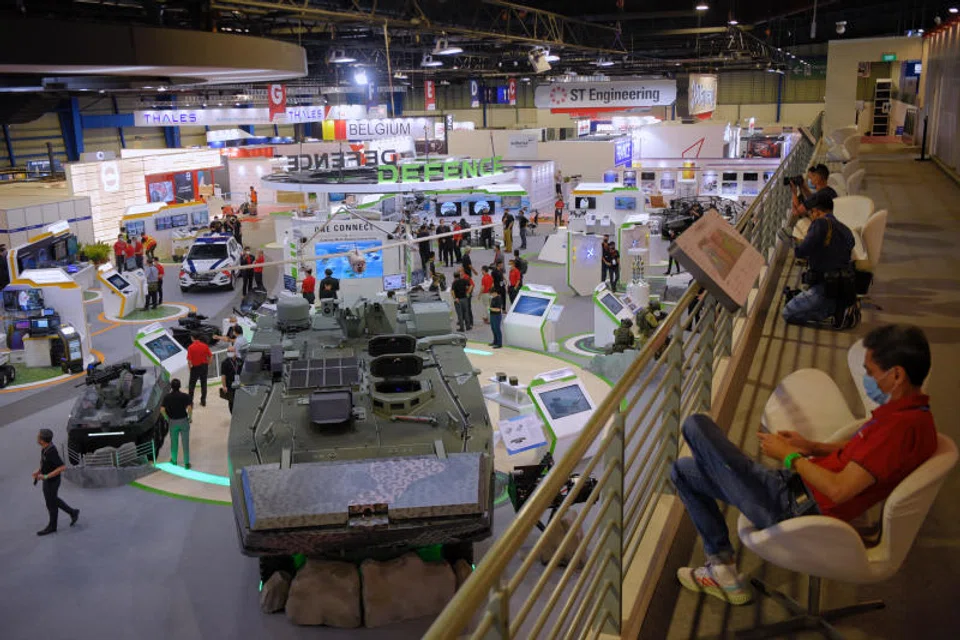
The Singapore Airshow 2024 is the ninth edition of the biennial aerospace and defence exhibition, and will take place from Feb 20 to 25 at the Changi Exhibition Centre.
Experia noted that this will be the first full-scale exhibition post-pandemic, with 1,000 companies from more than 50 countries expected to participate.
TRENDING NOW

China Investment Corp, PGIM’s 50% stake in Nex mall up for sale; asking about S$1.2 billion

Higher rates, weaker spending: Is the Philippines entering stagflation?

Singapore tech stocks plunge as Nasdaq bloodbath spills into region

OCBC wealth clients turn defensive amid market volatility as Q3 profit rises 3%

