

LTA announces changes to parking provisions from February 2019
Revisions will give developers greater flexibility in managing parking provisions of residential and commercial projects

Nisha Ramchandani
Singapore
REVISIONS to parking requirements for private and commercial developments will kick in from 1 Feb next year, which the Land Transport Authority (LTA) says would give developers greater flexibility in managing parking provisions.
The new Range-based Parking Provision Standards (RPPS) will replace the current Car Parking Standard (CPS) - which only sets a minimum number of parking lots - and the Range-based Car Parking Standard (RCPS) which allows some developments to reduce parking provisions as required by the CPS by up to 20 per cent.
In all non-residential developments, the LTA will also introduce mandatory provisions for motorcycle lots, with five per cent of the upper and lower range of the total parking lot provision requirement to be allocated to motorcycles. Currently, buildings are not required to allocate motorcycle parking lots.
The new standards are part of the Parking Places (Amendment) Act, which was passed in March this year. Announcing the changes on Friday, the LTA said the revised parking standards will "accord developers greater flexibility in managing parking provisions according to the needs of developments, particularly in areas well-connected to the public transport system."
It added that this would also free up more land for community spaces and greenery.
The new RPPS standards, which will stipulate a range of parking lots as opposed to a minimum provision, will allow developers to offer fewer parking spaces in the central business district and Marina Bay area (excluding gazetted car-lite precincts). The reduction ranges from 20 to 50 per cent from existing standards. This will apply to commercial and private residential developments, as well as non-residential white sites.
For example, an office in the city or Marina Bay with a gross floor area of 100,000 square metres will be able to offer between 105 car lots and six motorcycle lots to 169 car lots and 10 motor cycle lots under the new standard. Under the current CPS, the development is required to provide a minimum of 222 car park lots. The developer may apply to LTA to reduce this to 178 lots under the RCPS.
Commercial developments for retail, food and beverage (F&B), and hotel uses outside the CBD and Marina Bay but within four hundred metres of an MRT station will be able to offer up to 50 per cent fewer parking lots. Offices in this particular zone will be able to offer a reduction of between 20-50 per cent.
Meanwhile, all other areas - except gazetted car lite precincts - will be able to offer 20 per cent fewer parking lots.
Applications by developers to deviate from the specified range will be evaluated by LTA on a case-by-case basis. Developers may also have to pay charges of S$16,000 per car parking space or S$5,500 per motorcycle lot for every lot that is below or above the allowable range.
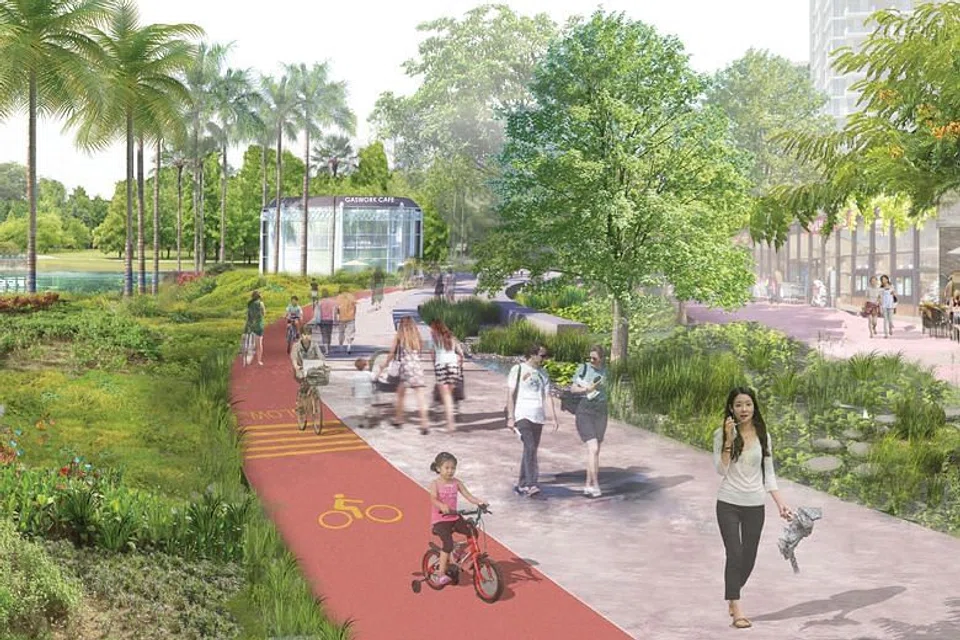
The LTA also said that five new areas have been gazetted for development as car-lite precincts, namely Marina South, Kampong Bugis, Woodlands North, Bayshore and Jurong Lake District; these areas will be "planned with added support for public transport and alternative travel options", the LTA added. Parking provisions for developments in these areas will be determined by the LTA on a case-by-case basis.
The RPPS, which is in line with the shift towards a car lite nation, encourages the use of public transport and other modes of transport such as cycling, said Knight Frank's senior director and head of research, Lee Nai Jia.
"Moving forward, rentals and prices of commercial and residential developments which are closer to transport nodes, especially those near MRT stations, could go up," Mr Lee said, adding that prices for residential developments within a 200-metre range from an MRT station could go up by 3-6 per cent.
Meanwhile, at residential developments, a reduction in overall car park lots could mean that the number of visitor car park lots set aside could be impacted, reckons Desmond Sim, CBRE's head of research for Singapore and South-east Asia.
Residents with two or more vehicles - such as families and high net worth individuals - could also be affected by any reduction. However, "generally speaking, the network of upcoming MRT lines and popularity of ride-sharing may also help to alleviate the need for cars," Mr Sim pointed out.
TRENDING NOW

He built the Vingroup empire. Now South-east Asia’s richest man is handing some key roles to his sons

Despite the de-dollarisation debate, demand for dollar liquidity in Asia is growing
Singapore’s new data centres must use renewables. Can they overcome the hurdles?

Tokyo reverses baby bust with AI matchmaking and generous subsidies

