As major bunkering port, Singapore has key role in global maritime decarbonisation: IMO chief
Derryn Wong
Published Mon, Apr 15, 2024 · 05:00 AM
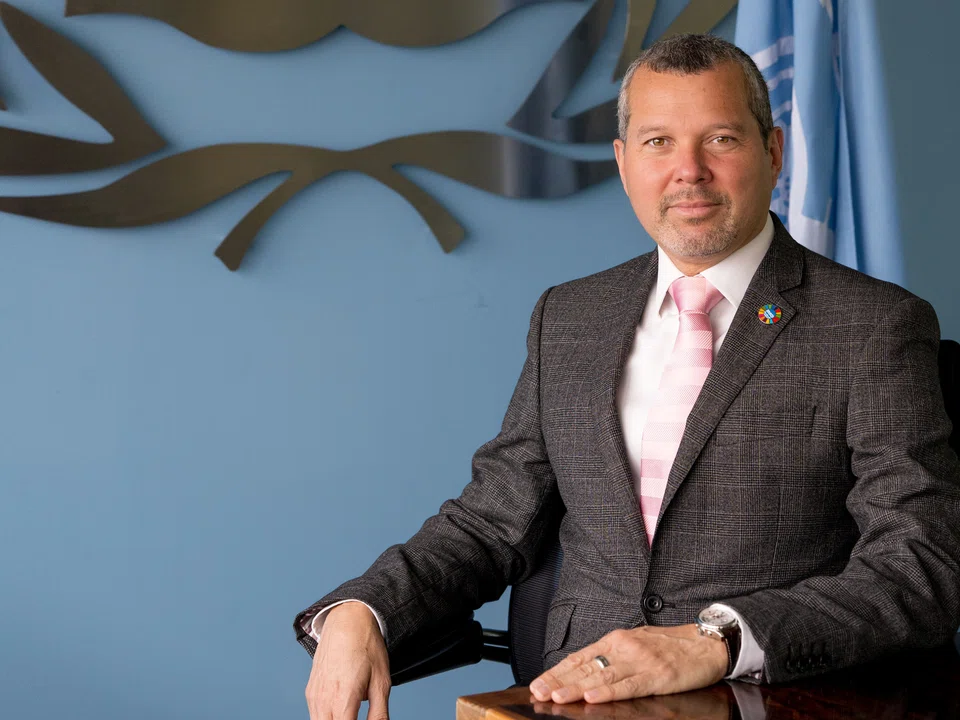
    • IMO chief Arsenio Dominguez says that two issues he has prioritised are decarbonisation and addressing terrorist attacks in the Red Sea.
    • IMO chief Arsenio Dominguez says that two issues he has prioritised are decarbonisation and addressing terrorist attacks in the Red Sea. PHOTO: INTERNATIONAL MARITIME ORGANIZATION

    AS THE world’s top bunkering port, Singapore has an important role in the decarbonisation of the maritime industry, said Arsenio Dominguez, the new secretary-general of the International Maritime Organization (IMO).

    Decarbonisation is one of two priority issues for his organisation, alongside the short-term challenge of conflict in the Red Sea, he told The Business Times in a video interview ahead of the annual Singapore Maritime Week (SMW) that begins on Monday (Apr 15).

    Bunkering refers to the supplying of fuel to maritime vessels – and greener fuels such as methanol are key to the maritime sector’s decarbonisation journey.

    Singapore sold a record 51.8 million tonnes of bunker fuel in 2023, roughly a quarter of estimated global demand.

    It is also one of the world’s busiest ports in terms of vessel arrivals, and the second-busiest container port after Shanghai.

    Singapore has been an active partner in IMO’s push for decarbonisation, and is an “early mover” in this, said Dominguez, a Panamanian who took up his current role on Jan 1 for a four-year term, succeeding Kitack Lim from South Korea.

    Dominguez, who began his maritime career back in 1996, was formerly the director of the IMO’s marine environment division, a post he held for two years.

    Collaborating on decarbonisation

    During the interview, he stressed that decarbonisation will be a major focus of this year’s SMW.

    Last year, the IMO adopted stricter greenhouse gas emissions targets: It will now aim to hit net zero around 2050, with interim reduction targets of at least 20 per cent from 2008 levels by 2030, and 70 per cent from 2008 levels for 2040.

    The 2050 net-zero target is more ambitious than the previous target of a 50 per cent reduction from 2008 levels by that same year. The old target, set in 2018, at the time drew criticism for falling short of Paris Agreement targets.

    Singapore is a leader in maritime decarbonisation, said Dominguez, noting efforts such as the setting up of green shipping corridors.

    These are shipping routes which cut emissions through the use of cleaner ships and measures such as reducing the time vessels spend in port. Singapore has initiated green shipping corridors with Australia, China, Japan, the Netherlands and the US.

    Added Dominguez: “Singapore also has been very good about sharing this experience and expertise with other countries around the world through partnerships with organisations, as well as directly through bilateral or multilateral activities.”

    During SMW, experts from around the world will look at further measures for decarbonisation and digitalisation, because the two “go hand-in-hand” with the progress of the shipping industry, said Dominguez.

    Organised by the Maritime & Port Authority of Singapore, the industry event runs from Apr 15 to 19. It is expected to host more than 10,000 maritime professionals from nearly 40 countries, including delegates from governments, port authorities and international organisations.

    Fair shares

    Dominguez said that, as a global effort, maritime decarbonisation must be calibrated for fairness across countries. As the United Nations’ agency for regulating maritime transport, the 176-member IMO is a “consensus organisation”, he noted.

    The IMO may have set emissions targets, but yet to be determined are specifics such as fuel standards and an emissions pricing mechanism. These will need to account for differing levels of national development. “We don’t want to create a bigger gap between developed and developing countries,” he said.

    “We need to support and address the concerns of developing countries, in particular, small-island states, developing states and less-developed countries.”

    Member states are now negotiating technical and economical pricing mechanisms and measures, and the IMO is “on track with a very ambitious timetable” to have measures drawn up by 2025, and to take effect in 2027.

    Staying safe

    Although decarbonisation is expected to dominate the discussion at SMW and in the maritime industry in the longer term, Dominguez’s second priority – addressing the terrorist attacks in the Red Sea – also turns the spotlight on the IMO’s work in maritime safety, which was its founding purpose.

    “The IMO has much more than just a green agenda, as the safety and human elements are also paramount. In fact, the organisation was created in relation to safety aspects and the protection of safety,” he said.

    The organisation was set up in 1958, following long-time calls for a permanent international body to promote maritime safety.

    Indeed, in the case of the Red Sea, the safety of seafarers must take priority over sustainability, said Dominguez. The conflict is forcing ships to sail longer routes to avoid the Red Sea, “which of course increases emissions”.

    “So we need to also be aware and take into account that sometimes, in order to guarantee safety of life at sea, these actions need to be taken, and the industry should not be penalised in this respect.”

    In February, he told international media that the IMO had been working “tirelessly” towards resolving the Red Sea situation by keeping diplomatic channels open and conversations among all parties going, before taking collective action.

    That, he told The Business Times, would continue to be the organisation’s modus operandi in general.

    “We always find ways to move forward to get the necessary agreements, to make progress, to address the challenges of the industry, as well as the necessary changes to continue to evolve as an industry, as a sector, and to keep pace with changes around the world, be it digitalisation or facing geopolitical situations around the world,” he said.