'Many will follow': SpaceX sends all-civilian crew into orbit
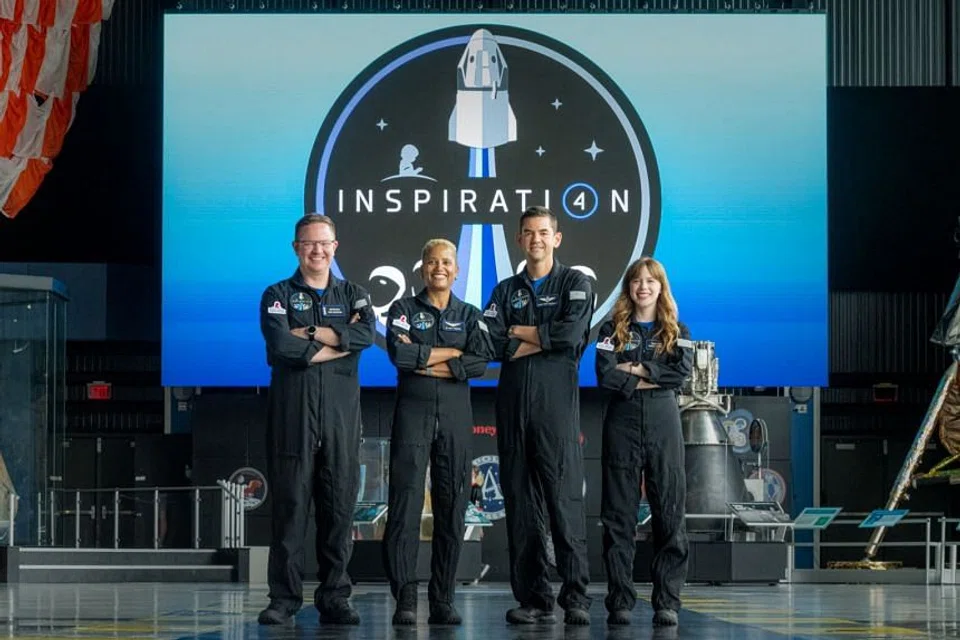
[KENNEDY SPACE CENTER] A SpaceX Falcon 9 rocket carrying four space tourists blasted off Wednesday night from the Kennedy Space Center in Florida for the first mission to orbit the globe with an all-civilian crew.
A huge fireball illuminated the sky as the rocket's nine engines began to pull away from Earth at 8.02pm (0002 GMT Thursday).
Around 12 minutes later, the Dragon capsule separated from the rocket's send stage as the crew entered orbit, while the re-usable first stage made its way back to Earth for a vertical landing on a sea barge.
"A few have gone before and many are about to follow," said Jared Isaacman, the 38-year-old billionaire who chartered the flight.
The spaceship's trajectory will take it to an altitude of 357 miles (575km), which is deeper into space than the International Space Station (ISS).
After spending three days spinning around the planet, the four-person crew, all Americans, will splash down off the Florida coast.
"The #Inspiration4 launch reminds us of what can be accomplished when we partner with private industry!" tweeted National Aeronautics and Space Administration (Nasa) administrator Bill Nelson ahead of the launch.
Building up commercial capability has been the vision of Nasa's commercial crew program since it was founded in 2011.
Tough training
SpaceX has not disclosed what the trip cost Mr Isaacman, a high school dropout who went on to found Shift4 Payments and is also a keen aviator. But the price tag runs into tens of millions of US dollars.
Mr Isaacman's three crewmates were selected through a competition, and their stories have been followed in a Netflix documentary.
Hayley Arceneaux, a pediatric cancer survivor, is a 29-year-old physician assistant. She will be the youngest American to go into orbit and the first person with a prosthesis, on a part of her femur.
Chris Sembroski, 42, is a US Air Force veteran who now works as an aerospace data engineer.
Sian Proctor, a 51-year-old geoscientist and educator, was almost selected to become an astronaut for Nasa in 2009.
She is only the fourth African-American woman to go to space.
They bonded over the course of six months' training that included climbing Mount Rainier, high G-force conditioning and experiencing a taste of weightlessness on a parabolic flight.
The mission is aiming to raise US$200 million for St Jude's Children's Research Hospital, a leading facility in Tennessee. Ms Arceneaux received treatment there as a child, and now works there.
The crew will take with them various objects - a ukulele, hops intended to brew space beer and several digital assets known as non-fungible tokens - that will be auctioned off for the cause.
Throughout the flight, biological data including heart rate and sleep, as well as their cognitive capacities, will be analysed to study the health impacts of space.
The Dragon is equipped, for the first time, with a cupola observation dome - the largest ever space window - to take in the view. The dome replaces the usual mechanism used on Dragons to dock with the ISS.
Privatisation of space
Beyond the charitable and scientific aspects, the mission's stated goal is to represent a turning point in the democratisation of space, by proving that the cosmos is accessible to people who have not been handpicked and trained for many years as astronauts.
For SpaceX, this is nothing less than a first step towards a multi-planetary humanity - founder and chief executive officer Elon Musk's ultimate vision.
The flight should remain fully automated, but the crew has been trained by SpaceX to be able to take control in the event of an emergency.
The space adventure bookends a summer marked by the battle of the billionaires Richard Branson and Jeff Bezos to reach the final frontier.
Mr Branson, the Virgin Galactic founder, achieved the feat first, on July 11, and was followed by the Blue Origin boss nine days later.
But these flights only offered a few minutes of weightlessness. SpaceX's mission is far more ambitious - though flights organised by a private company that contracted Russian Soyuz rockets in the 2000s took tourists to the ISS.
This is the fourth crewed mission for SpaceX, which has now sent 10 astronauts to the ISS for US space agency Nasa.
AFP
Decoding Asia newsletter: your guide to navigating Asia in a new global order. Sign up here to get Decoding Asia newsletter. Delivered to your inbox. Free.
Share with us your feedback on BT's products and services