

Marco Polo Marine expects to weather the storm of potential shipping slowdown

Yong Jun Yuan
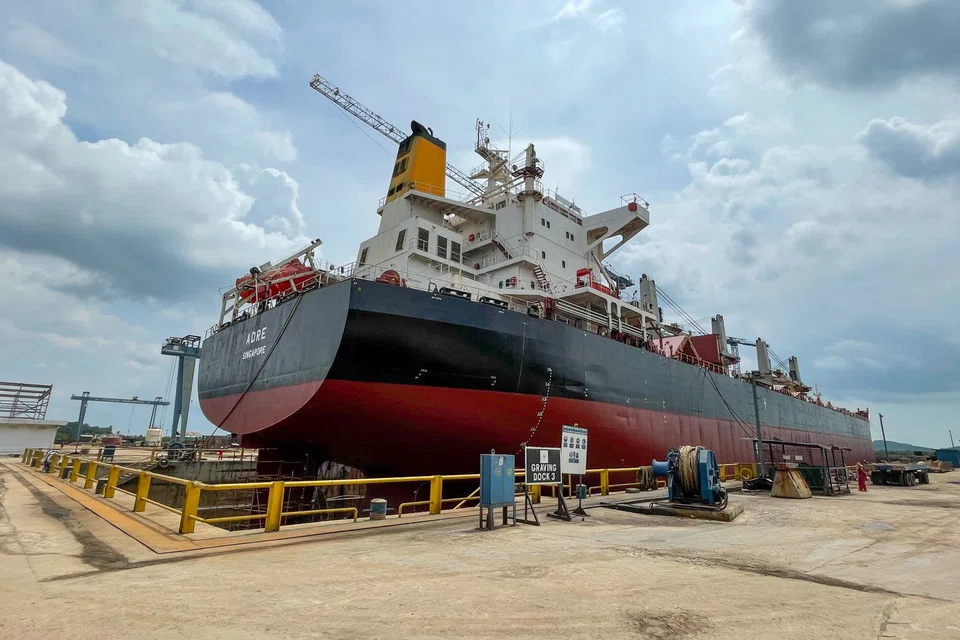
AT FIRST glance, Marco Polo Marine’s shipyard in Batam, Indonesia, appears to be deserted.
When The Business Times visited the facility on Jan 16, two bulker carriers and a ferry were parked in their respective drydocks.
But as a siren wailed through the air around noon, about 1,000 workers began filing out of the shipyard to take their lunch breaks.
In fact, according to Chandra Mohan, senior general manager of Marco Polo Shipyard, the shipyard operations arm of Marco Polo Marine, the Batam shipyard is currently 80 per cent utilised.
The shipyard experienced a boom last year, as it extended one of its drydocks to accommodate larger ships.
For the full year ended Sep 30, 2022, revenue from Marco Polo Marine’s shipbuilding and repair segment rose 59.2 per cent year on year to S$41.4 million.
The bulk of the revenue from this segment came from its ship repair services.
Today, repeat customers – including Singapore shipping company Pacific International Lines (PIL), mainboard-listed Samudera Shipping and Indonesian state-owned oil and natural gas corporation Pertamina – account for about 50 to 70 per cent of its ship repair revenue.
PIL alone accounts for 30 per cent of the revenue the company rakes in from its ship repair business.
Marco Polo Marine’s reliability, Mohan said, has been the key to winning more repeat customers. He noted that when the company first worked with PIL on a water ballast installation, it was given 18 days to do so.
As the shipyard became more efficient, Marco Polo Marine was able to shorten the time needed to complete the installation works to just 14 days. And it is looking to further increase its efficiency.
“For container ships, tankers, and bulk carriers, these customers are very demanding because they’ve already chartered the vessels… so when they give a window period, say 12 or 14 days, they need a reliable working partner,” Mohan said.
It also helps that Marco Polo Marine has been able to tap the large Indonesian labour market, which has allowed the company to be selective about the workers it hires.
Mohan noted that the company accepts fewer than half of the applicants for jobs at the shipyard.
Changing tides
While Marco Polo Marine mostly served oil and gas companies in the past, its focus has shifted to merchant vessels.
The company is expected to face some rough seas in the coming year as freight rates decline from pandemic highs.
The Freightos Baltic Index, a global index of container freight prices, tumbled to about US$2,246 for the week of Dec 30, 2022, from a high of US$11,109 for the week of Sep 10, 2021.
And rates are expected to fall by a further 15 to 20 per cent in 2023, according to Yuvraj Narayan, chief financial officer of Dubai-based global logistics company DP World.
Despite declining charter rates, Mohan believes the impact to Marco Polo Marine’s business will be limited as companies will still need to dock their ships every two to five years for maintenance work to be done. He added that container operators he spoke to also do not appear to be shrinking their fleets.
That said, Mohan foresees that customers could reduce their budgets and decrease the scope of work done on these ships, which would result in a slight hit to Marco Polo Marine’s margins.
To mitigate this impact, the company is trying to diversify its customer base.
Marco Polo Marine group chief executive Sean Lee noted that the company has been engaged in different projects that require a range of expertise. These, he said, include the building of offshore construction vessels, and the conversion of cargo vessels to cattle carriers.
“We are also trying to expand and reach out to new customers as well… so we always target to have new anchor customers every year,” Lee said.
Ship chartering on the rise
In addition, Lee noted that the company’s ship chartering rates have improved as oil prices rise. The company currently has 12 offshore service vessels, two maintenance work vessels, and 21 tug and barges.
Charter rates for the company’s offshore vessels have risen to about US$1 per horsepower, up from US$0.75 per horsepower a year ago.
The price has been factored into contracts that will last until the end of FY2023, and is expected to be supported by crude prices of about US$80 per barrel.
UOB Kay Hian analyst Heidi Mo noted in a recent report that the lack of investment in the offshore oil industry since 2014 has led to upward pressure on utilisation and day rates of support vessels as well. The research house has raised its target price on Marco Polo Marine to S$0.048, from S$0.038 previously.
“Vessel utilisation has been improving, helped by minimal newbuilds and increased demand in Asia,” Mo said. She added that the company’s strong balance sheet and expansion efforts in the offshore wind farm sector should reap greater benefits in the long term.
Marco Polo Marine also expects to see additional growth from the commissioning service operation vessels (CSOVs) that it is currently building. These vessels will be used to install offshore wind turbines off the coast of Taiwan, Korea and Japan.
Already, the company is four to five months into the process of building its first CSOV. The vessel will begin operating in the first quarter of 2024 in Taiwan, after it signed a memorandum of understanding (MOU) with wind turbine manufacturer Vestas Taiwan in December 2022.
Marco Polo Marine has also signed MOUs with “K” Line Wind Service, an offshore support vessel services provider in Japan, as well as Namsung Shipping and HA Energy Co in South Korea to pursue similar offshore wind projects.
However, the company is having to use its internal cash resources to fund the building of new CSOVs. Each CSOV is worth about US$70 million, said Lee. He added that banks have been reluctant to lend to the company without a signed contract for the operations of CSOVs.
As the company looks to ramp up its capital expenditure, it does not expect to declare dividends in the near term.
Marco Polo Marine had a net cash position of S$50.3 million as at Sep 30, 2022. The company saw revenue climb 86.7 per cent to S$86.1 million, while net profit rose 44.4 per cent to S$21.3 million in FY2022. It currently trades at seven times its earnings, with a market capitalisation of S$149.8 million.
Notably, Lee acquired 2.5 million shares in Marco Polo Marine on Jan 12 for a consideration of S$100,000, raising his stake in the company to 4.8 per cent. In August last year, he acquired 121.8 million shares of the company for S$4 million.






