More EVs in Category A could crowd out hybrids, drive up COE prices
Increasing number of EVs in the mainstream category could fan volatility amid strong competition

ELECTRIC vehicle (EV) giants such as BYD and Tesla are offering more models under the Category A Certificate of Entitlement (COE), in a trend that could drive adoption and push up COE prices.
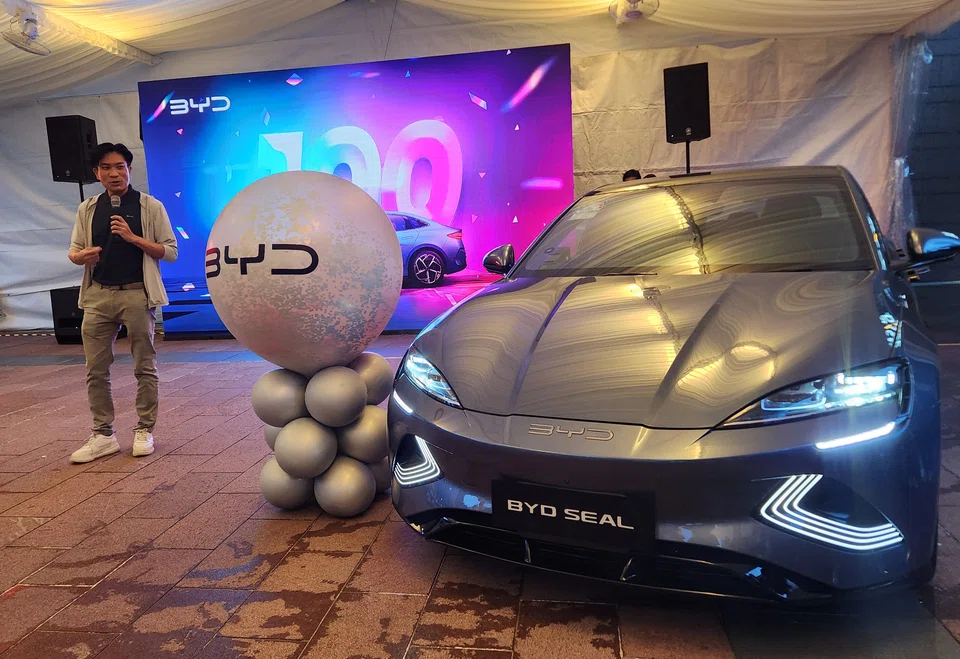
On Wednesday (Jun 26), China EV maker BYD launched a new Category A version of its Seal sedan, which starts at S$169,888 with COE – S$28,000 lower than the existing Category B model.
This is the latest in a series of popular models that have entered the Category A market in recent months.
Industry observers warn that these could crowd out non-EV cars with their price competitiveness, leading to more volatility and rising premiums for Category A COEs.
A spark for EV adoption
Previously, EVs were mainly available under Category B, which is for larger or more powerful cars.
But in May 2022, the Category A classification for EVs was revised, with the horsepower limit raised to 110 kilowatts (kW), from 97 kW previously. (The lower limit remains in place for internal-combustion engine or petrol cars.)
Since then, EV manufacturers such as BYD, Hyundai, MG, Ora and Tesla have released models specifically to meet Category A requirements.
BYD’s bestseller, for instance, is the Atto 3 mid-sized sport utility vehicle. This was introduced in July 2022 as a Category B model, but sales picked up mostly after the Category A version was introduced in March 2023.
A BYD spokesperson said the Category A Atto 3 had “significantly boosted” the brand’s sales.
The average monthly sales of this model rose from 16 units a month in January and February to 114 units a month for the rest of 2023.
The Atto 3 has been racking up the most new registrations in Singapore, with 1,861 units registered in the first five months of 2024. The majority of these were the Category A model, with BYD having discontinued sales of the Category B version in May 2024.
Say Kwee Neng, an automotive consultant and former managing director of a car dealership, said BYD’s entry into Category A has catalysed EV sales, helped by brand recognition and an aggressive dealer network that is offering good trade-in prices.
“This turns earlier market assumptions on their head, because everyone thought that with the high cost of batteries, only high-end EVs would sell. Not any more,” he added.
“Popular Category A models like the Atto 3 will be the spark that ignites EV adoption in Singapore, both among private buyers and private hire cars.”
Passenger EV adoption has accelerated this year, with 4,797 registrations in the first five months of 2024, against 5,410 for all of 2023.
The Land Transport Authority data indicated that for the first five months of 2024, BYD was the best-selling car brand in Singapore in terms of authorised dealership sales, with 2,184 units; BMW was second (1,973 units) and Mercedes-Benz, third (1,865).
On May 17, American EV brand Tesla introduced its Category A version of its Model 3 sedan. Model 3 registration numbers jumped to 123 that month, up from a monthly average of 68 for the first four months.
Crowded house
With these EV models exerting intense price pressures in Category A, COE premiums could rise and become more volatile, said car dealers.
Ron Lim, head of sales and marketing for Nissan distributor Tan Chong Motor Sales, said: “EV sellers are all gunning for more volume – that is their greatest incentive to be in Category A too. So as the EV war intensifies, we could see more volatility in Category A.”
It is easier to tweak EV models so they fit into Category A, compared to making such changes for cars with internal-combustion engines, said Lim as well as Nicholas Wong, chief executive officer for authorised Honda dealer Kah Motor.
This is because an EV’s power output can be changed via software adjustments.
Said Lim: “The segment is getting overcrowded, with more and more EVs detuned to qualify for Category A, like the Tesla Model 3 and BYD Seal.
“This is definitely not healthy for the segment in the long run. With intense competition for sales, COE premiums will increase, and we might one day see (the premium for) Category A exceeding Category B.”
Furthermore, with government incentives making EVs more affordable, non-EV models do not have the margins or incentives to compete, noted Lim and Wong.
Passenger EVs are eligible for a total of up to S$40,000 in rebates: S$15,000 under the EV Early Adoption Initiative (EEAI) and S$25,000 for the highest rebate band under the Vehicular Emissions Scheme (VES) A1.
In contrast, many mainstream petrol-electric hybrid models – such as the Toyota Prius – receive a S$5,000 rebate under VES band A2, down from S$15,000 at the end of 2023.
“It is impossible to fight EVs now on margins. EVs have more rebates now, and they already have extra leeway in terms of Category A eligibility,” said Wong, referring to the higher horsepower limit for EVs.
However, Associate Professor Raymond Ong from the National University of Singapore Department of Civil and Environmental Engineering expects that despite this competition, “hybrids will still play a big role in consumer choices”.
Category A EV demand has been driven by the government’s pro-EV policy, but it is clear that EV incentives will not be around permanently, he added.
The EEAI started in 2021, and was originally to run until the end of 2023. It has since been extended until the end of 2025, but with the maximum rebate reduced to S$15,000 from S$20,000.
TRENDING NOW
Grab CEO’s wife Chloe Tong on life with Anthony Tan and finding her purpose
Three ex-employees of Envy group join Ng Yu Zhi in bankruptcy
He built the Vingroup empire. Now South-east Asia’s richest man is handing some key roles to his sons
If AI has a one-in-five chance of destroying us, what do we do with the remaining four?