

MOT, LTA seek public feedback on regulating EV chargers in Singapore
 Add BT as a preferred source
Vivienne Tay
DeeperDive is a beta AI feature. Refer to full articles for the facts.
SINGAPORE’S Ministry of Transport (MOT) and Land Transport Authority (LTA) are seeking public feedback on proposed legislation to regulate electric vehicle (EV) charging in the Republic.
This includes providing LTA with statutory powers to enforce new regulations that govern EV charging, like implementing a licensing regime for EV charging operators (EVCOs) and mandating developers “future proof” their developments to support EV charging.
These measures will fall under a potential Electric Vehicle Charging Bill that will also empower LTA to regulate the supply, advertisement, installation, registration, use and maintenance of EV chargers, it said in a press statement on Wednesday (Jun 15).
The move comes as the Singapore government looks to phase out internal combustion engine vehicles and have all vehicles run on cleaner energy by 2040.
Currently, only the Energy Market Authority regulates the installation of fixed EV chargers by licensed electrical workers (LEWs). Other activities by charger suppliers, charger owners, and charging operators are still not regulated, LTA said.
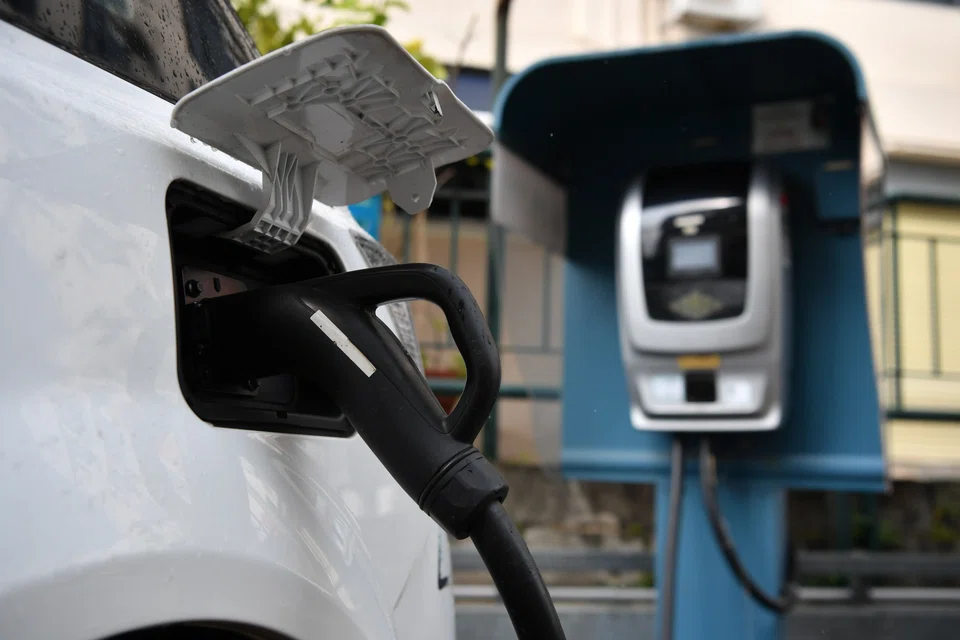
The proposed legislation will cover all EVs and plug-in hybrid vehicles whose batteries can also be charged with a charger. They include the 3 main types of EV chargers – fixed chargers, non-fixed chargers and battery charge and swap stations, which charge detachable batteries belonging to an EV.
Navigate Asia in
a new global order
Get the insights delivered to your inbox.
The licensing regime for EVCOs will generally apply to commercial operators. These operators will be subject to a set of requirements by LTA, including requirements for data sharing, third-party liability insurance, payment methods, cybersecurity and service downtime recovery.
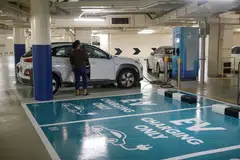
As for developers, MOT and LTA propose mandating all developments with car parks undergoing selected building works to make passive and active provisions for EV charging.
Works include the erection of a building, increasing the gross floor area of a development by 50 per cent or more, or increasing the approved electrical load of a development where the approved electrical load is 280 kilovolt-amps or higher.
Additionally, LTA is proposing that all EV chargers supplied in Singapore must belong to a model it approves – similar to the existing process where all vehicles supplied in Singapore must be models green-lit by LTA.
To be approved, EV chargers must meet safety and performance standards prescribed by LTA. This may include international standards related to smart charging. Chargers supplied solely for export or re-export from Singapore will be excluded from this requirement to obtain approval from LTA, it said in its proposal.
The agency is also looking to establish an ownership regime for EV chargers by keeping a registry of chargers. It will require all charger owners to register their EV chargers with LTA within a reasonable timeframe after installation but before use.
The public consultation for the proposed legislation will be open from Jun 15 to Jul 14.
Decoding Asia newsletter: your guide to navigating Asia in a new global order. Sign up here to get Decoding Asia newsletter. Delivered to your inbox. Free.
Copyright SPH Media. All rights reserved.
TRENDING NOW

Air India asks Tata, Singapore Airlines for funds after US$2.4 billion loss

Beijing’s calculated silence on the Iran war

China pips the US if Asean is forced to choose, but analysts warn against reading it like a sports result

Richard Eu on how core values, customers keep Singapore’s TCM chain Eu Yan Sang relevant

