

New outbreaks dent airline recovery
Seat capacity is just 68% of the number of seats offered in same week of 2019 due to spread of Delta variant
 Add BT as a preferred source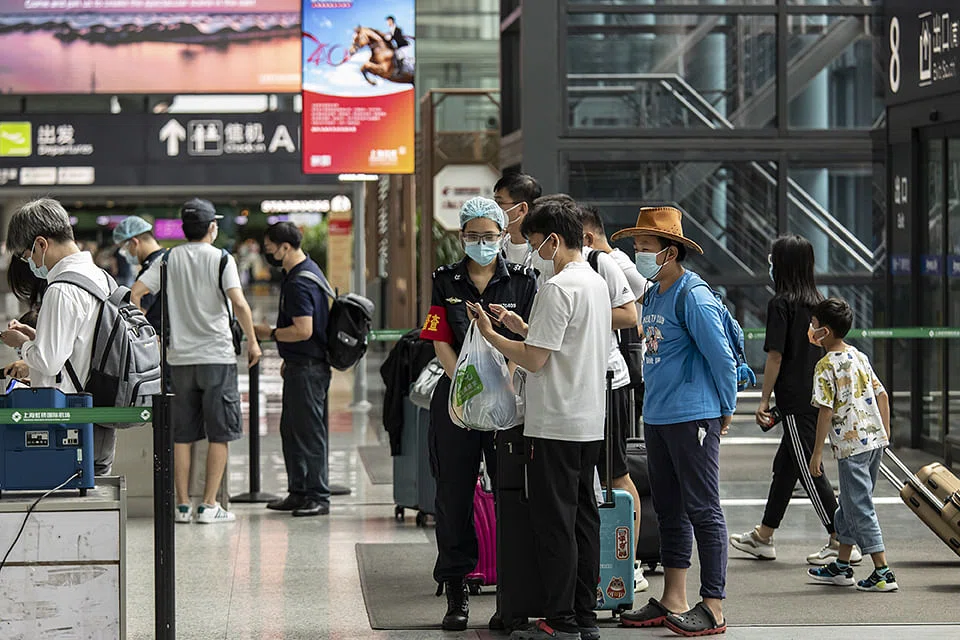
DeeperDive is a beta AI feature. Refer to full articles for the facts.
Beijing
FOR the second week in a row, the recovery in global air traffic has taken a step back. Airline seat capacity declined about a quarter of a percentage point to 68 per cent of the amount offered in the same week of 2019, before the Covid-19 pandemic disrupted a multi-year travel expansion fuelled by the rising number of middle-class tourists from China and South-east Asia.
The latest setback, attributed largely to the spread of the Delta variant, follows an almost one-point decline the prior week, said Bloomberg's weekly flight tracker, which uses data from aviation specialist OAG to track the pulse of the comeback.
The biggest challenges are once again in Asia. The broadest virus outbreak in China since the pandemic first began has forced officials there to suspend flights and increase testing of airport workers. That has taken a chunk out of the nation's massive domestic aviation trade, which has performed the best among the largest pre-pandemic global markets.
In the US, capacity has been stuck for several weeks due to staffing constraints and slow progress toward lifting border restrictions with Europe and other markets. In Europe, the only region where so-called vaccine passports are in widespread use, the comeback has made further progress, though it, too, will be limited by the failure to fully re-open trans-Atlantic travel, said Rob Morris, global head of consultancy at Cirium, which tracks air traffic.
The question for airlines now is whether vaccines can be distributed quickly enough to counter the spread of new coronavirus variants.
Navigate Asia in
a new global order
Get the insights delivered to your inbox.
From the start of the year, carriers in China, India, the US and Europe registered steady gains as they slowly added more flights to their schedules. But the rise of the Delta variant has challenged the return to normalcy - first in India, then in the UK, and now in China and other Asian nations like Indonesia and Vietnam.
At the same time, there are signs of progress - most notably in Singapore, which rapidly scaled up its vaccine programme, and in Hong Kong, which this week started to loosen some of the world's tightest restrictions.
The United Arab Emirates, whose hubs in Dubai and Abu Dhabi connect hundreds of thousands of travellers daily to far flung points, this week said it will lift its ban on transit passengers from India and other Southeast Asian nations.
While the Delta variant creates risk for the recovery, the rising pace of vaccinations offers cause for optimism, said Cirium's Mr Morris.
"We always knew that 2021 would feature a one-step-forward, one-step-backward approach, but were hopeful that the strides forward could be larger," he said. While that does seem to be the case, "we'll know in the next few weeks if China, for example, sees that recovery dented by the latest outbreak. But for now, on balance, there's more reason for optimism than pessimism".
The International Air Transport Association said Tuesday that 2020 was the worst year on record for the airline industry, with 66 per cent of the world's commercial air transport fleet grounded at the depth of the crisis in April.
In China, airline capacity has fallen below pre-pandemic levels for the first time in five weeks. Airlines scheduled 9.8 per cent fewer seats this week than last, said OAG. Capacity was lowered to 95.7 per cent of 2019 levels.
The outbreaks started in eastern China, leading to traffic shutdowns at airports including Nanjing, Beijing and Yangzhou. While the overall infection rates remain low, the latest set of cases have reached nearly half of the country's 32 provinces in just two weeks. Governments are on high alert, and moving quickly to close off access to cities as well as popular tourist sights. At least 46 cities have advised residents to refrain from travelling unless absolutely necessary. The rapid drop has sent jitters across the crude-oil market, as airlines rapidly scale back on flights. In an effort to discourage travel, the Civil Aviation Administration has told customers they can seek a full refund on domestic flights through Aug 31.
Schedules for this week, which likely do not yet reflect the full impact of the latest developments, show Shanghai-based China Eastern Airlines Corp at 13 per cent below 2019 capacity levels - an almost nine-point drop in one week.
A slightly smaller magnitude of decline was registered at Air China Ltd, which is now down 5.6 per cent from the same week two years ago. China Southern Airlines Co remains just 3 per cent below pre-pandemic capacity.
But Chongqing-based China Express Airlines Co, one of the country's first privately owned regional carriers, has seen an 84 per cent week-to-week plunge. It now stands at 21 per cent of 2019 capacity. "Air travel in China will get worse," said Mark Martin, founder of Dubai-based Martin Consulting. "South-east Asia will get worse." BLOOMBERG
Decoding Asia newsletter: your guide to navigating Asia in a new global order. Sign up here to get Decoding Asia newsletter. Delivered to your inbox. Free.
Share with us your feedback on BT's products and services
TRENDING NOW

Ministry of Home Affairs Permanent Secretary Pang Kin Keong to retire

Shelving S$5 billion office redevelopment plan proved ‘wise’ as geopolitical risks mount: OCBC chairman

Richard Eu on how core values, customers keep Singapore’s TCM chain Eu Yan Sang relevant

China pips the US if Asean is forced to choose, but analysts warn against reading it like a sports result

