Noisy O'Hare airport could decide Chicago's mayoral race
Residents complain of noise with new runway and different flight patterns at airport
Chicago
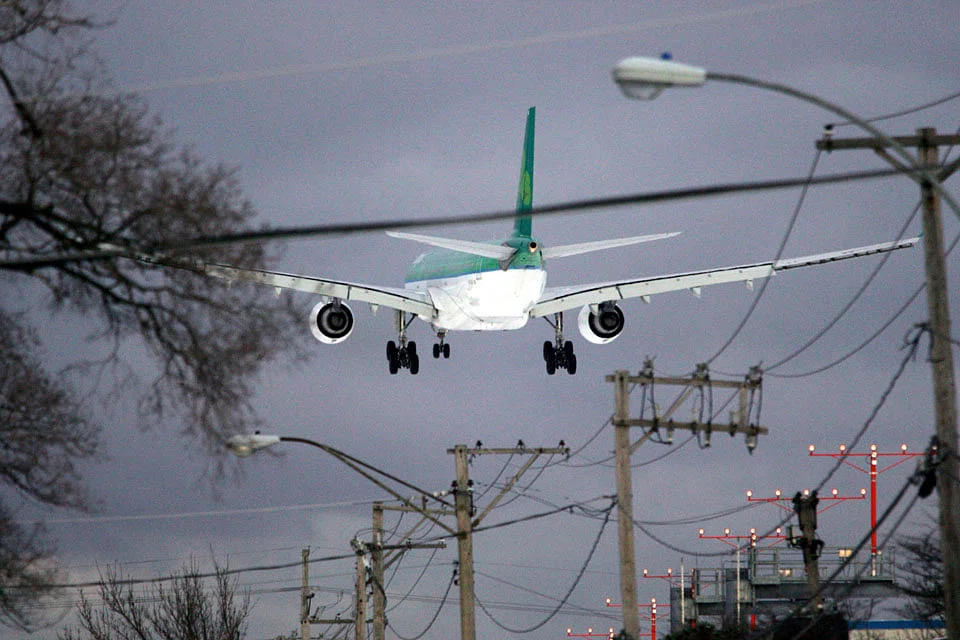
IN 15 minutes on a recent weekday evening, 18 noisy airplanes buzzed over Marie MacDonald's back porch. They flew past one after another: regional jets and jumbos, airliners and cargo planes, all rumbling above this city's Northwest Side on their final approach to O'Hare International Airport.
"They've come to a point where they're going to make me a prisoner in my own house," said Ms MacDonald, a 52-year-old teacher who moved to this mostly residential, middle-class neighbourhood more than two years ago expecting solitude and quiet.
That quiet has proved elusive. The Chicago Department of Aviation reported 39,500 noise complaints in the area around O'Hare in January, up from 1,357 in January 2013, months before a new runway opened and flight patterns changed.
The mounting frustration, and what some perceive as indifference from City Hall, has made plane noise a subplot in Tuesday's mayoral election. Though hardly as divisive as Chicago's public school closings and severe financial woes, Mayor Rahm Emanuel's handling of the jet noise could drive away support in a section of the city he won convincingly in 2011.
The changes to O'Hare, one of the world's busiest airports, had been planned before Mr Emanuel took office, but the new runway at the centre of the furor opened under his watch.
Mr Emanuel, who once represented part of the Northwest Side in Congress, says that he has been responsive to the complaints. He says that he has met with concerned residents, installed noise monitors and pushed the Federal Aviation Administration (FAA), which regulates the nation's air traffic, to speed up a review of which homeowners are eligible for assistance installing insulation to dull the noise.
"Mayor Emanuel is very sensitive to residents' concerns, which is why together with local aldermen, the city is working with federal partners to understand the extent and magnitude of the problem," said Kelley Quinn, a mayoral spokeswoman, in a statement. "A number of steps have been taken to address airport noise, including a US$700 million investment in communities neighbouring both Chicago airports, as well as a US$120 million investment to insulate 4,700 residences." On the Northwest Side, however, some say that is not enough. Largely because of the jet noise, Ms MacDonald said that she planned to support Mr Emanuel's challenger, Jesus Garcia, in Tuesday's runoff election. Mr Garcia, a county commissioner, has made the noise a campaign issue, and the topic has come up repeatedly in televised debates and on the campaign trail.
"I'm concerned that your complaints about noise and your proposed solutions have fallen on deaf ears," Mr Garcia said to residents at a recent campaign event on the Northwest Side. "As mayor, I will work with you to find solutions to cut noise pollution." Ms MacDonald lives on a block of well-kept homes about seven miles from O'Hare, a safe but often overlooked slice of Chicago far from the bustling downtown. To be sure, Mr Emanuel retains significant support in this part of Chicago, where yard signs for both candidates can be spotted amid the rows of brick bungalows and two-storey houses. In the first round of the mayoral election in February, Mr Emanuel won about 48 per cent of votes in Ms MacDonald's ward , compared with around 35 per cent for Mr Garcia.
But in the buildup to the runoff, a group of residents called the Fair Allocation in Runways Coalition has become more visible, staging a protest outside a mayoral debate and speaking critically of Mr Emanuel and his handling of the noise complaints.
One of the coalition's leaders, Lisa Ziems, introduced Mr Garcia at his recent campaign stop in the Jefferson Park neighbourhood, near Ms MacDonald's house. Though Ms Ziems always heard some planes flying over her house, she said that the increase since 2013 was so unbearable that she sometimes had trouble reading books to her children.
"Ninety per cent of the time," she said in an interview, "it's this constant railroad in the sky." The changes that led to the complaints stem from a broader, continuing project to modernise O'Hare, which handled more than 60,000 flights in February and serves as a hub for both United and American Airlines. The new runway was promoted as a way to increase efficiency and build capacity at the airport.
Officials at the FAA said last week that they had worked with community members to address noise problems, and that they had held meetings before the runway changes were made. But many on the Northwest Side say that they did not know about the new runway until it was open and now are left worrying about the effect on their sleep and property values.
The issue, though, is a complex one, and the difficult truth is that one neighbourhood's reprieve from the noise can come at another's expense. Officials have published a map suggesting that the changes to O'Hare would concentrate the noise over a smaller area than before, a boon for some Chicago neighbourhoods and suburbs.
Even as they promise to listen to residents' concerns, Mr Garcia and Mr Emanuel also emphasise O'Hare's importance to Chicago's economy and the fact that the airport will not be going anywhere. Most residents who bought homes near O'Hare say that they understand that plane noise will not disappear altogether. NYT