

One stuck box of fertiliser shows the global supply chain crisis
Its journey reveals the limits of diversification, as all networks are still closely connected with China
 Add BT as a preferred source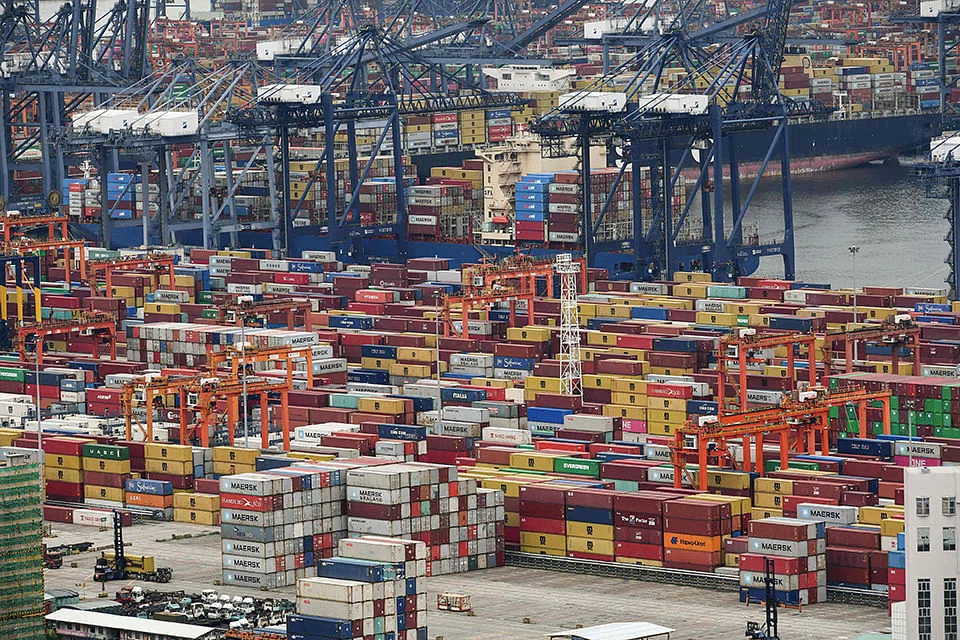
New York
SOMEWHERE in the world's busiest port of Shanghai, a container of fertiliser sits among tens of thousands of boxes, waiting for a ride to the United States. It has been on the dock for months, trapped by typhoons and Covid-19 outbreaks that have worsened major congestion in the global supply-chain network.
While the fertiliser has been stranded there since May, the port is just one stop on the long journey from central China to the US Midwest. Delays have stretched a delivery that ordinarily would take weeks to more than half a year. And that time frame will keep expanding, as the goods have barely started the roughly 15,000km trek.
This is the tale of one humble shipment and its arduous journey across the world. While some of the barriers keeping it from its final destination may be specific to this particular case, the journey is emblematic of the inertia that has gripped global trade during the pandemic.
From the US to Sudan to China, container boxes have been lying at ports, railyards and in warehouses as the pandemic rages on. In an industry with 25 million containers and some 6,000 ships hauling them, it is easy to see disruptions as one big headache confined to the shipping world.
But each container that is delayed is economic activity that is restrained, heaping costs one box at a time on consumers and making it more challenging to put corn on consumers' tables or deliver presents for the holidays.
It is also a lesson in the ripple effects across global supply chains, showing the limits of diversification, as all networks are still closely connected with China.
"All roads lead back to China, and that has a major effect across the entire supply chain," said Dawn Tiura, head of US-based Sourcing Industry Group. "Congestion at one port or factory has far-reaching implications for neighbouring facilities, which trickles out across the world."
The factory
The journey for our particular box of sandy-looking ammonium phosphate began in February. That is when, deep in the agricultural heartland of the US Midwest, a supplier for farmers in Illinois placed an order for eight container boxes filled with fertiliser from factories in central China.
Before the pandemic, a batch like this would typically arrive in Chicago in April, just in time for growers to use during planting season, said Steve Kranig, director of logistics at IM-EX Global, which is in charge of coordinating transport for the fertiliser cargo.
But by May some of the fertiliser was still sitting in Chongqing, 2,400km west of Shanghai, where it was manufactured. The culprit: a shortage of empty containers for transport.
The crucial return of these steel boxes from trips to the US and Europe has been delayed by everything from understaffing to a lack of trucking equipment to move goods out of ports. The Chinese inland city surrounded by mountains is especially hard to reach by sea, reducing the chances of getting one.
It took Mr Kranig months to secure boxes and spots on several ships that would leave from Shanghai. The fertiliser was loaded into the containers, and they were driven to barge vessels on the Yangtze River.
The river
The trip down China's busiest inland waterway took eight days. This container was lucky as it was shipped ahead of typhoon season. Others recently have not been so fortunate. Traffic on the Yangtze, which saw a record 2.93 billion tons of cargo pass through in 2019, has been battered as waves of extreme weather swept across China this summer.
Authorities have had to close the river during storms, creating severe backlogs at Chinese ports as ships wait days for passage to resume. While the shipment avoided any flooding disasters, it could not escape high transit costs, as freight rates have skyrocketed on international routes, as well as along the Yangtze.
In addition to high demand for goods as China's economy rebounds, the scarcity of vessels is pushing prices higher. Shipping lines are pulling smaller coastal vessels away to use on long-haul routes like the lucrative Trans-Pacific from China to the US.
"There is already a limited amount of containers that run the Yangtze River lane, and some companies are paying top dollar to take any available containers so they don't have to try to move their stuff to Shanghai via non-water routes," said Mr Kranig.
The container finally arrived in Shanghai on May 27 and a truck delivered it to the world's busiest port.
The port
Mr Kranig is not sure why the container is still stuck in Shanghai while seven other boxes of the shipment found their way to Chicago, but he suspects the chaos that hit Chinese ports is a major factor. The pandemic has thrown shipping into upheaval over the past year and a half, with China becoming a major choke point.
Yantian port in Shenzhen was closed in May because of a Covid-19 outbreak, creating congestion for the entire eastern coast, which in turn caused ripple effects across the global supply chain.
Typhoons and extreme weather have made matters worse. In July, the stranded container withstood Typhoon In-Fa, shutting Shanghai and other nearby ports for about four days. Delays could reach an all-time high in the weeks ahead if the trend persists, said Glenn Koepke, a senior vice-president at FourKites, a supply-chain information provider.
The Pacific and beyond
Once the fertiliser finally hitches a ride to the US, the risks are not over. The Pacific can be a treacherous crossing for ship captains racing to meet deadlines. And when the cargo safely arrives on the North American coast, more headaches await.
The biggest US trade gateway with Asia has been clogged with the most inbound container vessels in more than six months. Earlier this month, 35 ships were anchored awaiting berth space outside the twin ports of Los Angeles and Long Beach, California. Because of the backup, many ships are being diverted to Vancouver.
Next comes the inland journey. It could take another one to three months for the container to get from a West Coast port to Chicago by rail or truck.
Another trip
The case of the stranded container seems like the worst nightmare for anyone involved in global trade. But Mr Kranig is back for another round of orders - eight more containers to get from China to the US.
Again there were no empty boxes in Chongqing, so Mr Kranig decided to skip the river route - he loaded the fertiliser in loose, sandy form in open trucks that were driven to a warehouse in Shanghai.
The cargo was packed into containers, with some brought to Ningbo this month. Then came news that a part of Ningbo port was shut because of a worker infected with coronavirus.
"It's an uphill battle," said Mr Kranig. BLOOMBERG
Decoding Asia newsletter: your guide to navigating Asia in a new global order. Sign up here to get Decoding Asia newsletter. Delivered to your inbox. Free.
Share with us your feedback on BT's products and services
TRENDING NOW

OCBC rolls out AI-native banking, to hire 600 relationship managers in wealth push
Can Vietnam’s small-business backbone survive a compliance squeeze – all at once?

Malaysian tycoon Vincent Tan’s sell-downs point to pruning rather than an exit plan
High Court dismisses StanChart's appeal to strike out US$2.7 billion 1MDB-linked lawsuit

