

Premiums for EVs still relatively high as insurers struggle to price risk
But experts believe that as more turn to EVs, these and other challenges with owning EVs will eventually decrease

Janice Lim
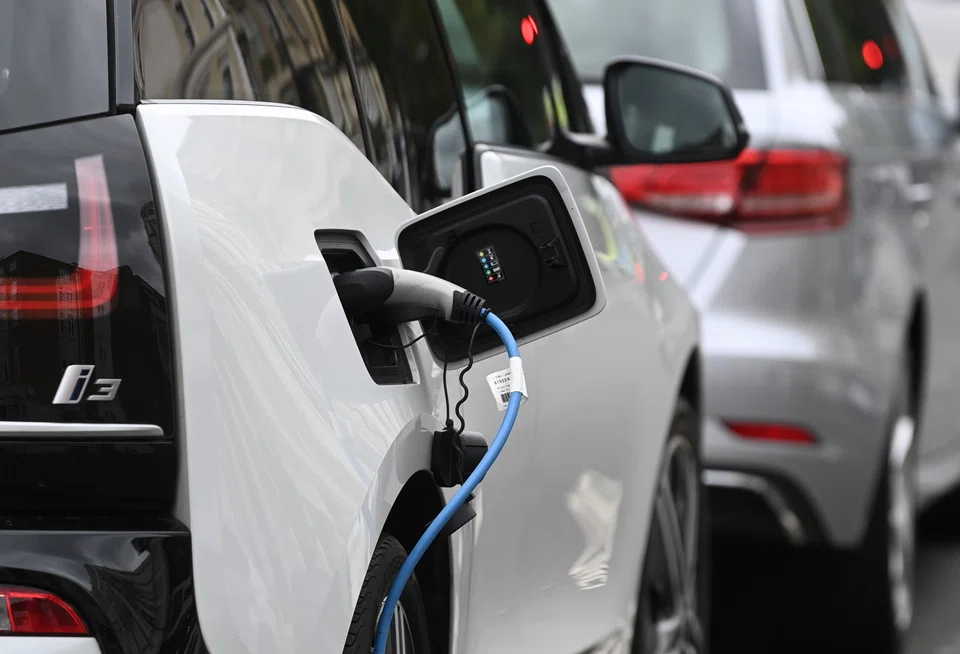
Paying higher insurance premiums, finding fewer online quotes and facing inconveniences when sending their electric cars for repairs — these are some hurdles electric car owners in Singapore have had to go through as early adopters of this more sustainable form of transport.
These problems point to a disconnect in the electric vehicle (EV) ecosystem here: while great efforts have been made to encourage EV adoption, with plans to improve the infrastructure and financial incentives doled out by the Singapore government, the insurance market has not yet caught up.
Based on checks done by The Business Times, the insurance premiums for electric cars are distinctly higher than comparable combustion engine models, and even higher for Teslas. Electric-car owners shopping on the Internet for quotes would also find that fewer insurers provide one for these models, compared to their combustion counterparts.
In general, the lack of claims data for EVs due to its small population, the higher cost of components such as the battery, and fewer workshops with mechanics trained in EV maintenance and repair, are some challenges insurers face while formulating the appropriate level of coverage, said several insurers responding to queries from The Business Times.
Given the small EV population, the insurance industry does not have a lot of data on the types and causes of losses, including their frequencies and severity, said Chen Renbao, an associate professor of finance at the National University of Singapore Business School.
“Insurance companies are very conservative in underwriting EVs even though they are highly promoted or even subsidised by many governments, including Singapore,” said Chen.
According to the latest statistics by the Land Transport Authority, there were 3,713 EVs in Singapore at the end of last year — less than 0.4 per cent of the total number of motor vehicles. In terms of cars alone, there were 2,942 electric cars, or 0.5 per cent of the total car population.
Even the most popular EV models are more comparable to exotic cars in Singapore, in terms of the owner base, noted transport economist Walter Theseira, an associate professor at the Singapore University of Social Sciences.
“And there is little track record in Singapore of claims experience, so it’s hard to price risk,” he added.
However, based on observations from other markets, Theseira noted that the current problems in the EV industry are temporary.
“EV sales generally outsell internal combustion engine cars once you get purchase price parity, because EVs are often simply better cars at the same price point - this is what customers in the European Union have already shown. With large-scale adoption, you get your larger market, you get a claims experience record, and costs of repair and administration also go down,” he noted.
Already, premiums for EVs have gone down over the last few years, and are inching closer to those of internal combustion engine cars, said Paul Brenchley, head of insurance advisory at professional services firm KPMG.
Even though EVs make up less than 0.4 per cent of total vehicle population, he said that the figure to watch out for is the number of new EV registrations, which now equal 8.1 per cent of all new car registrations in the first quarter of 2022.
“It is a fast-growing area - the 8 per cent new vehicle registration number is already starting to become significant. That half a percent will absolutely grow,” said Brenchley.
One key driver pushing the growth of EV adoption would be the Singapore government’s goal to phase out all conventional vehicles by 2040 and have all vehicles run on cleaner energy.
Several insurers told The Business Times that they are monitoring the market trends and will be making adjustments to their premiums accordingly.
Having more car workshops equipped with EV maintenance and repairs, including skilled mechanics, is another factor cited by insurers that will bring down the cost of premiums.
In a possible indication that more insurers are entering the market, DirectAsia’s chief marketing and distribution officer Robbie Brown told The Business Times that it will also be launching insurance for EVs in the third quarter of this year.
Elysia Chan, the managing director and insurance lead of South-east Asia at professional services company Accenture, said that insurers who enter the EV market first would be ahead of later entrants in terms of gaining experience in underwriting, workshop management and development systems that could offer value-added services for such vehicles.
Later entrants would, however, have the advantage of learning from the pioneers and be able to manage these new products at improved combined ratios — these include better pricing models and improved underwriting decisions, Chan added.
While it is ultimately a commercial decision that insurers will have to make in terms of whether to enter the EV market, Theseira points out that there is some room for the government to clarify emerging issues of liability with EVs that are different from conventional vehicles.
“I think the question is whether the market is complete and competitive, and whether there are any aspects of policy or concerns that prevent insurers from competing. This is a matter for the insurers to raise, if needed,” he said.
At the end of the day, motor insurance is one of the largest lines of business for insurance companies in Singapore, noted Brenchley.
“It would be a significant hit to their topline if they were not to have the appetite to insure EVs,” he said.
“My personal view is many of the big motor insurers in Singapore, in the next couple of years, will launch EV policies. Otherwise, their market shares will be significantly reduced.”
TRENDING NOW

Motoring tycoon Peter Kwee is back in court: Here are his previous legal battles

Demand, tech capabilities position Apac and AI as Skyscanner’s next growth frontiers: CEO Bryan Batista

Beyond the greenback, Vietnam’s big borrowers turn to Asian-currency bonds

Nvidia’s outlook cut to stable by Moody’s on governance concerns

