

Qantas may recover from decline if Canberra relents
Airline's nosedive offers its CEO best chance to steer it to long-term growth
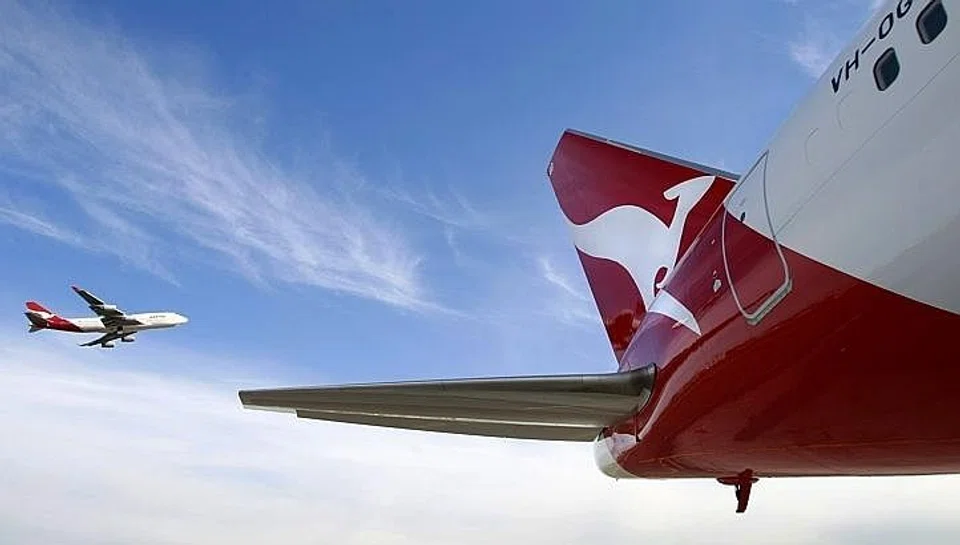
[SYDNEY] Whether through error or circumstance, Qantas Airways Ltd's spectacular fall from grace is giving chief executive Alan Joyce his best chance of steering the airline towards long-term salvation.
Mr Joyce has called on the Australian government to help the national flag carrier in its hour of need. If Canberra is convinced Qantas is in peril, it may have little option but to abandon decades of resistance and provide state aid.
The executive needs little help making a convincing case: Losses from a domestic price war and international competition are piling up; Qantas is now worth only half what it was when Mr Joyce took the helm in 2007; and its credit rating is now junk across the board.
The A$2 billion (S$2.26 billion) cost savings and 5,000 job cuts Mr Joyce announced last week represent the airline's most radical shake-up since it was privatised in 1995.
As yet, Prime Minister Tony Abbott appears unmoved by Mr Joyce's plea for the government to offer a debt guarantee that would lower Qantas's costs.
A change in laws to allow more foreign investment to flow into Qantas, as it has done to rival Virgin Australia Holdings Ltd, is a longer-term proposition.
Yet Qantas still has plenty of cash to keep it afloat pending changes, as well as inevitable disputes with trade unions over cutting 15 per cent of the carrier's workforce.
As Mr Joyce's calls for state support grow louder, so too does criticism of the way he has run the airline. The spotlight on his management has spurred some to call for his resignation.
"The only way for Qantas to get out of this nosedive is for Alan Joyce and the board to resign," said lawmaker Nick Xenophon.
There's no sign of that happening. The Irish-born executive, 47, promoted from Qantas's low-cost Jetstar unit seven years ago, likes to say that the struggling carrier is fighting lavishly funded competitors "with one hand tied behind our back", citing the unfettered foreign funds provided to Virgin Australia and others.
The law authorising Qantas's privatisation contains a provision that foreign investors may not hold more than 49 per cent of the company: Though officially a domestic airline, Virgin Australia is nearly two-thirds owned by non-Australian carriers - Etihad, Singapore Airlines and Air New Zealand - whose investments have provided funds for growth.
Others say Qantas's troubles rest squarely with the airline - and in part with Mr Joyce himself.
Analysts point to what they say are a number of key errors by Mr Joyce, notably the fight to retain Qantas's share of an already crowded domestic market and the failure to get proper lift-off for low-cost subsidiary Jetstar.
"Alan Joyce came from Jetstar, his performance in Jetstar was pretty good, but Jetstar is a cheap airline and the cheap airlines were quite popular during the global financial crisis," said Biyi Cheng, head of Asia Pacific dealing at City Index. "Since he took over the role at Qantas I haven't seen too much improvement for the company structure or commercial plans to improve the revenue."
Mr Joyce has dug in his heels in the Australian market, spending on planes and staff to keep Qantas's domestic market share at 65 per cent or above. That has locked the airline in to a deeply unprofitable price war with Virgin Australia.
Mr Joyce defended that strategy last Thursday after unveiling A$252 million for the six months ended Dec 31.
The domestic arm remained profitable but earnings of just A$57 million were a quarter of the A$218 million it made the previous year.
"We are very clearly protecting our position in the domestic market," he told reporters, noting Qantas's dominance of flight schedules gave it a significant advantage. "It would be remiss of us to weaken that product in any way," he added.
Mr Joyce does have supporters, who credit him with decent stewardship through competitive times in the Asian airline business, the most attractive in the world with passenger numbers growing faster than in any other region.
"I think Joyce has done a solid job," said Geoff Wilson at Wilson Asset Management. "It's a lot easier when you are running a company and things are going forward. I don't necessarily think he's the wrong man for the job."
Still, analysts say, the brand was weakened in an incident in 2011 when Mr Joyce grounded the entire airline in an attempt to win an industrial dispute, stranding passengers and creating headlines around the world.
The incident cost shareholders some A$70 million and allowed Virgin Australia, under the stewardship of Mr Joyce's former rival for the top Qantas job, John Borghetti, to ramp up its business, adding lounges and routes and building up an international alliance network. - Reuters
TRENDING NOW

Indonesia’s coal tycoon Low Tuck Kwong replaced as Bayan Resources president-director

OCBC names Ang Eng Siong as global corporate banking head in rejig of wholesale banking business

Consider lowering homeownership barriers for some non-resident foreigners

DBS opens flagship investment strategy to retail investors with new fund

