Scoot to ride China’s reopening to ramp up capacity above pre-pandemic levels

Tay Peck Gek
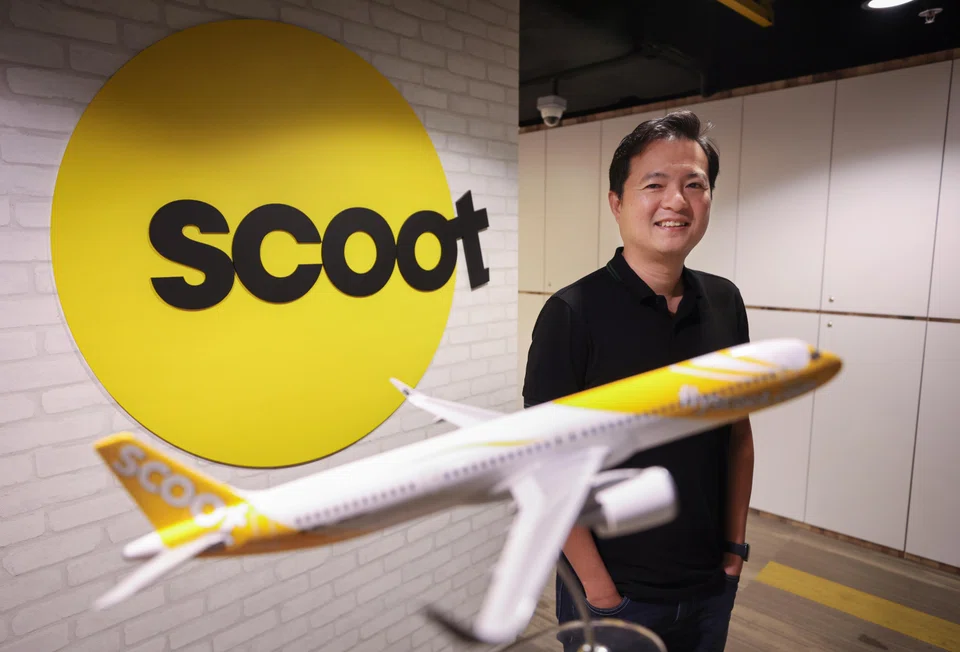
CHINA’S reopening will provide Scoot with the much-awaited tailwind to reach capacity above pre-pandemic levels, said the budget airline’s chief executive, Leslie Thng.
The low-cost unit of listed Singapore Airlines (SIA) had seen some years of losses before the pandemic. It managed to climb out of the red in recent quarters, and it is banking on the positive momentum to help it stay profitable in the new financial year.
In his first media interview since taking the helm in June 2022, Thng told The Business Times that flying at a capacity above pre-pandemic levels is one of Scoot’s priorities for FY2024, which starts in April.
Scoot is now operating at about 80 per cent of pre-pandemic levels, having scaled up from slightly below 50 per cent in early 2022.
While the carrier has adequate resources – it added six aircraft to its fleet during the pandemic years and 1,000 employees to its payroll in the past nine months – restoring capacity to pre-pandemic levels had been an uphill task.
This was especially so as one of its key markets remained a no-fly zone for foreign carriers.
“One country that we were eagerly waiting for reopening was China,” Thng said in an interview on Tuesday (Feb 28). “When China was not opened, it was difficult for Scoot to go to 100 per cent or beyond.”
“It is an important piece within our network… (and) would help us to go back to pre-pandemic capacity,” he added.
The airline used to deploy a quarter of its capacity – or slightly over 100 flights a week – to China, before the North Asian nation closed its borders.
It now operates 26 flights a week to China, up from 14 in February. Scoot expects to further ramp up this frequency to 42 in April and 57 by June.
China and South-east Asia rank after Scoot’s Singapore hub in terms of its capacity deployment, followed by India and Australia.
The airline’s recent decision to suspend its Gold Coast services from July caused such a stir that even the mayor of the Australian city weighed in on the matter. But Thng told BT that this is to allow Scoot to “better optimise our resources based on the demand that we are seeing”.
While forward bookings for the next quarter remain “very robust”, Thng is sanguine about the year ahead.
“For FY2024, we think that the outlook is still bright, because travel within the region is still very strong,” Thng shared.
The veteran, who has about two decades of industry experience, has observed that more people are now making short-haul trips more often.
“Maybe because of the pandemic, they have not been flying for the past two years. So instead of only flying once every two or three months, there are (now) some passengers who want to do a short-haul holiday more frequently,” he said.
Still, as Scoot’s capacity increases, so will its competitors’. As such, both yield and load factor are likely to be impacted, Thng said, referring to the respective metrics for revenue and the percentage of available seating capacity filled by paying passengers.
“When I say (the S$135 million operating profit in Q3 FY2023) was a record, it was really a record. The reason why it was a record was because of the supply and demand situation,” Thng said. “But definitely, we are setting a goal to ensure that we remain profitable in FY2024.”
The airline recently delivered an operating profit of S$135 million for the third quarter to December, on its highest ever operating revenue of S$592 million. But before the pandemic, there were years when it was in the red.
Apart from raising capacity, improving network connectivity is on Scoot’s radar as well, especially when transfer traffic has risen by 15 per cent compared to pre-pandemic.
As part of the plan, the airline from 2024 will be leasing nine Embraer aircraft with a smaller seating capacity of 112. This will allow it to fly to more destinations on a more commercially viable basis.
Meanwhile, Scoot is still looking at recruiting a “couple of hundred” more employees for flight crew and office roles to meet operational requirements for the years ahead.
But, should the carrier with a staff strength of 2,500 ever be short of cabin crew, Thng – who did a shift in October – could be deployed. This would be an opportunity to raise brand awareness overseas and operational excellence – two other priorities he has set for Scoot.
TRENDING NOW
Fed hike throws Singapore banks a margin lifeline; UOB most likely to feel impact
He built the Vingroup empire. Now South-east Asia’s richest man is handing some key roles to his sons
Real-estate veteran Desmond Sim quits from CEO roles at Realion, ETC
Chagee, Mixue and Luckin won the market. Sustaining their edge is the harder part