

Sea freight rates could ride crest of looming US port strike to reverse slide
A strike in the US East and Gulf-Coast ports could hit more than half of US imports and 15 per cent of the global container fleet capacity, HSBC says

OCEAN freight rates have been on a steady slide, but events in the US might just kickstart a reversal. Market watchers are warning that a scheduled port strike on the US East Coast is expected to put upward pressure on rates in the short term, particularly, if the industrial action runs into weeks.
Already, carriers have announced that they would impose “disruption surcharges” in view of the labour walkout.
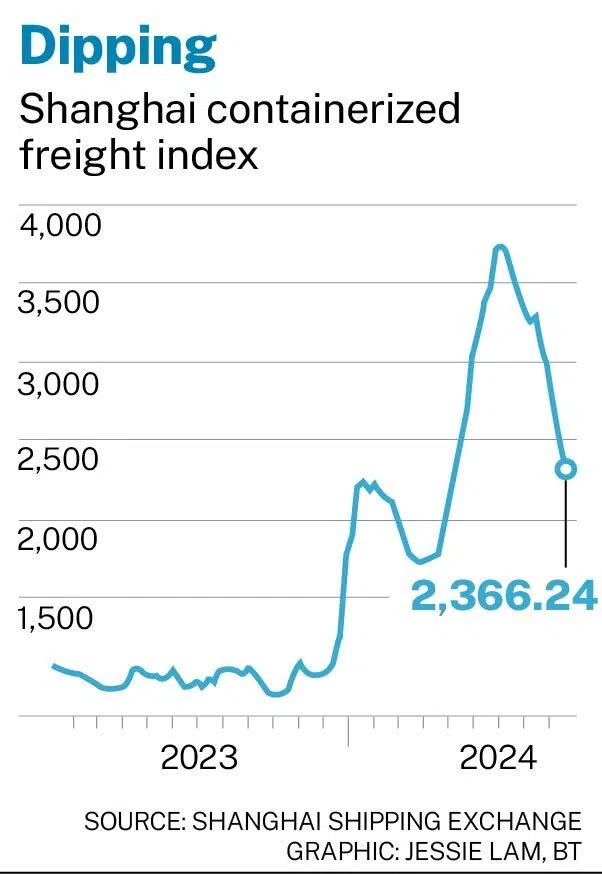
The Shanghai Containerized Freight Index has been on a decline since June, except for a brief respite in mid-July. The index covers 13 export trades out of Shanghai, and is the world’s most widely used index for spot market ocean-freight rates for Chinese imports.
This index was down 5.8 per cent week on week to 2,366.24 points on Sep 20, but still more than double the level a year ago – before most vessels began making detours via South Africa last November to avoid attacks in the Red Sea.
The Drewry World Container Index’s latest reading showed a decrease of 5 per cent week on week to US$3,970 per 40-foot container. The composite index, a weighted average of spot rates on eight east-west routes, has been on a downward trend since mid-July.
Drewry, a maritime research and consulting-services provider, projected that weak demand could drive further falls in east-west spot rates in the coming weeks.
Parash Jain, HSBC’s global head of transport and logistics research, told The Business Times that exports out of Asia have largely peaked, and there have been record new vessel deliveries throughout the period.
“For the rest of the year, with continued new vessel deliveries and no further volume momentum, we expect further downward pressure for spot rates, unless there is a US East Coast port strike come October,” he said.
Major industrial action is on the cards if the dockworkers’ wage demands are not satisfied.
A strike at the US East and Gulf Coast ports could affect more than half of US imports and 15 per cent of the global container fleet capacity, Jain noted.
“If the strike lasts beyond a few weeks, the ripple effects of the disruption could affect demand-supply ahead of the seasonal cargo rush for the Lunar New Year, which is on Jan 29, 2025.”
Lars Jensen, the chief executive of consultancy Vespucci Maritime, pointed out recently that spot rates have come down, but that the market is far from crashing: “When we are interpreting the spot rates, we need to keep in mind that capacity can change dramatically from one week to the next. We have a very unstable capacity situation.”
He added that if the strike becomes lengthy, Asia would feel a major impact in the run-up to the Lunar New Year. He did not say what would be considered a prolonged strike.
This is because vessels that are stuck in the ports would reduce their capacity elsewhere, and the impact of that would be felt only five to seven weeks after the start of the strike.
A spokesperson from PSA Singapore said it has been communicating with its customers on any possible disruptions to the vessel sailing schedules, in view of the potential strike at the US East Coast. This is for the port operator to “pre-empt and mitigate” any potential impact through information exchanges and planning for changes in vessel arrivals.
Carrier Maersk has warned shippers that “even a one-week shutdown could take four to six weeks to recover from, with significant backlogs and delays compounding with each passing day”.
The Danish-listed carrier and some of its peers have announced surcharges to “cover the higher operational costs that will be incurred due to the service disruptions” arising from the US port industrial action.
Maersk’s share price rose by as much as 4.9 per cent shortly after the announcement about the surcharge.
Citi published a report on Tuesday (Sep 24), saying that its initial assessment of potential strikes at reduced capacity “suggests near-term minimal impact as we are coming to the tail-end of (the) container peak season”, and noting that shipments have been shifting to the West Coast in preparation for the strike.
It also pointed out that “limited” parties are involved and concentrated in the US, compared to the impact of the Red Sea disruptions, which affected many countries and took place in international waters.
“We thus reiterate our expectation of minimal impact to freight rates in the near-term, should the strike take place and (be) resolved quickly,” the Citi report wrote.
However, the Citi analysts say that if they are proven incorrect, then air-freight volumes and pricing should see upsides, given that season-sensitive containerised cargo such as Christmas toys and decorations will likely switch to air transportation. This would strengthen its buy-thesis for airport-sector pick, ground-handler Sats .
As for where sea freight spot rates would be heading in 2025, Jensen said it is not possible to predict. “You can, of course, play the market, almost like you play the roulette and guess either… we’re going to get a strike, and we’re going to get high rates, or the Red Sea is going to be resolved, and those strikes kind of go down. But that’s almost like playing the casino. You don’t know which one of these is going to play out.”
He has a piece of advice for shippers who want to be assured of securing a space on board – lock in contractual rates or settle for index-linked contracts.






