

Shipping prices ease as US port strike ends, but unresolved issues could spark fresh action in January
The current tentative agreement, which ends on Jan 15, does not address dockworkers’ demands for no automation

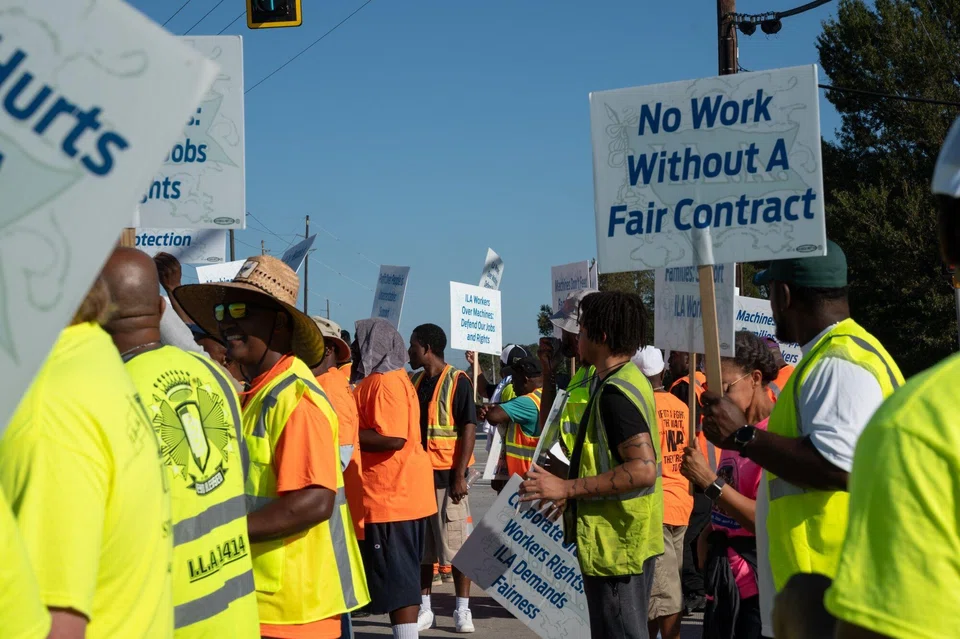
JUST over a week after US dockworkers ended their strike, congestion is easing at East Coast ports and shipping rates are expected to fall in the coming weeks.
Proposed congestion surcharges have been called off. When strikes ended on Oct 3, media reports estimated that the backlog of ships and containers would take two to three weeks to clear.
Yet this may not be the end of the troubles. The strike-ending agreement is a tentative one, ending on Jan 15, and does not address all of the union’s demands – particularly those on automation.
Lim Lian Hoon, managing director at consulting firm AlixPartners, said: “Nothing material was resolved other than the union members getting significant wage increases over the next few years.”
Higher wages
Members of the International Longshoremen’s Association (ILA) – the largest maritime union in the US – went on strike from Oct 1 to Oct 3, demanding higher wages and a guarantee of no automation in order to preserve jobs.
The strike shut down more than 30 ports on the US East and Gulf coasts.
It was resolved after the ILA reached an interim deal with ocean carriers and terminal operators represented by the US Maritime Alliance for a 61.5 per cent increase in wages over six years.
But as the deal did not address the ILA’s demands for no automation, industry observers warn that more industrial action could follow after the Jan 15 expiry.
The brief duration of the strike does not mean the ILA is satisfied, they said.
AlixPartners’ Lim said the ILA’s immediate priority was to secure wage increases, with a short strike as part of its tactics. This was the union’s direct aim, he added, after its West Coast counterpart made similar gains in 2023.
The ILA might have felt pressure to end the strike early because of Hurricane Helene, said Gregg Johnston, partner and head of shipping and offshore finance at Stephenson Harwood.
The late September storm was the deadliest to strike the mainland US since 2005’s Hurricane Katrina. In its aftermath, keeping the logistics chain open would have been seen as critical to US national interests, noted Johnston.
Ending the strike would prevent the ILA from losing public sympathy and circumvent the threat of direct government intervention.
Meanwhile, serious negotiations are needed to resolve the thorny issue of automation, said observers.
AlixPartners’ Lim said: “This ‘resolution’ just bought time until Jan 15, 2025, before they can go on strike again. The position of absolutely no automation will be a major sticking point.”
Johnston said that negotiations will have to “get into the weeds of issues of artificial intelligence and automation substituting the labour force”.
Not-so-plain sailing
For now, congestion is expected to continue easing in the coming weeks, with freight rates coming down after that.
Large price hikes have been avoided. Major carriers CMA CGM, MSC, Maersk and Hapag-Lloyd did not implement their intended strike congestion surcharges, which were planned for mid-October onwards and would have added as much as US$3,000 per 40-foot container.
Peter Sand, chief analyst at freight analytics platform Xeneta, said that while the strike lasted only three days, its effects could ripple through global supply chains in the coming weeks.
Ships delayed at East Coast ports will be late returning to Asia, which could impact schedules towards the end of this year and possibly into 2025, he said.
Barring major developments, rates should moderate as the traditional peak season – August to October – was front-loaded this year, with most goods shipped in advance.
AlixPartners’ Lim said: “Rates are likely to revert to being driven by the underlying factors, (meaning) they will gradually go down for the rest of the year as peak season ebbs away... unless there is another strike in January or some major escalation in geopolitical events that will impact trade routes.”
Johnston saw post-strike congestion as a small issue, but warned of disruptions on the US East Coast from tropical storms. Hurricane Milton made landfall on Florida’s west coast on Oct 10 and is expected to cause unprecedented damage, having already left millions without power.
“Since the strike ended almost as soon as it began, the congestion has been minimal… but a number of ports that did strike, including Port Everglades and Port Tampa Bay, will likely experience serious disruption from Hurricane Milton,” he added.






