

SIA expects passenger yields to further moderate
The market and analysts were not impressed with the lacklustre yields

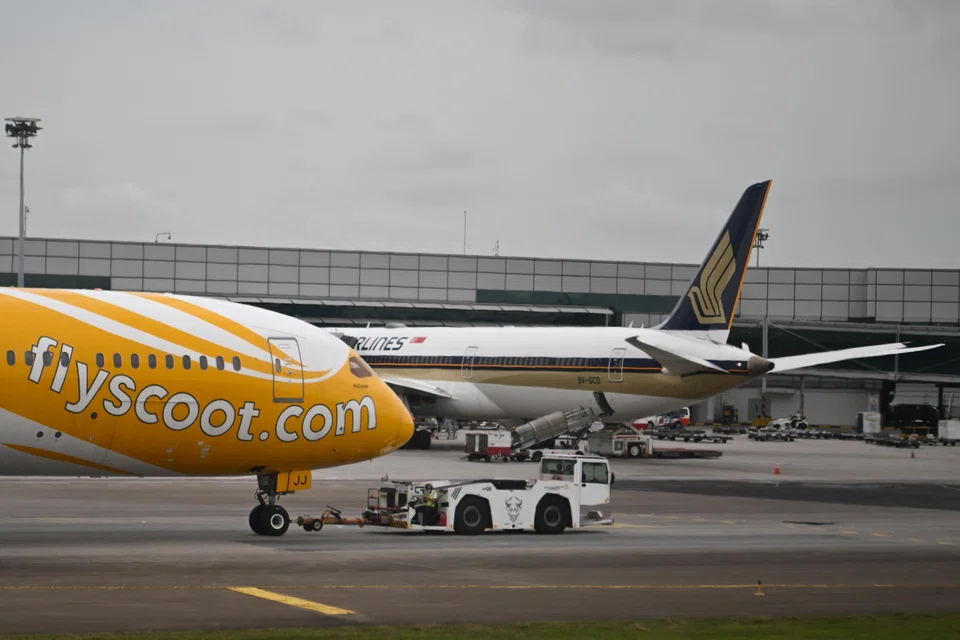
SINGAPORE Airlines (SIA) expects passenger yields to continue to moderate amid rising industry capacity, even as dipping yields across all its markets and customer segments have hit the group’s bottom line.
At the financial results briefing for the second quarter of FY2025 on Monday (Nov 11), SIA’s chief commercial officer Lee Lik Hsin said: “Obviously yield declines are different for different routes... But I would say that the yield declines were across the board. All our routes have seen a yield moderation in light of increasing competition from the additional supply that’s put into the market.”
He also disclosed that the declines were also broad-based across all customer segments, including economy class and business class.
Passenger yield at the full service carrier was S$0.111 per revenue passenger-kilometre, 9 per cent lower year on year. At Scoot, the yield was 4.5 per cent lower at S$0.064.
But Lee said SIA will not hold back on capacity in the face of competition. Instead, the group will adjust the flights and frequencies according to demand.
The carrier’s net profit for the quarter to September more than halved as it plunged 59 per cent to S$290 million, with the drastic reduction mainly driven by lower operating profit.
Revenue amounted to about S$4.8 billion, marginally higher by 2 per cent. However, lower yields have led to a 0.9 per cent drop in passenger-flown revenue for the quarter.
Also, costs surged by 14.7 per cent in an inflationary environment and as the group ramped up capacity.
A Citi report said that the market might react negatively to SIA’s share price because some investors had expected fares to hold up because of protracted delayed plane delivery.
SIA shares slid 6 per cent in early trading on Monday, after the flag carrier last Friday evening posted financial results that were below street expectations.
However, chief executive officer Goh Choon Phong added during the Monday briefing that passenger load factors were “consistently very strong” and that they “expect demand to be healthy”.
The passenger load factor measures how much the airline’s passenger capacity has been utilised.
The helmsman also said that passenger yields in the past two years FY2023 and FY2024 were “exceptional” because SIA group had been able to capture pent-up demand as it had been preparing for the post-pandemic recovery, as well as having kept its flight crew and planes largely intact.
The current yields also were still higher than pre-pandemic levels, said Goh.
Moreover, SIA has been able to rein in costs such that the percentage rise in the full-service-carrier’s unit cost excluding fuel was lower than that in yields, compared to pre-pandemic levels.
As an illustration, the passenger yield for Q2 FY2025 was S$0.111 per revenue passenger-kilometre, 12.1 per cent higher than pre-pandemic. Yet the unit cost excluding fuel of S$0.059 was only 5.4 per cent higher.
Still, analysts were not impressed.
Raymond Yap, an analyst at CGS International, had expected a smaller drop in the passenger yields at the full-service-carrier, but noted the decline had accelerated to 9 per cent year on year for the quarter, from 5.8 per cent in the immediate preceding quarter.
Meanwhile, cargo yields’ improvement of only 0.3 per cent quarter on quarter showed that SIA had not captured the strength in North Asian freight movement to Europe and North America. Yap had forecast that SIA would post a 3.9 per cent rise in cargo yields.
He noted that the spread between unit revenue and unit cost has also been falling sequentially, with the quarterly spread in Q2 being the narrowest since post-pandemic recovery began in 2022.
Yap’s “reduce” recommendation for the stock has not changed, but he lifted the target price to S$6 from S$5.88.
SIA shares were 3.1 per cent or S$0.20 lower at S$6.25 at 1.23 pm on Monday.
TRENDING NOW

Demand, tech capabilities position Apac and AI as Skyscanner’s next growth frontiers: CEO Bryan Batista

Motoring tycoon Peter Kwee is back in court: Here are his previous legal battles

South-east Asia has lost Nvidia’s best salesman

Could Jensen Huang work for Elon Musk? It would be ‘a titanic ego death match’, says biographer

