

SIA’s planned frequency and capacity boost unlikely to raise yields by much, analysts say
These are moves made in response to travel trends through the year, and Chinese airlines have also given SIA competition

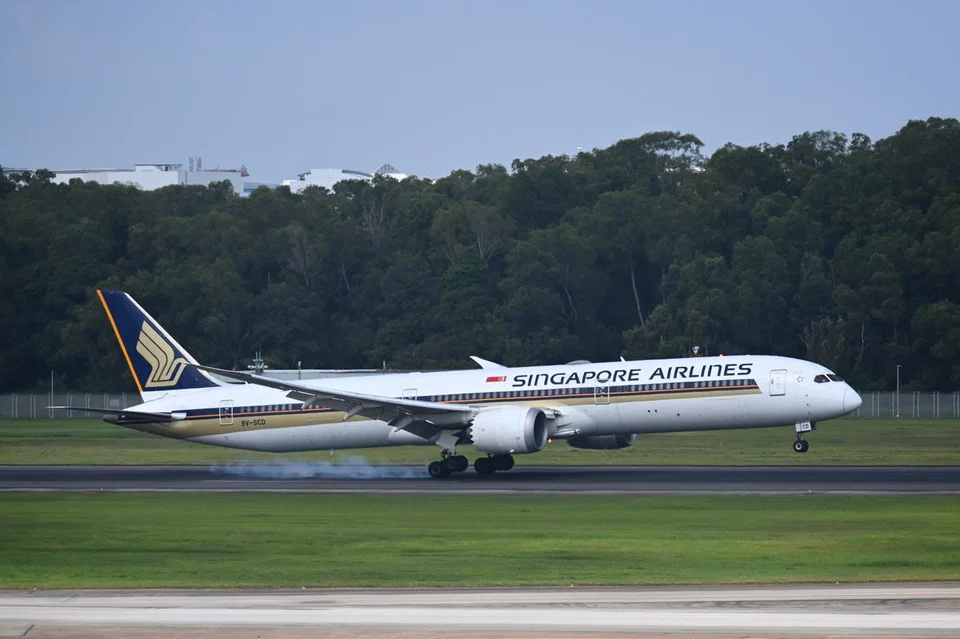
THE planned frequencies and passenger capacity boost by Singapore Airlines (SIA) are unlikely to move the needle for the national carrier’s yields and load factors, say industry watchers.
DBS analyst Jason Sum pointed out, for example, that such moves by the airline for the 2025 travel season – to deploy more capacity on routes where there is robust demand, or less competition – are strategic shifts it makes consistently anyway, amid increasing competition across the board.
SIA announced early this week that it would raise flight frequencies and passenger capacity to popular destinations in the Northern Hemisphere to capture the demand for travel in the 2025 mid-year summer season.
The 2025 Northern Summer runs from Mar 30, 2025 to Oct 25, 2025 and is a period of high demand.
There will be up to 10 flights a week to Adelaide in Australia, across the Northern Winter 2024 and Northern Summer 2025 seasons, up from the current seven weekly services.
SIA also plans to use the jumbo Airbus A380 for one of its two daily flights to Narita Airport in Tokyo, in place of Boeing 787-10, which has fewer seats.
Like Sum, Mabel Kwan, managing director at Alton Aviation Consultancy, sees the exercise as a regular review by SIA of its network plan and rationalisation, in response to demand and competitive dynamics.
Some routes are being ramped up to daily flights, creating a more attractive product and more scheduling options for travellers. And the launch of direct services to popular leisure destinations, such as the Spanish city of Barcelona, is a “much awaited development and a win for SIA”, she added.
The additional capacities should not have a material impact on network-wide yield and load factors, although route-specific metrics would need a period of stabilisation for demand-supply dynamics to play out, she said.
But with aircraft shortage and supply chain issues continuing to disrupt the industry, she noted that SIA’s ability to ramp up capacity and secure additional slots for key hubs and grow its market share could provide a strategic advantage in the longer term.
Hu You, analyst of the research and portfolio management team at FSMOne Singapore, believes the adjustments are expected to enhance the passenger load factor by catering to higher travel demand.
She said the airline posted a 2.6 percentage point lower year-on-year passenger load factor at 87.1 per cent in June. “To address this shortfall and better align capacity with traffic flows, it is not surprising to see SIA adjusting its network for 2025.”
Liu Miao Miao, Phillip Securities Research analyst, said the addition of long-haul flights would support revenue performance, as these flights typically have higher revenue passenger kilometres (or RPK) – even as yields may be further compressed because of the rising capacity in the industry.
The mainland Chinese market has always been important to SIA and its budget arm, Scoot. SIA has announced that it would be boosting frequencies to this market.
However, Chinese airlines are giving SIA a run for its money.
Much of the capacity to China was reinstated in 2023, although overall flights remained lower than pre-pandemic for SIA, said Kwan of Alton. In the meantime, Chinese carriers have been raising their international capacity, planning to rebuild their networks of intercontinental routes, and increasing their market share of outbound flights to Europe and South-east Asia.
She has also noted that SIA has been using Scoot as an entry product to open up more routes to secondary cities in China.
DBS’ Sum noted that the SIA group’s capacity to and from China reached approximately 87 per cent of pre-pandemic levels as of the week of Aug 12. “While there is still room for recovery, progress may be challenging.”
He said the rapid ramp-up of international flights by Chinese airlines has whittled the SIA group’s market share on these routes from 64 per cent pre-pandemic to about 49 per cent.
FSMOne Singapore’s Hu noted that SIA is still actively restoring operations across other cities in China that were previously limited by regulatory constraints, even as it is set to raise frequencies to Beijing. “We therefore expect the capacity in China will be only gradually expanded over time.”
Liu of Phillip said: “Markets such as China and Indonesia, which have experienced a slower-than-expected recovery, continue to operate below pre-pandemic capacity levels. We believe these markets have the potential to become revenue catalysts.”
SIA’s latest operating numbers published on Thursday (Aug 15) confirmed that the increased capacity in North Asia is crimping its load factors.
It posted lower passenger load factors for both the full-service airline and budget carrier for July, compared to the year-ago period. Load factor measures the percentage of available seating capacity filled by paying passengers.
The group passenger load factor came in at 85.6 per cent, 4.2 percentage points lower year on year. Those of SIA and Scoot were 84.7 per cent and 88.9 per cent, respectively, down by 4.3 percentage points and 3.8 percentage points, also respectively.
SIA said the group recorded lower load factors for the East Asia route region as a result of the significant growth in capacity in North Asia, notwithstanding “robust” increase in passenger traffic.
Cargo loads rose by 18.5 per cent from the previous year, driven by robust e-commerce demand; some of this growth was the result of the disruptions to sea freight and congestion in global ports.
The growth in cargo loads outpaced the 8.2 per cent growth in capacity; cargo load factor was 57.4 per cent, up five percentage points year on year.
As at end-July, SIA and Scoot covered a total of 125 destinations in 36 countries and territories across its passenger network.
Shares in SIA closed 2 per cent or S$0.12 higher at S$6.12 on Thursday, before the operating statistics were published.
TRENDING NOW

He built the Vingroup empire. Now South-east Asia’s richest man is handing some key roles to his sons

Fed hike throws Singapore banks a margin lifeline; UOB likely to benefit more

Luxury properties seized in S$3 billion money laundering case fail to sell at auction

US stocks: Tech leads Wall Street to higher close as oil eases, Treasury yields dip

