

Singapore joins hands with New Zealand to tackle 'a wicked problem' in aviation
 Add BT as a preferred source
Tay Peck Gek
DeeperDive is a beta AI feature. Refer to full articles for the facts.
DECARBONISING aviation is a "wicked problem" that involves the entire ecosystem and requires all stakeholders working together to resolve, noted aviation industry practitioners from Singapore and New Zealand.
Their comments come as they gathered for the collaboration being formalised between the 2 countries on sustainable aviation.
Chief executive of Air New Zealand, Greg Foran, said at a roundtable discussion on future aviation on Wednesday (Apr 20) that the current climate problem facing aviation is a "wicked problem". He added: “One that's going to require everyone to work together - governments, the private sector, all my colleagues, right through the supply chain, a total ecosystem approach to solve.”
A "wicked problem" is one that has no immediate solution, is unique, which conventional processes fail to tackle and involves many stakeholders, all of whom have different ideas about the problem.
Foran also said that the flashpoint in this is often government policy, which will drive real change.
Concurring, CEO of Changi Airport Group, Lee Seow Hiang, cited sustainable aviation fuel (SAF) as an example that is lacking an acceptable global standard but needs a consensus across countries, taking into account what is relevant to or available in a particular region.
Navigate Asia in
a new global order
Get the insights delivered to your inbox.
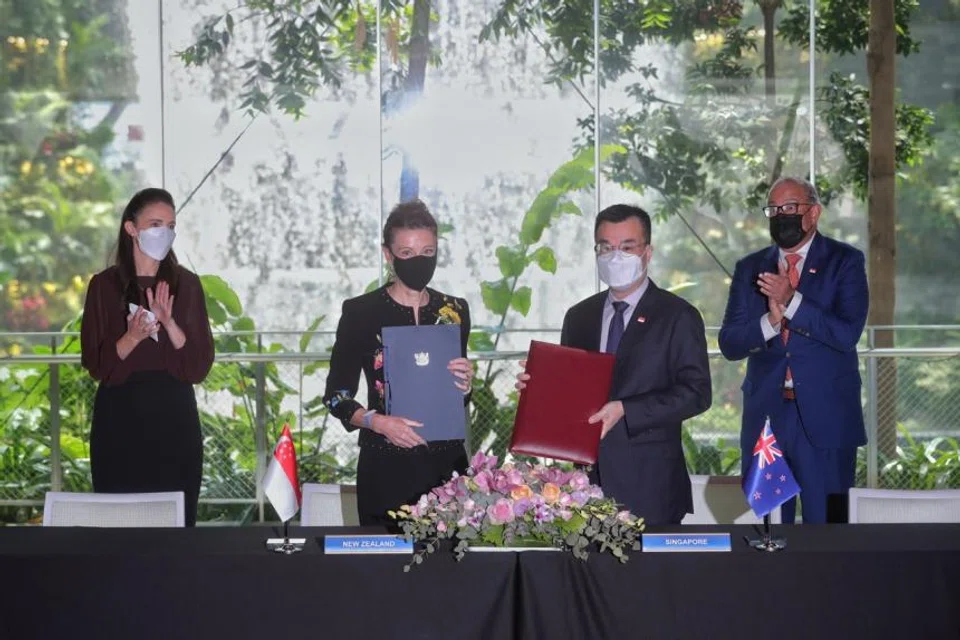
Intergovernmental collaboration is a point that is being taken up by Singapore and New Zealand, with both countries entering into a memorandum of arrangement on Wednesday to collaborate on promoting sustainable aviation.
Both sides would focus on 4 key areas - policy and regulation, industry development, future infrastructure planning and provision, and workforce transformation. The scale, costs and technical viability of developing "green lanes" between the 2 countries to encourage the gradual uptake of SAF-fuelled flights by travellers will be studied.
Prime Minister of New Zealand, Jacinda Ardern, and Singapore's Minister for Transport and Minister in charge of Trade Relations, S Iswaran, witnessed the signing of the arrangement at Jewel Changi Airport.
Iswaran said: "This collaboration is more than just a bilateral cooperation between Singapore and New Zealand on sustainable aviation. I do believe it can also serve as a catalyst for many more like-minded states to come together to reimagine international aviation, take decisive climate action, and turn constraints into opportunities."
Ardern said the arrangement is an acknowledgement that aviation cannot return to "business as usual" in a post-pandemic world, and that collaboration will lay the foundation for the longer-term goal of decarbonisation and environmental sustainability across both countries' economies.
She was in Singapore for a 3-day visit that ended after the signing ceremony.
The roundtable discussion followed the signing of the arrangement, and saw the participation of chief executives of flag carriers and airport operators from Singapore and New Zealand.
Pre-Covid, international aviation accounted for 2 per cent of global emissions.
Copyright SPH Media. All rights reserved.
TRENDING NOW

StarHub hands Ensign InfoSecurity control back to Temasek in S$115 million deal, books S$200 million gain

Singaporeans can now buy record amount of yen per Singdollar
Air India asks Tata, Singapore Airlines for funds after US$2.4 billion loss

Keppel DC Reit posts 13.2% higher Q1 DPU of S$0.02833 on strong portfolio performance

