

Singapore’s COE system is both boon and bane for used EVs
COE premiums distort prices, but may have surprising benefits

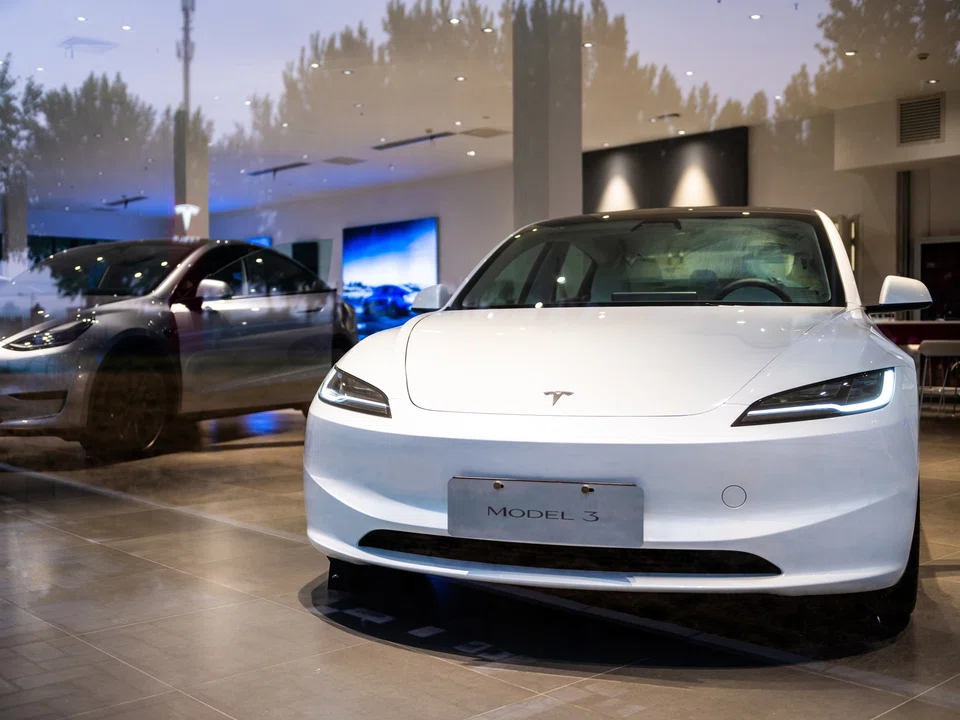
A BRUTAL price war among electric vehicle (EV) makers has dragged down the resale value of such used cars in China, the United States and Europe. But what about Singapore?
In Singapore, used EVs do seem to take longer to sell than conventional equivalents. But it is less clear whether they have a lower resale value.
Anecdotal evidence suggests that when popular EVs are traded in, the fall in value – compared to the price of a new EV – is similar to that of conventional cars.
Older, niche EVs lose a greater portion of their value, compared to similar conventional cars.
Yet these observations may not reflect the underlying EV market – because Certificate of Entitlement (COE) premiums make it hard to judge resale values accurately.
As a result, the price war between global EV giants may not necessarily have the same dampening effect here.
No crystal ball
Based on data from automotive portal Sgcarmart, used EVs take longer to sell than conventional cars.
Used EVs took an average of 71.8 days to be sold after listing, based on 905 transactions in the 15 months through March 2024.
Non-EV used cars took an average of just 53.7 days, based on 90,760 deals in the same period.
Sgcarmart editor Desmond Chan attributed this to lower demand for used EVs. The effect of this on EV resale values, however, is less clear.
In other markets, it is easy to calculate the loss in value for used cars: compare a large number of transactions for EVs and non-EVs across different segments, calculate the price difference as a percentage of the original value and average this out.
In Singapore, however, both the new and used car markets are distorted by COE premiums.
New cars are priced as a package that includes both the car itself and a COE. Prices therefore change with every twice-monthly COE bidding exercise.
The higher the COE premium, the larger the distortion. While COE prices have decreased from last year’s record-breaking run, they can easily be as much as twice the cost of the actual vehicle.
Used car prices also take into account current COE prices, alongside variables such as age, mileage, number of owners, warranty coverage and overall condition.
“We calculate (used car prices) based on current COE prices, because we are competing with new cars,” the sales manager for a used car dealer told The Business Times.
All nuance
EVs or not, mainstream models from popular brands are generally easier to sell and thus lose less value, while older or niche cars have the worst resale value.
But the gap between mainstream and niche resale values seems to be wider for EVs.
Popular EV models such as the BYD Atto 3 and Tesla Model 3 would lose around 20 per cent of their value when traded in, similar to the loss for a mainstream non-EV, said the sales manager.
In contrast, a niche, luxury EV would lose more value than a similar petrol-powered car. The Jaguar I-Pace, for instance – one of the first luxury EVs to go on sale here, in 2019 – would see a greater fall than a similar conventional Jaguar.
Those with the biggest trade-in losses are older models with obsolete technology, such as the BMW i3, one of the earliest EV debutants in Singapore.
One reason for the greater value loss is the relative immaturity of the EV market.
The dealer stressed that when it comes to EVs, “pretty much anything that isn’t a BYD or a Tesla is evaluated on a case-by-case basis”.
As most EVs are new, they present extra risk for a used car dealer to take on.
What distorts might also protect
Consumers tend to view the COE premium in a wholly unfavourable light. Yet it has arguably prevented EV resale values from falling too far.
First, potential COE rebates boost a used car’s residual value.
When a car that is less than 10 years old is deregistered, a prorated portion of the COE premium is returned as a rebate. Dealers take this into account when calculating how much to pay for a traded-in car – essentially, the rebate is added to the car’s resale value.
Second, COE premiums form such a big share of a car’s overall selling price that manufacturer-side price cuts have a much smaller impact, proportionally. Such price cuts are rare for conventional cars, but have been made by major EV players.
For instance, in April 2023, Tesla reduced the price of its new Model 3 and Model Y by S$4,000 and S$5,000, respectively. This implies a corresponding dollar fall in resale value for such used cars.
That might be a hefty discount in the US, where the price of a Model Y starts at US$31,000. But in Singapore, where the final price with COE is now around S$200,000, a S$5,000 cut is proportionally much smaller.
COE fluctuations also mean that under the right conditions, in-demand EVs can be resold for more than the original price, as is the case for non-EVs too.
Alvin Seet, president of the Electric Vehicle Association of Singapore, noted that in October 2023, a year-old Tesla Model 3 Performance could be sold for S$50,000 over its original retail price – because the Category B COE had hit a record S$151,000.
While not an everyday occurrence, this does illustrate how the COE system can preserve resale value.
Potential owners might still fear that used EVs are harder to sell because of the risk of battery failure and their limited range.
Yet those fears, too, might be overblown. Lithium battery technology has matured, and modern EV ranges are more than adequate for the average Singapore driver.
EVs are still cars, and in Singapore, that means they are subject to the vagaries of the COE system – for better or worse. For EV owners, current or prospective, it is far more worthwhile to keep an eye on COE values than worry about charger installations.






