Singapore’s EV registrations surge 50.5% to 5,468 in 2023

Tay Peck Gek
REGISTRATIONS of electric vehicles (EVs) in Singapore surged 50.5 per cent year on year in 2023, but industry watchers do not think that demand will soon stall, like what is happening in China and the West.
According to Land Transport Authority (LTA) numbers published on Monday (Jan 29), the Republic registered 5,468 EVs in 2023, 50.5 per cent higher than 3,634 in 2022.
The adoption rate of EVs in Singapore climbed to 18.1 per cent of total car registrations of 30,225 in 2023, compared to 11.7 per cent in 2022.
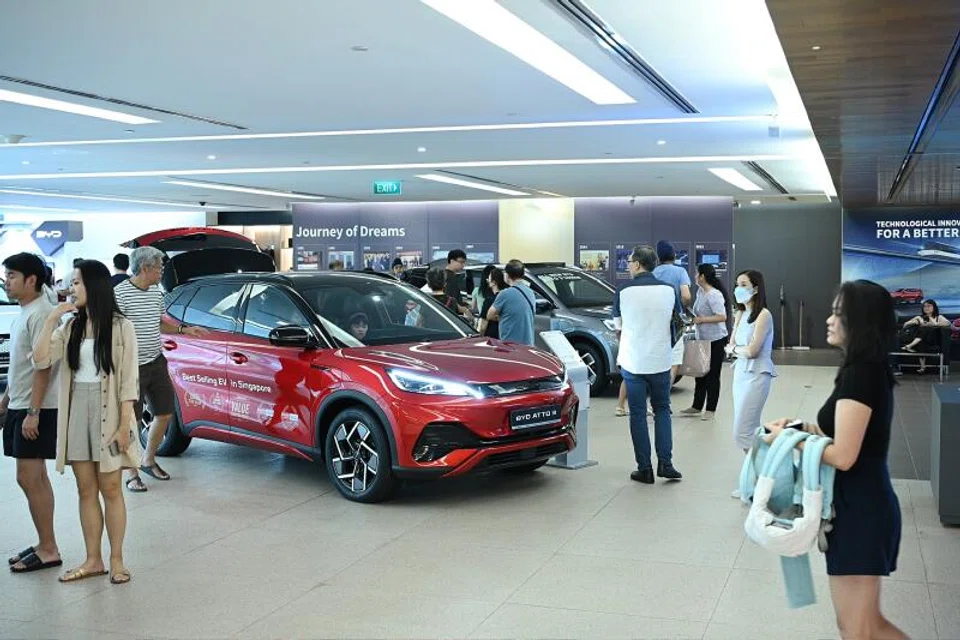
Chinese carmaker BYD took the pole position and the lion’s share at 1,416 – or 25.1 per cent – of the EV registrations in the city-state in 2023. The carmaker’s market share was at 21.6 per cent in 2022.
In contrast, Tesla only registered 941 units, relegating to the second best-selling position. Germany’s BMW took the third position with 789 EVs registered, South Korea’s Hyundai had 694 units and another German luxury brand Mercedes-Benz came in fifth with 537 units.
BYD and Hyundai shifted into high gear in the July-December period, reporting 1,053 and 591 registrations respectively, with the South Korean brand notably outnumbering Tesla (541), BMW (491) and Mercedes-Benz (315).
Hyundai only registered 126 EVs in 2022 and was placed eighth.
Ng Choon Wee, Komoco Motors’ commercial director, said Hyundai having a facility in Singapore and the model Ioniq 5 being awarded Car Of The Year by The Straits Times “definitely played a part” in the higher registrations in 2023.
Komoco Motors is Hyundai’s distributor.
“The made-in-Singapore Ioniq 5 is another positive factor contributing to driving interest in the Hyundai range,” Ng said.
He added that having a wide range of offerings – with models such as Ioniq 6 sedan and Kona EV compact sport utility vehicle that fall under both Categories A and B for the Certificate of Entitlement (COE) – was a “driving force” behind the catch-up.
In contrast, Japanese legacy automobile makers were far behind in the EV race.
In spite of 7,248 registrations of all types of passenger vehicles making it the best-selling brand, Toyota only had 43 EV units registered and was placed 15th. Counterparts Mazda, Nissan and Honda had 11, 10 and eight EV registrations, respectively.
In 2022, Tesla took the crown with 875 EVs registered, or 24.1 per cent of the total 3,634 EVs. Close behind was BYD, which had 786 registrations while BMW, Mercedes-Benz and Chinese-owned, British brand MG had 492, 327 and 228 units registered, respectively – rounding up the top five EV makers.
Associate professor of economics at the Singapore University of Social Sciences, Walter Theseira, said BYD has clearly established itself in the local EV mass market, with models such as the Atto 3 that are offered at a lower price point and eligible for COE Category A.
In contrast, Tesla and a few other makes are largely available in the more expensive Category B market.
Jochen Siebert, Singapore-based managing director of JPW Asia Consulting, noted that BYD also offers discounts and goodies, making its EVs attractive to the mass market.
Neither was he surprised about Hyundai’s quick rise, pointing out that it is one of the few makers whose new models feature the fast-charging 800-volt technology, which could potentially cut charging time by 40 per cent.
BYD has a presence in the fleet sector as well, with the e6 model, whereas most of the other makes are not marketing much to that sector, noted Prof Theseira.
The academic also highlighted that most EV makes appear to have challenges reaching the mass market so far. Over the course of 2023, this was due to most EVs coming from luxury makes or targeted at Category B.
However, he thinks the recent decline in Category A premiums and the introduction of more mass market EV models could push up sales significantly in 2024, although this will depend on whether manufacturers offer Category A versions of their EVs at prices that are compelling for mass-market buyers.
Although some markets have reported a slower rise in demand for EVs in the absence of government subsidies and early adopters having made their purchases, Singapore is not likely to encounter that yet.
JPW’s Siebert said there is overcapacity along with a wide range of EV models in China, resulting in market saturation. The American market has a different problem in the form of a price war, as demand is rising at a slow pace with that from the early adopters drying up.
In contrast, Singapore has not hit that phase yet, he said.
Prof Theseira pointed out that Asean’s demand for EVs such as those from Thailand is still robust. In markets where there is good access to Chinese EVs, he said superior cost competitiveness and features offered by those Chinese EVs will drive demand.
“In the Singapore market, the critical factor really is whether there will be more mass market EVs offered when COE supply surges in 2025 onwards. I expect that the Japanese makes will still be severely behind then, but there will be multiple Chinese brands ready to enter the Singapore market or enhance their offerings.”
Chinese carmakers have been making inroads in international markets, albeit with increasing scrutiny from foreign authorities amid trade protection calls.
Nonetheless, BYD overtook rival Tesla in sales internationally in the last quarter of 2023, delivering 526,409 EVs against Tesla’s 484,507.
BYD, which also makes batteries, stated on Monday that it expects net profit in 2023 to be between 29 billion yuan (S$5.4 billion) and 31 billion yuan, or to rise as much as 86.5 per cent on the previous year, buoyed by strong sales and cost cuts. However, the expectation fell short of analysts’ estimate of 31.5 billion yuan, with a price war in BYD’s home ground hitting the maker’s bottom line.