

South Korea seeks space race entry with first home-grown rocket
 Add BT as a preferred source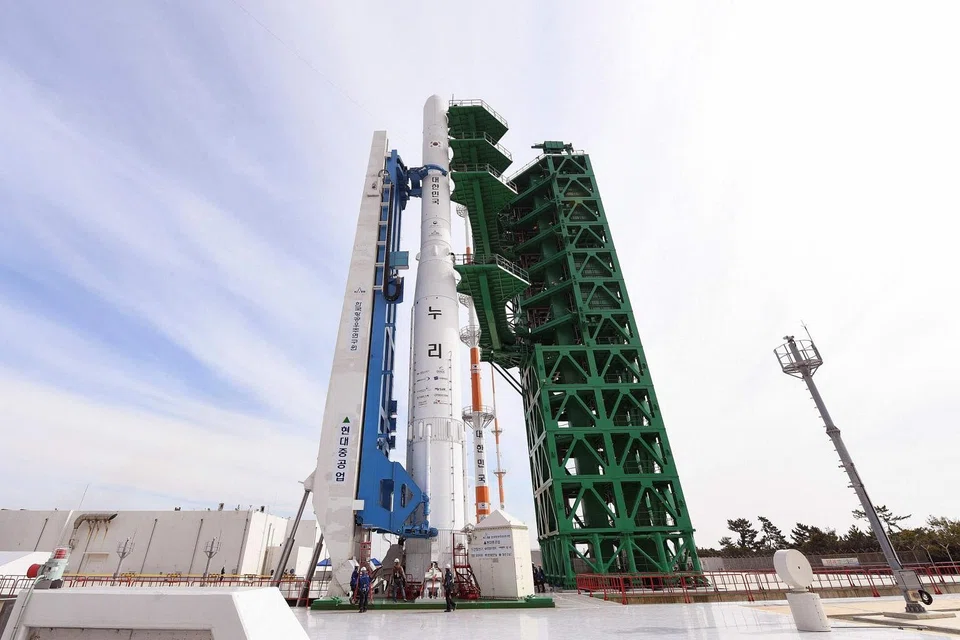
[SEOUL] South Korea is aiming to join the ranks of advanced spacefaring nations on Thursday when it attempts to put a one-tonne payload into orbit using its first fully homegrown rocket.
The country has risen to become the world's 12th-largest economy and a technologically advanced nation, home to the planet's biggest smartphone and memory chip maker, Samsung Electronics.
But it has lagged in the headline-making world of spaceflight, where the Soviet Union led the way with the first satellite launch in 1957, closely followed by the United States.
In Asia, China, Japan and India all have advanced space programmes, and the South's nuclear-armed neighbour North Korea was the most recent entrant to the club of countries with their own satellite launch capability.
Ballistic missiles and space rockets use similar technology and Pyongyang put a 300 kg satellite into orbit in 2012 in what Western countries condemned as a disguised missile test.
Even now, only six nations - not including North Korea - have successfully launched a one-tonne payload on their own rockets.
The South will become the seventh if the Korean Satellite Launch Vehicle II, informally called Nuri, succeeds in putting its 1.5-tonne dummy cargo into orbit from the launch site in Goheung, with an altitude of 600 to 800 km being targeted.
The three-stage rocket has been a decade in development at a cost of 2 trillion won (S$2.1 billion). It weighs 200 tonnes and is 47.2 metres long, fitted with a total of six liquid-fuelled engines.
AIMING FOR THE MOON
But the South Korean space programme has a chequered record - its first two launches in 2009 and 2010, which in part used Russian technology, both ended in failure, the second one exploding two minutes into the flight and Seoul and Moscow blaming each other.
Eventually a 2013 launch succeeded, but still relied on a Russian-developed engine for its first stage.
The satellite launch business is increasingly the preserve of private companies, notably Elon Musk's SpaceX, whose clients include the US space agency Nasa and the South Korean military.
But one expert said a successful Nuri launch offered South Korea "infinite" potential.
"Rockets are the only means available to mankind to go out into space," Lee Sang Ryul, the director of the Korea Aerospace Research Institute, told local paper Chosun Biz.
"Having such technology means we have fulfilled basic requirements to join this space exploration competition."
Thursday's launch is one step on an increasingly ambitious space programme for South Korea, which President Moon Jae In said would seek to launch a lunar orbiter next year, after he inspected a Nuri engine test in March.
"With achievements in South Korean rocket systems, the government will pursue an active space exploration project," he said.
"We will realise the dream of landing our probe on the Moon by 2030."
AFP
Decoding Asia newsletter: your guide to navigating Asia in a new global order. Sign up here to get Decoding Asia newsletter. Delivered to your inbox. Free.
Share with us your feedback on BT's products and services
TRENDING NOW

Xi Jinping has just rewritten the rules of US-China rivalry

High Court raps UOB over inconsistent legal positions on late mortgage payment charges

‘Whole deck of cards just toppled’: FoodXervices’ Nichol Ng on how a 92-year-old family business unravelled – and what’s next
China’s Huawei reveals chip design breakthrough amid US sanctions

