

Journey to ERP 2.0: A timeline of road pricing in Singapore

THE LAND Transport Authority (LTA) has released more details on the next-generation Electronic Road Pricing (ERP), or ERP 2.0, which will be rolled out by the end of 2025.
In its latest update on Mar 28, the LTA said that all new vehicles registered in Singapore on or after May 1, 2024, will have the new on-board units (OBUs) that will enable distance-based road pricing.
The Business Times takes a look at the history of road pricing in Singapore.
What is road pricing?
Road pricing is the practice of levying direct charges for the use of roads, the most common example of this being highway toll charges.
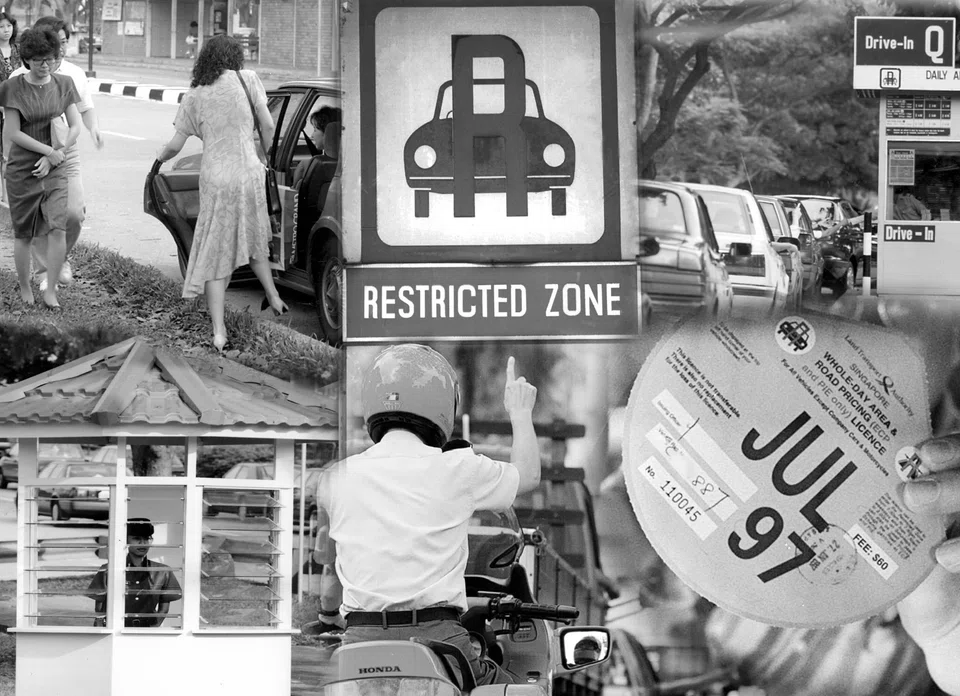
The first practical application of road pricing in Singapore was the Area Licensing Scheme (ALS), which started in June 1975. Under ALS, the Central Business District was demarcated as a Restricted Zone and vehicles entering were required to pay a fee – initially S$3 a day – or face a S$50 fine.
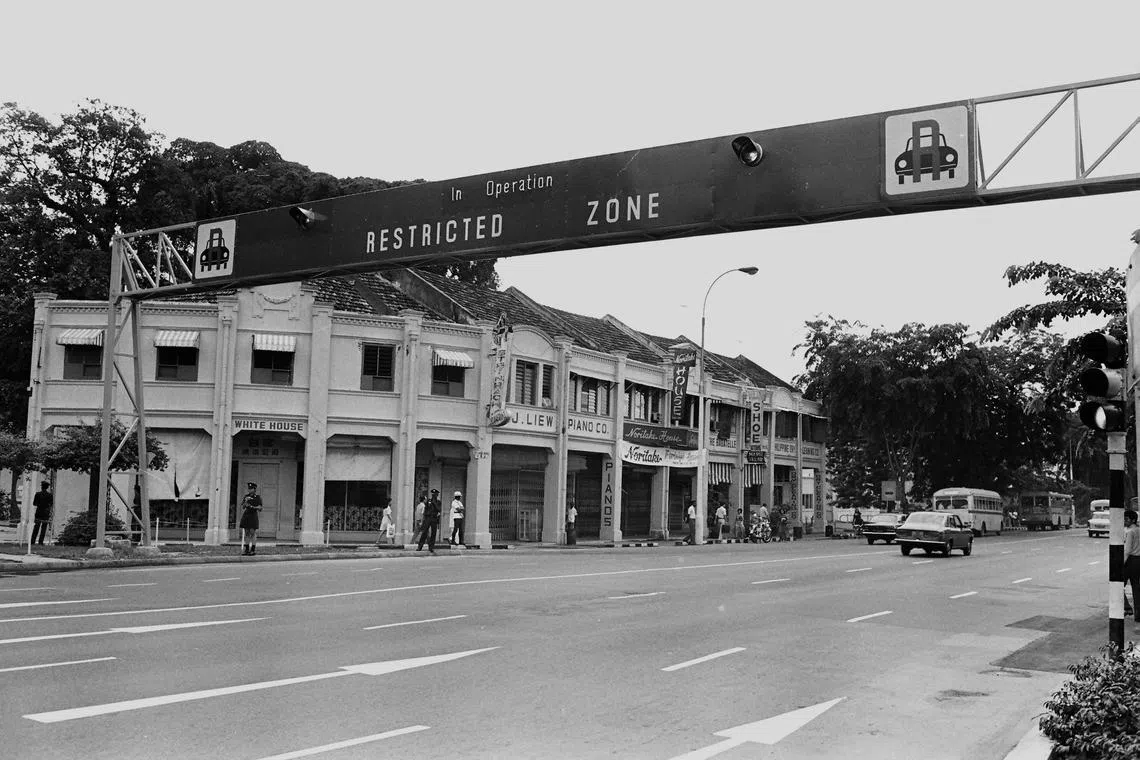
ALS did have an effect, reducing Restricted Zone traffic by 31 per cent in 1988, but it was a manual system that required motorists to buy and display a day licence. It also required around 120 officers for the enforcement and sales of the licences.
Electronic Road Pricing (ERP)
In the mid-1980s, the government began the search for a more efficient system of road pricing. The Cabinet gave its approval in 1989, although technical issues meant that the first real tests only took place in 1995. The new ERP system became operational in 1998.
Then-communications minister Mah Bow Tan said at a transport conference in 1998: “The ERP is in many ways a world first. No other city or country has implemented congestion pricing on such a wide scale using such sophisticated equipment.”
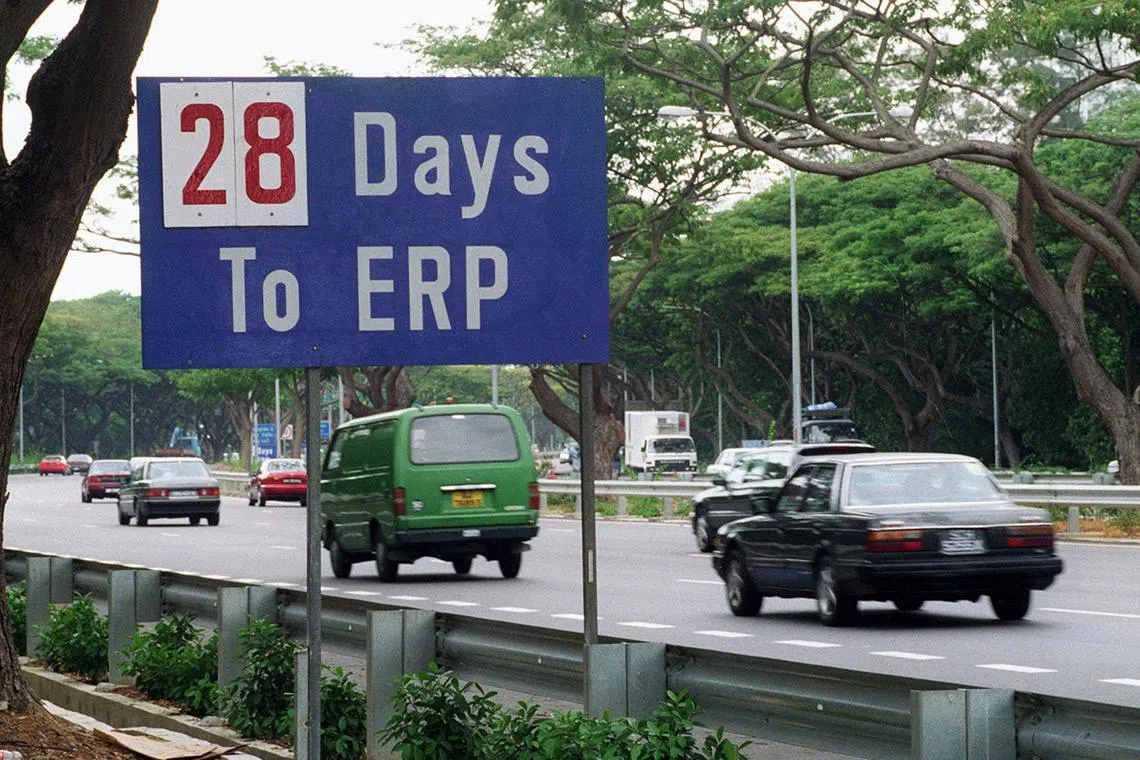
It uses a system of fixed gantries built on the roads that need pricing, and there are currently 98 ERP gantries across Singapore, although not all of them are switched on.
Fees are deducted automatically from an in-vehicle unit (IU), which uses radio frequency identification technology. The gantries also have number plate recognition cameras to track vehicles without an IU.
As at March 2023, rates range from S$0.50 to S$12.00.
According to the LTA, ERP rates are determined by traffic conditions, with the optimal traffic speed range targeted as 45 km per hour (kmh) to 65 kmh on expressways, and 20 kmh to 30 kmh on arterial roads. If traffic speeds rise above the target, ERP charges are reduced; and vice versa.
ERP rates are reviewed every quarter and also adjusted during the June and December school holidays, based on the traffic conditions at the time.
The ERP works to manage vehicle usage, while the Vehicle Quota System (through Certificates of Entitlement) manages vehicle ownership.
At the time of its debut, the government saw ERP as a way to bolster car ownership while moderating car use.
Mah said in Parliament back in 1998: “As the roads become less congested, we can review our vehicle quotas and, if feasible, release more COEs. Together, ERP and the Vehicle Quota System will provide a long-term sustainable and effective framework for managing the traffic on our roads.”
That approach has changed, however, as the government has pivoted towards a “car-lite” model of urban transport around 2016, with the car population growth rate reduced to zero in 2018.
ERP 2.0
The next-generation ERP system has been tested in Singapore since 2011, and was originally slated to begin rolling out in 2020. Its launch was delayed by Covid and the subsequent microchip shortage.
Unlike the first-generation system, ERP 2.0 uses global navigation satellite systems – such as the global positioning system – and will not need gantries. Such a system will enable the implementation of distance-based road pricing.
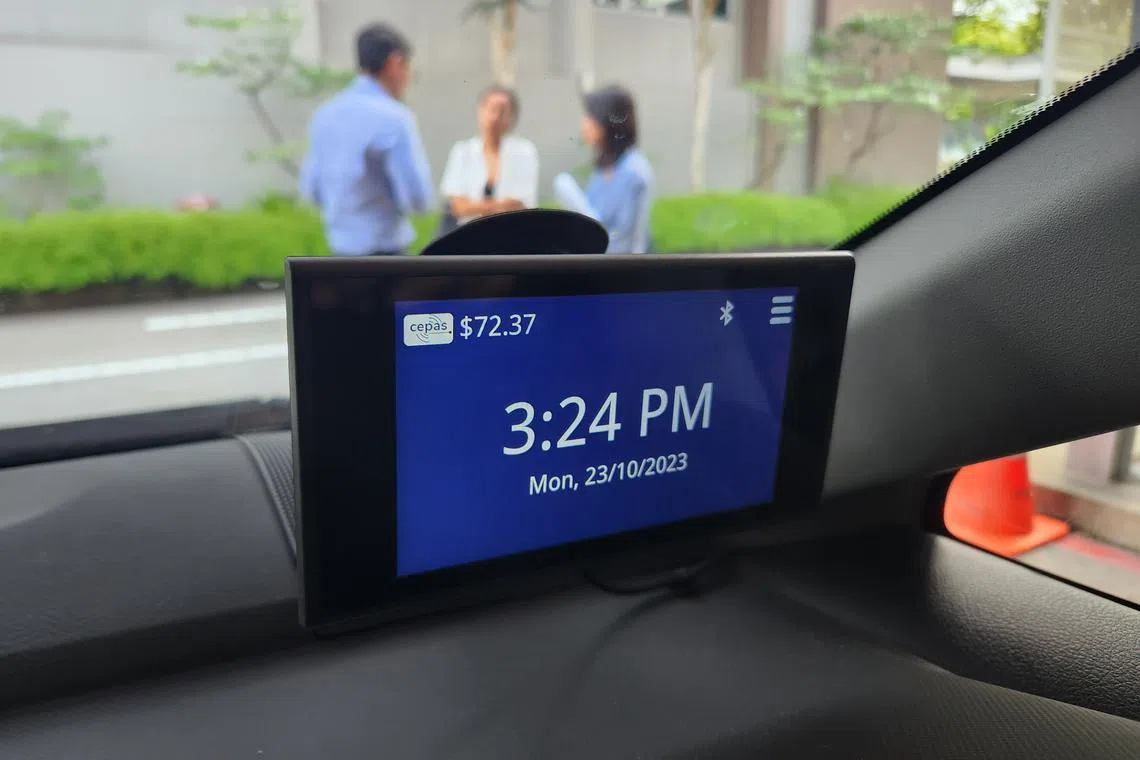
ERP 2.0 will use a new three-piece on-board unit (OBU) consisting of an antenna, a touchscreen display, and a processing unit. The display will be able to show maps and traffic information. Motorcycles will have a one-piece OBU.
According to the Transport Ministry, the new system will be a “more responsive traffic management system that is less costly to build and maintain, more space-efficient and requires a shorter lead time to implement compared to the current gantry-based system”
It will also be able to collect a wider range of traffic data, which will be used to improve traffic management and planning.
LTA said the data used will be anonymised, with vehicle-specific data only used for payment, charges and enforcement, and strict safeguards will be in place to prevent unauthorised access to such information.
The installation of new OBUs began with fleet vehicles in November 2023. OBUs began appearing on new motorcycles from February 2024. All new vehicles from May 2024 will have the new units as well. According to LTA, it aims for all vehicles in Singapore to have the new units by the end of 2025.
The switch to the ERP 2.0 system will happen after that, although the point-based pricing regime under first-generation ERP system will continue. It has not announced, however, when distance-based pricing will be introduced.
TRENDING NOW

ComfortDelGro appoints two new independent directors

Once staunchly pro-China, Malaysian Chinese businesses are now distancing themselves from Beijing

NoonTalk needs continued financial support from CEO Dasmond Koh, auditors warn

DP Architects sets the benchmark for sustainability disclosure and design

