

Turbulence in India’s skies as duopoly strains aviation boom
The country’s commercial aviation fleet has grown from about 100 planes in 2000 to almost 900 jets currently
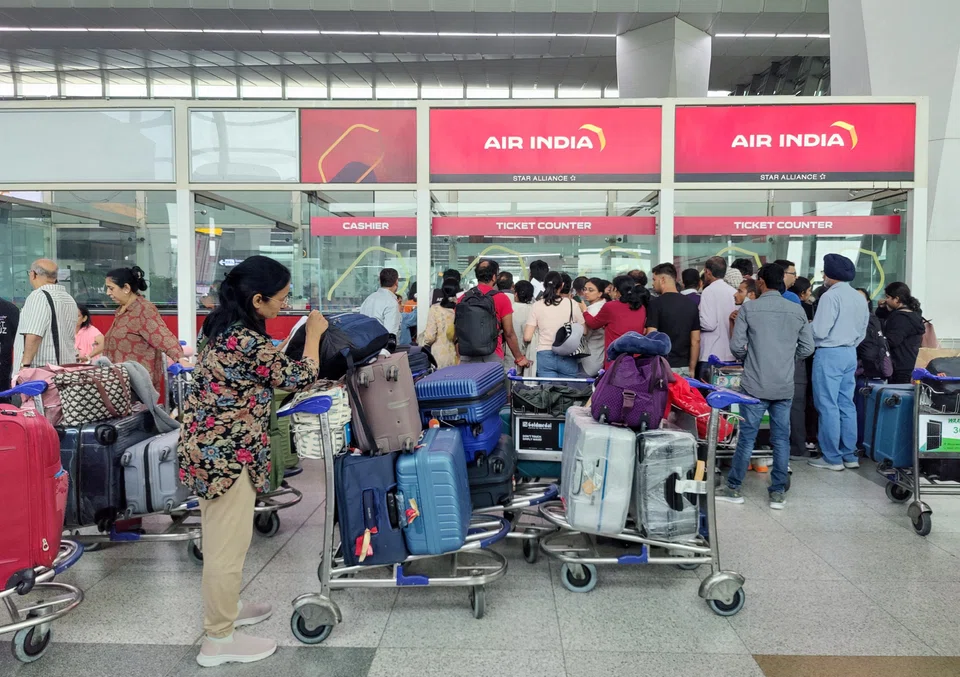
[DELHI] India’s aviation industry is poised for a reckoning after crises at its two dominant carriers exposed cracks in the booming market and forced government intervention.
IndiGo, which controls two-thirds of the market, suffered an unprecedented meltdown when pilot shortages and software glitches stretched its tightly run schedules to breaking point in early December. It triggered thousands of flight cancellations and stranded half a million passengers. A report by the sector regulator on IndiGo’s lapses is expected soon.
Air India, which has been stumbling through its transition from state ownership to Tata Group control, faced embarrassing slip-ups as well as human tragedy last year. It had the most number of issues among local carriers in a safety audit in July, weeks after it lost a Boeing 787 Dreamliner in a crash that killed 241 people.
While the probe into the cause of the crash is still ongoing, Air India will need to put its profitability roadmap back on track this year.
India’s skies over the past decade have shifted from a battleground of about half a dozen carriers to a near-duopoly. IndiGo and Air India now control nearly nine out of 10 domestic seats in the world’s No 3 domestic aviation market, magnifying every shock and exposing the system’s fragile underpinnings.
“India’s aviation moment has arrived, but in the worst possible way. The market sits at a dangerous inflection point,” said Linus Benjamin Bauer, founder at global aviation advisory firm BAA & Partners, adding that the recent episodes around Air India and IndiGo “are symptoms, not anomalies”.
The Air India crash “prompted a national reckoning about oversight, while the IndiGo disruption has exposed how fragile fast growth can be when systems are thinly provisioned and rules change”, he added.
The market leader, IndiGo, is being probed by the Directorate General of Civil Aviation, or DGCA, as well as the country’s antitrust body. The Narendra Modi-led government has pledged to take strict action against the no-frills airline and make an example of its failure to manage manpower requirements.
Explosive growth
While the sector is booming, its regulator is constrained by limited autonomy, funding and manpower. Struggling to keep pace with this explosive growth – fleets growing, passenger traffic surging, airports multiplying, DGCA has been seeking reinforcements, Bloomberg News reported in October citing people familiar with the matter.



The squeeze is set to get worse. India’s commercial aviation fleet has grown from about 100 planes in 2000 to almost 900 jets currently. Local carriers have ordered more than 1,500 planes, the largest order book for any country, and India plans to double the number of airports to 350 by 2047. The International Air Transport Association forecasts an additional 425 million passengers in India by 2044, almost tripling 2024 levels.
“The system is being stretched like never before,” said Subhas Menon, director general of the Association of Asia-Pacific Airlines industry group. “When you are growing at the speed that the Indian carriers are, it is impossible to do so if the existing constraints are not addressed,” he said, referring to the shortage of aircraft and pilots.
The regulatory setup too, appears to be unprepared for this rapid growth in the sector.
As at July, the DGCA had filled only 553 of 1,063 technical posts and employed 4,295 air traffic controllers, Bloomberg News had reported. In contrast, the US Federal Aviation Administration (FAA) had 46,170 employees, including 14,000 controllers and 7,000 safety inspectors.
DGCA’s annual budget of roughly US$38 million is dwarfed by the US$23 billion enjoyed by the US FAA in 2024.
The DGCA did not respond to an e-mail seeking comments. India’s aviation minister said in a Dec 10 interview with a local news channel that about 190 officials were recruited at DGCA in the past four months.
“This is a governance problem since the regulator is not independent and is a department under India’s aviation ministry and is influenced by political leadership,” said Shakti Lumba, a former airline operations chief. He argued that making the DGCA independent, with greater resources and authority, is the only way to ensure effective oversight.
A decade ago, Indian airlines carried about 81 million passengers, or about half the traffic last year. IndiGo was already the largest carrier with about 37 per cent of the market in 2015, while now-defunct airlines Jet Airways and Go Air carried about 20 and 9 per cent, respectively. Then state-owned, Air India controlled about 16 per cent of the market.
Brutally efficient
Several airlines have gone bankrupt and folded since. The Tata Group merged the full-service carrier Vistara into Air India and AirAsia India into Air India Express to consolidate its aviation business.
All this while, IndiGo went from strength to strength, expanding from 500 daily flights to over 2,200 a day in a decade and garnering nearly 66 per cent market share on the back of its brutally efficient operational structure.
The same cut-throat efficiency and quick turnaround cycle came back to bite the market leader last month as flight cancellations cascaded and public outrage forced regulators to order a 10 per cent cut in IndiGo’s routes.
The government has promised to broaden competition and reduce dependence on IndiGo. India’s aviation minister said in a Dec. 23 post on X that three new airlines received the no-objection certificate from his ministry.
But new aircraft are sold out until the early 2030s, constraining any entrant’s ability to scale up.
“You require probably a couple of billion dollars before you start creating an airline,” said MR Sivaraman, who led India’s aviation regulator in the 1990s in an interview with Bloomberg TV. “You require technical skills to start an airline. You require crew, you require trained pilots, you require an engineering establishment.”
Smaller airlines such as SpiceJet continue to battle cash-flow stress, highlighting how razor-thin margins make survival precarious even as demand soars. Government efforts to lower operating costs for smaller players remain at the discussion stage.
The Indian aviation regulator’s limits were most visible in the crisis engulfing India’s largest carrier, when it had to roll back the stricter pilot rest rules to allow IndiGo to stabilise.
“The entire system has got stuck,” said Sivaraman. “Everyone is responsible.”
An annual sectoral safety audit by the DGCA exposed repeated defects, ineffective monitoring, and maintenance issues across Indian airlines in July. A total of 93 lapses were reported for Air India, 23 for IndiGo and 14 for SpiceJet, though the audit did not make public the exact nature of the issues detected.
It also found that a work order was not followed during aircraft maintenance and in one case, a domestic flight of a scheduled carrier was held up due to worn tyres.
Other episodes seem almost comical, though they have exposed the serious shortcomings of the market.
Forgotten plane
In just the past few months, a forgotten Air India aircraft was rediscovered after being parked at a major airport for over a decade, while another was found flying without necessary documentation, according to local media reports.
A representative for Air India did not respond to an e-mail seeking comments on these two issues.
These challenges have emerged as Air India embarks on a US$70 billion fleet expansion under the Tata Group ownership, part of a sweeping transformation centred on new branding andthe pursuit of profitability.
While IndiGo and Air India have global ambitions and the Indian government wants its aviation sector to rival Middle Eastern hubs, it needs a lot of catching up if the aspirations have to become a reality in the coming years.
Rapid demand and fleet growth without a matching build-out of regulatory bandwidth and infrastructure results in systemic fragility, according to Bauer.
“The recent crises should be viewed as a turning point,” he said. “India’s aviation authorities and carriers can either treat these as teachable moments or as episodic shocks that will recur.” BLOOMBERG
Decoding Asia newsletter: your guide to navigating Asia in a new global order. Sign up here to get Decoding Asia newsletter. Delivered to your inbox. Free.
Share with us your feedback on BT's products and services
TRENDING NOW

World’s largest offshore wind platform by Seatrium consortium on track to be completed by 2028

Is stamp collecting enjoying an analogue revival or are its best days over?

GovTech retrenches another 38 staff in second round of layoffs

MBS adjusted property Ebitda falls 20.6% in Q3 with fewer high-roller visits, weaker hold

