

US airport congestion now a common occurrence
Airlines merging and consolidating operations in fewer hubs have left four big carriers controlling about 80% of airlines' seat capacity, down from 11 in 2005
New York
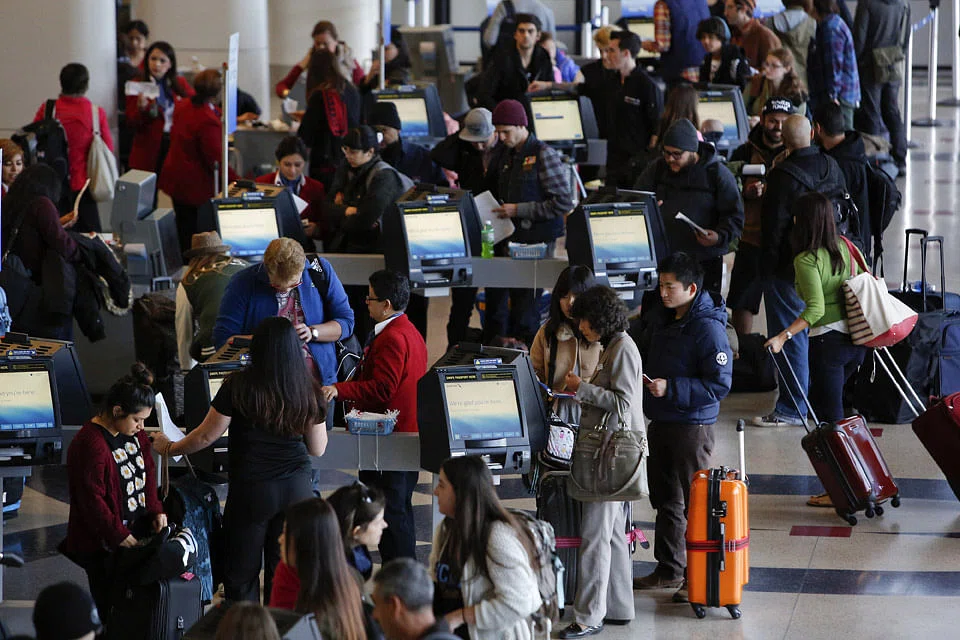
THANKSGIVING weekend has traditionally been the busiest time of the year for air travel, but that distinction is quickly becoming a thing of the past. With airlines merging and consolidating operations in fewer hubs, congestion that was once characteristic of the holiday is becoming more common at major airports all year-round.
The change follows a string of megamergers that left four big carriers controlling about 80 per cent of airlines' seat capacity, down from 11 in 2005. It might take another year to assess the impact of these mergers - American Airlines and US Airways have not yet integrated their operations - but fliers can already get a glimpse of the future of air travel.
"What was once the exception slowly becomes the rule," said Erik Hansen, the senior director of policy at the US Travel Association, a trade group. It found that 13 of the nation's top 30 airports already experienced Thanksgiving-like congestion and traffic at least one day a week. "People will see our airports bursting at the seams."
And while the number of passengers keeps growing every year, airlines are not increasing seat supplies much, which means planes are growing more crowded. Fares, as a result, have risen in the last five years after being driven down by weaker demand during the recession and fare wars in previous years.
Heidi Golledge, the founder and chief executive of CareerBliss.com, a job search website, said that she had noticed the change. "A few years ago, you could still get last-minute tickets," she said. "Definitely, across the board it's been more expensive and harder to get. I would say like 95 per cent of the flights I'm on are just full to the rafters, which was never the case before."
JetBlue Airways, which had long stood out from the competition by offering passengers more legroom and free checked bags, was the latest carrier to yield to Wall Street demands and give passengers less legroom. The airline announced last week that it would add 15 more seats to its planes. It also said that it would introduce checked bag fees. (Southwest still offers free checked bags.) The fare increases have been most noticeable on the most desirable flights - nonstop flights in the mornings, for instance - and fewer cheaper seats are available on each flight.
Average airfares rose to US$396 in the second quarter of the year, up 2.5 per cent from the same period last year, according to the latest government statistics. But those prices can mask wide disparities depending on the time of the flight or the day of the week. Also, they do not include extra fees that airlines have imposed on passengers, and that can add up fast.
"You never seem to fly those good deals anymore," said Adam Zeitsiff, president of Jonas Fitness, a software company on Long Island, who travels most weeks. He said that he regularly paid US$900 to US$1,000 to fly to Columbus, Ohio. "The routes where they know they can get you they sure do," he added. "I go to Houston all the time, and it's still US$600 or US$700. Those US$300 to US$400 fare days are pretty much over."
If there has been any beneficiary recently, it's the airlines, which are enjoying a rare period of financial stability.
Delta Air Lines registered a 12 per cent increase in its domestic passenger revenues in the last quarter compared with the same time last year. American Airlines, which emerged from bankruptcy, is making money for the first time in a long time. Even United Airlines, which stumbled repeatedly after merging with Continental, posted its highest-ever profit in the third quarter.
"It's like the five families in The Godfather movies," said Mike Boyd, an industry consultant. "You now have four network airlines, they each have their turfs, and they are not out to kill each other. They might squabble sometimes, and they might give up some of their turf. But it's now a stable industry focused on making money."
Kevin Mitchell, the chairman of the Business Travel Coalition, a trade group, said that the risk was that airlines would start moving in lockstep. "The No 1 concern is passive coordination of policies, fees and practices," Mr Mitchell said. "And that's what we are seeing."
Airlines have also made it harder for passengers to compare fares and fees as they withdraw from popular search engines. Now, they seek to draw travellers to their own websites, reducing consumers' ability to compare and shop.
Airlines, for their part, maintain that competition remains strong, and that airfares have actually fallen.
"Customers have options among airlines and even options within airlines for what they value and are willing to pay for," said Jean Medina, a spokeswoman for Airlines for America, the industry's trade group. "Airfare remains a bargain. Adjusted for inflation, airfare actually fell when comparing 2013 to 2000."
Brett Snyder, president of Cranky Concierge, an air travel assistance website, also saw benefits for consumers. "You are seeing better reliability, you are seeing more attention to the experience itself, and in general I think there is a better product out there," he said.
Those include investments made by many airlines including American, Delta and JetBlue to upgrade seats on transcontinental flights, or to improve airport amenities and business lounges.
And airlines say that they are creating bigger networks linking more cities both in the US and abroad. For instance, American Airlines passengers can use the combined network of American and US Airways, which serves more destinations than any airline could on its own.
And there is still room for competition, the airlines say. Lower-fare carriers such as Spirit, Virgin America, JetBlue and Frontier can act as a check to keep fares from rising too much. For example, when Delta sought to expand its presence in Seattle, an Alaska Airlines hub, fares there fell. The New York area, with three major airports, remains a battleground for the three international carriers Delta, American and United.
Consumer advocates point out that not every passenger is equally served by these bigger networks. Charlie Leocha, from Travellers United, a consumer rights organisation, said that airlines had focused operations on fewer big hubs, such as Kennedy Airport in New York, O'Hare in Chicago or the Dallas/Fort Worth Airport, providing residents there the benefit of a much bigger network. For people in mid-sized cities that have lost their hubs because of the mergers, though, the impact has been a big downgrade in choices. Those include cities such as Cincinnati, Cleveland, Memphis, Milwaukee, Nashville, Pittsburgh, Raleigh, North Carolina, or St Louis, Mr Leocha said.
"In those cities, you've seen your options cut," he said. "Everybody is experimenting with passengers. I call it a petri dish in the sky." NYT
TRENDING NOW

Knight Frank’s Tan Tee Khoon leaves firm, Nicholas Keong takes over auction business
Keppel Energy, Sembcorp Utilities and Tuas Power to supply biomethane in pilot project

GovTech retrenches another 38 staff in second round of layoffs
Take-up of new private homes dives 45% in Q3 as prices accelerate with 1.4% rise

