

US carmakers' wage talks with union start on high note
New York
WHEN US carmakers negotiated their existing contract with the United Auto Workers union four years ago, the domestic car industry was just recovering from a deep recession.
But conditions have vastly improved since then. US sales are roaring towards 17 million vehicles this year, and the bankruptcies and bailouts of General Motors and Chrysler are fading in the rearview mirror.
Instead of closing plants and cutting workers, GM, Ford and the newly merged Fiat Chrysler have been adding jobs, made possible by big profits on surging sales of pickup trucks and sport utility vehicles.
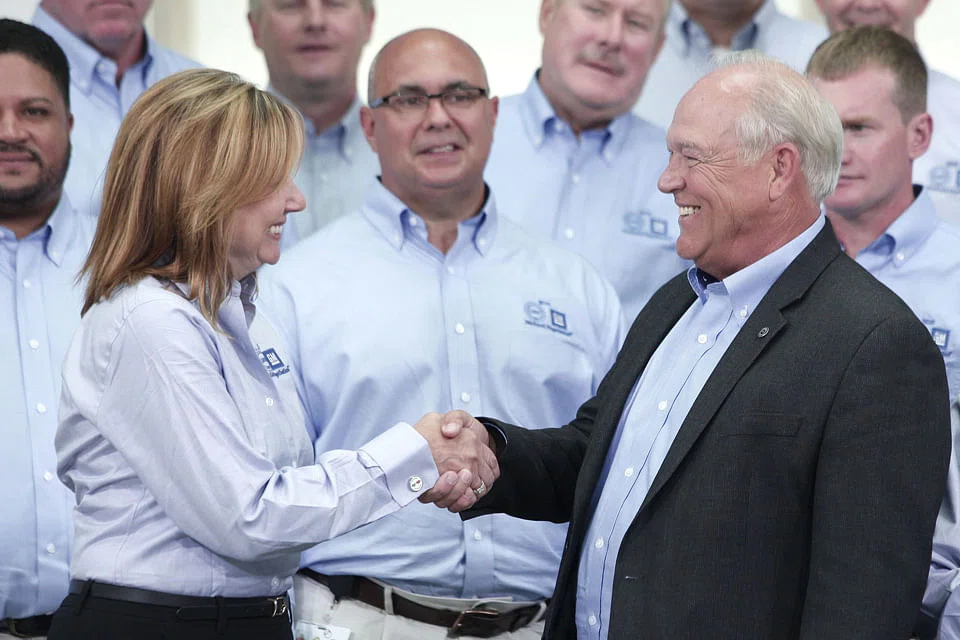
On Monday, GM became the first of the three Detroit carmakers to open talks on a new contract with the union to replace the current pact that expires in September.
And if the upbeat tone of the opening ceremony is any indication, this summer's discussions are all about keeping the good times rolling.
"We are going to truly listen to each other and understand the issues we need to work through," said Mary Barra, GM chief executive.
The president of the UAW, Dennis Williams, said that the union was seeking wage increases and greater job security, and to close the gap between veteran workers earning US$28 an hour and entry-level jobs that pay up to US$19.
Mr Williams, however, was unusually generous in his praise for GM's comeback and played down the notion that the union was gearing up for a battle or even a strike against any of the three carmakers.
"I am not afraid of confrontation, but I don't want one, and our members don't want one," Mr Williams said to the cheers of union workers packing the ceremony at the GM-UAW human resources centre in Detroit.
Fiat Chrysler will open its talks with the union on Tuesday, and Ford will follow next week. Together, the three carmakers employ about 138,000 blue-collar workers across the country - about one-third of which have been hired since 2011.
The new jobs have come at a price, and entry-level workers have become increasingly vocal about the disparity in pay with long-time union members. And while GM and Ford have distributed big profit-sharing cheques to workers in recent years, the union has not had an across-the-board wage increase in more than a decade.
"The real issue for all UAW members is about sharing in the gains the companies have made," said Harley Shaiken, a University of California, Berkeley, professor who has worked with the union in the past. "And there is considerable pressure to close the divide between legacy workers and the two-tier people."
Still, industry executives note that UAW wages and benefits are still higher than those of non-union workers employed by foreign carmakers such as Volkswagen and Nissan in the US.
Analysts suggest that the car companies will be hard-pressed to avoid wage hikes, even though higher structural costs will take a toll on profits when vehicle sales inevitably cool off.
"They'll likely get a contract that not only doesn't address longer-term structural issues but also results in mild wage inflation," said Brian Johnson, an analyst with Barclays Capital.
The carmakers are expected to push for reductions in healthcare costs, possibly by adjusting deductibles, co-pays on doctor's visits and prescription medication coverage.
Mr Williams has previously said that he would consider pooling hourly employees into a healthcare plan with salaried workers if that would save the corporations money.
But any concessions by the union on health care will most likely be offset by the UAW's demands for bigger paychecks in the factories.
The two-tier system itself has come under added scrutiny because of how different companies have taken advantage of it.
GM and Fiat Chrysler have had unlimited freedom to hire lower-paid workers because of agreements struck by the companies and the union with the Obama administration as part of their government bailouts.
Ford, which did not go bankrupt or require a bailout, is required by its UAW contract to begin bumping new workers up to the higher pay grade when lower-tier employees make up 25 per cent of its overall workforce.
GM's proportion of lower-paid workers is about 20 per cent. By contrast, more than 40 per cent of Fiat Chrysler's US employees are entry-level workers.
Besides shrinking the wage gap, the union is also intent on preventing the carmakers from moving production of some vehicles to lower-wage nations. Last week, Ford said that it would shift production of small cars to Mexico from a Michigan factory.
The positive vibe on Monday was different from that at the same event in years past, when the ceremonial handshakes between labour and management were often tense affairs.
Still, the tone of Monday's ceremony, unlike during previous events, had a sense of unity between two camps that have often been adversaries. "Many people counted us out," said Mr Williams, referring to the last recession. "But we came back." NYT
TRENDING NOW

Nvidia reinstates Jensen Huang as CEO; Trump says move poses no national security risk

Beyond the greenback, Vietnam’s big borrowers turn to Asian-currency bonds

Indonesia’s coal tycoon Low Tuck Kwong replaced as Bayan Resources president-director

Six workers file employment claims against Crystal Jade Food Manufacturing

