

US cities turn to gondolas as a means of transport for commuters
New York
THEY would seem more at home in Switzerland, zipping up the side of the Alps. But suddenly, American cities from Albany, New York, to Austin, Texas, are pinning their hopes on, of all things, gondolas.
The allure is not just speed. Gondolas do not contribute to greenhouse gases, and they soar over clogged highways and baulky subway signals. They are relatively fast and cheap to build. And unlike most forms of transportation, they offer singular vistas that attract tourism as well.
In New York state alone, there have been at least three recent proposals for gondolas. One plan, the East River Skyway, would connect Williamsburg in Brooklyn to Lower Manhattan with a gondola that would rise to 126.5 km alongside the Williamsburg Bridge.
In Albany, an engineering firm is pushing a gondola that would run from the Amtrak station in Rensselaer, one of the busiest in the country, across the Hudson River to downtown Albany. A third proposal to build a gondola at the state fairgrounds in Syracuse - Governor Andrew Cuomo had put US$15 million in the state budget for the attraction - has met resistance, and the money has gone elsewhere.
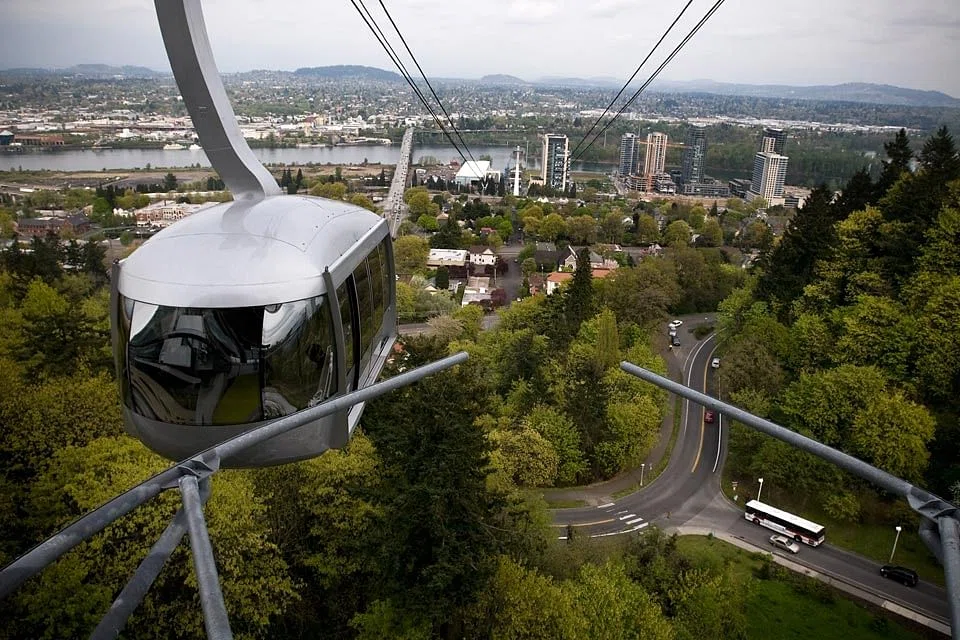
Despite a dozen gondola proposals around the US, in cities as varied as Seattle, Tampa, Chicago and Baton Rouge, Louisiana, only one such system has opened in recent years. The Portland Aerial Tram, which was built mainly to relieve crowding at Oregon Health and Science University, recently had its 10th anniversary. The tram drew more than two million riders last year and has spurred economic development in the area.
Backers of gondolas in New York recognise the hurdles in convincing both elected officials and the riding public that aerial transit's time has come.
"There's not really a road map for doing this type of project," said Daniel Levy, president of CityRealty, a real estate listings and data website, and the man behind East River Skyway. "If you are doing an office building or apartment building, those things get built every day."
Mr Levy lives in Williamsburg, Brooklyn. During a ski trip to Chamonix, France, in the Alps a few years ago, he had an epiphany of sorts.
"I stumbled upon a brand-new state-of-the-art gondola system in France, and it frankly reminded me of a New York City subway car," he recalled. "It was quite large, with 35 passengers per car. And by the time I got halfway up the mountain, I said, 'Jeez, why isn't there one of these between Brooklyn and Manhattan?' The congestion on the L train is legendary." And the L train itself will shut down for 15 months for repairs, beginning in 2019.
In 2014, Mr Levy formed East River Skyway, a limited liability corporation. He has since talked to anyone who will listen - including officials in City Hall and potential investors - about his vision for a three km system that would have cables strung across a half-dozen towers carrying 120,000 people a day, between the intersection of Delancey and Chrystie Streets in Manhattan, to two different stops in Williamsburg.
Like the proponents of the Albany-Rensselaer gondola, Mr Levy thinks that the East River Skyway could be built with private financing and supported through a combination of ticket sales (monthly passes of about US$25 to US$30) and corporate sponsorships, similar to Citi Bike, the bicycle sharing programme.
There are sceptics. Transportation Alternatives, the bicycle and pedestrian advocacy group, said that a gondola, while worth pursuing, was not a solution to the coming shutdown of the L train for repairs related to Hurricane Sandy. Rather, the group was focused on urging the city to create a network of dedicated bus lanes in and around the L train corridor.
In Syracuse, a gondola seemed far less a priority there than it was to Mr Cuomo, who included it in his executive budget in January. The gondola would "transport visitors and concertgoers between the fairgrounds and Onondaga County's Lakeview Amphitheater", according to the budget summary.
Syracuse newspaper The Post-Standard was not impressed. In a scathing editorial, it wrote that the gondola proposal had "boondoggle written all over it", adding that it was the "butt of jokes in Albany". The money for the gondola has apparently gone to other needs at the state fairgrounds.
While the fate of the fairgrounds gondola seems murky at best, another gondola plan seems to be gaining traction in the state capital. State lawmakers and others who get off Amtrak trains in Rensselaer often compete for taxis to take them over the Hudson to Empire State Plaza, the state government complex in downtown Albany, and a new convention centre.
The so-called Capital District Gondola Project was conceived by the McLaren Engineering Group, a firm in West Nyack, New York, with offices in Albany. The company commissioned a feasibility study; teamed up with a number of firms, including Doppelmayr USA, a leader in gondolas; and appointed a project manager, Peter Melewski, who worked on the hugely popular state historic park in Poughkeepsie known as Walkway Over the Hudson. NYTIMES
TRENDING NOW

Gas Supply may pursue remedies if contract breached following Indonesia’s export cuts: Tan See Leng

Why the biggest business decision about AI isn’t which model to choose

If Europe goes to war, the fallout will be felt in East Asia

Singapore expects all parties to honour commitments, says PM Wong after Indonesia cuts gas exports

