Twin engines of warehousing and concrete production drive returns for GKE
Company turned profitable last year as demand improves at both its business segments; it is also looking into new ventures.
Singapore
GKE Corp's diversified business of warehousing and logistics in Singapore and strategic infrastructure investments in China has proven resilient in the Covid-19 crisis. Demand at both arms of its business has risen.
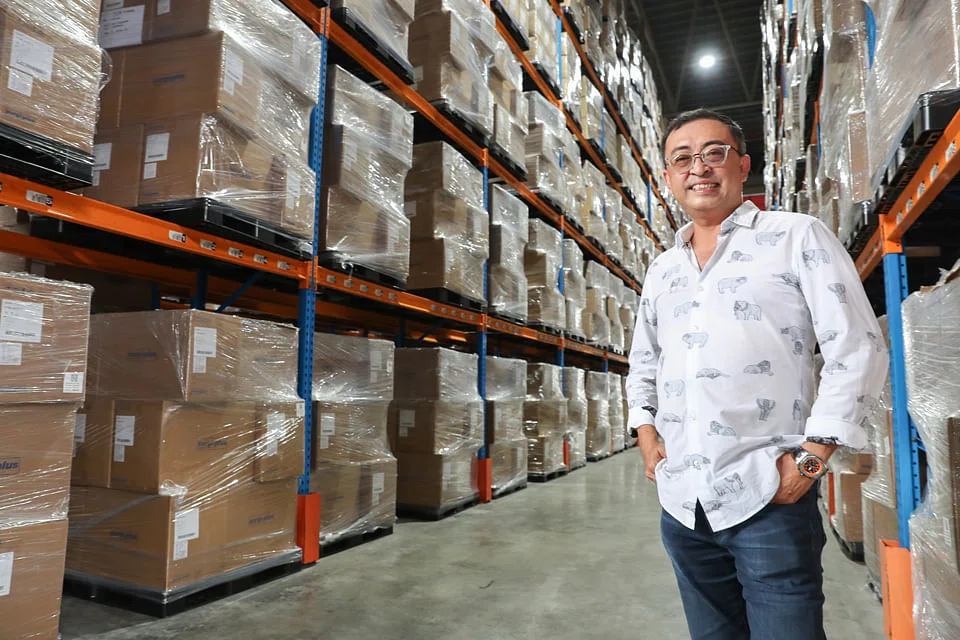
Faced with supply chain disruptions, many of GKE's clients started stockpiling supplies in a move away from the common asset-light "just in time" (JIT) strategy. GKE Corp's warehouse capacity of about one million square feet is currently full, and the company is on the lookout to acquire or rent additional storage space.
Meanwhile, the resumption of infrastructure projects after China's lockdown has been driving demand for ready-mixed concrete (RMC) from the group's plant in Wuzhou, China.
The resulting performance was "unexpected", said chief executive and executive director Neo Cheow Hui.
For the financial year ended May 2020, GKE Corp's revenue increased 21.6 per cent to S$107.3 million. The group reversed a loss of S$2.1 million in FY2019 to achieve S$4.7 million in net profit in FY2020.
In January, it reported H1 2021 revenue growth of 9.2 per cent to S$60 million. Net profit more than trebled to S$6.5 million from S$1.8 million a year ago.
"When the pandemic started at the beginning of last year and China went into lockdown, we thought our China side would take a big blow. But surprisingly, China didn't lock down for too long; and after they recovered, demand for infrastructure over there was very high," Mr Neo said.
"Warehousing and logistics in Singapore also improved. Demand in Singapore increased, and with the switch from JIT, all this has resulted in us being exposed to more opportunities. From there, we improved our space efficiency and yield."
GKE shares have climbed in tandem with the improved performance. They closed at S$0.132 on Friday, near a 52-week high of S$0.152 that they hit on Jan 21. This time last year, the shares were trading around S$0.06. The company now has a market capitalisation of S$104.9 million, and trades at 10.9 times its historical earnings.
China construction demand
The concrete business in China contributed about 40 per cent of overall revenue for the first half of FY2021 and is on track to overtake the logistics business within the next year, Mr Neo said.
In addition to enjoying a short-term boost from projects restarting after the lockdown delay, the business is seeing increased demand from longer-term developments including a government urbanisation project that will take 10 years to complete.
GKE Corp started investing in RMC production in China in 2014, led by executive chairman Chen Yong Hua who has experience in the infrastructure industry and RMC production.
Its first concrete plant has been operational for about four years now, and GKE Corp recently increased the plant's concrete production capacity to 1.2 million cubic metres by adding a third production line.
Two new projects are expected to commence production within the next few months: a construction waste recycling plant in Cenxi city under a joint venture with the local government, and a second concrete plant with production capacity of 400,000 cubic metres next to the recycling plant.
The recycling plant is due to commence full production after Chinese New Year. It will provide recycled construction materials directly to the neighbouring factory, which will commence trial production around the same time.
It took GKE Corp about a year to get its first RMC plant off the ground. But Mr Neo is confident the timeline will be significantly shorter for the second plant. "Cenxi is only 30 km from Wuzhou, where we have our first factory. It's still within the parameters and the same management team, so I think this will be faster. The learning curve will be about three months."
Pandemic-driven stockpiling
For GKE Corp's logistics and warehousing business in Singapore, the current surge in demand is closely tied to the pandemic as companies respond to the impact of lockdowns in other countries and to the Singapore government's encouragement to stockpile materials as a buffer against supply chain disruptions.
Mr Neo expects the elevated demand to last one to two years, based on contracts signed with customers.
GKE Corp's profit margin in warehousing has improved during this time. While it maintained high occupancy rates even before the pandemic, the increase in demand allowed it to filter low-yield customers and rebalance space allocated to various industries. It diversified its customer base into healthcare and medical supplies, and is now holding large quantities of personal protective equipment for private medical institutions.
Mr Neo said: "We play our part to ensure we have good use of space. It indirectly benefits the customer so they don't have to commit to more warehouse space than they need, only paying as they use."
The lack of supply in the market has also put GKE Corp in a better position to negotiate prices. It has not, however, adjusted rental rates for existing customers, only doing so for new customers and those that take space on an ad hoc basis.
The group is looking to expand its warehouse capacity. But Mr Neo said he will only acquire a property if the price is reasonable so that it can continue to offer clients affordable rates.
GKE Corp is also careful not to compete on prices alone. Over the past 20 years, it has acquired several logistics-related companies to offer clients value-added services such as inventory management, relabelling and procurement.
Mr Neo hopes to expand into specialised segments such as pharmaceutical logistics once he finds people with the right skill set. "There will definitely be price competition. But to uphold it, you've got to come with some upside that makes the customer feel that they must have you. If you can't offer them any other thing to hold them, only the price, that is the worst," he said.
GKE Corp is already embarking on a new venture that will diversify its businesses further and make use of excess space if demand for warehousing falls in the wake of the pandemic: vertical farming. The crop of choice is kale, and the first phase of growing will start in March with about 8,000 square metres of cultivated area.
The business idea was sparked by a former employee who left the company to start his own indoor farming business and returned with a wealth of knowledge and skill in the field.
GKE Corp intends to make use of its mostly empty seven-storey office building at 6 Benoi Road.
"Today, it's an office. If this solution is workable, tomorrow when there is oversupply of warehouse space, I can use the same solution in the warehouse to erect a higher structure to do farming," Mr Neo said.
"We may need to do a little bit of investment; but if it is viable, let's gain the knowledge and know-how. We may need this in future, and we can also sell solutions... That can be another business."