

UMS rides semiconductor upswing
UMS is a primary supplier in Asia for AMAT, and has renewed its integrated system business contract for another three years.
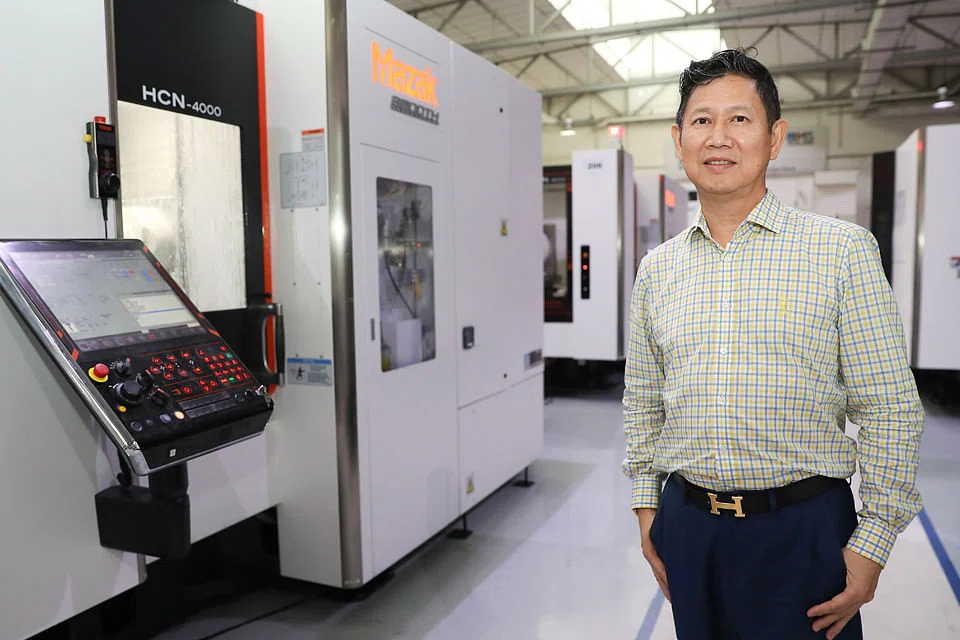
IT IS common for smaller contractors down the semiconductor supply chain to get squeezed by the big boys, but Singapore-listed UMS has consistently operated more profitably than most, posting an enviable net margin of 30.7 per cent in the March quarter.
"The reason why our margin is higher: We focus on a lot of technology and also high-end products. We want to focus on value," group chairman and chief executive Andy Luong told The Business Times earlier this month.
UMS is known to be one of three primary suppliers in Asia for the Endura product line trademarked by Applied Materials (AMAT), the giant semiconductor equipment maker.
Endura machines, known as wafer transfer modules, are widely used by chipmakers in the wafer fabrication process to deposit metal films onto silicon wafers before they are cut into individual chips.
AMAT has worked with UMS since 2009 and even owns some legacy UMS shares, which it took years ago in exchange for sharing with UMS the secrets of how its parts are made.
Analysts estimated that UMS has a 70 per cent supplier market share for the Endura machines.
Lean manufacturing
Last year, UMS renewed its integrated system business contract with AMAT for another three years, commencing 2020. As with previous renewals, the criteria was straightforward.
"You need to be cheaper than the last time you make it," Mr Luong said in his Changi North office that is walking distance from AMAT's complex in Singapore. "They've told us that the business volume has gone up, and they want us to sharpen the pencil." He is undaunted: "We have lots of room to make adjustments."
To help keep its costs down, UMS does practically all of its manufacturing work in Malaysia, in a 500,000 sq ft factory in Penang. Purchasing of parts and customer servicing is done in Singapore, and all products pass through the city-state before they are exported.
Mr Luong plans to expand the Penang plant by another 200,000 sq ft by 2022.
UMS is also vertically integrated. At its plants, raw materials in the form of metal plates are turned into machined components before undergoing additional processing such as cleaning, chemical treatment and assembly and testing.
"We use a term called lean manufacturing. This is the thing most people try to achieve, and we've been doing it for the last 10 years," Mr Luong said. "By doing so, (we) speed up and shorten our cycle time so we generate cash faster and are very low in debt."
"Other companies will borrow S$1 million, then borrow S$1.5 million, then borrow over their accounts receivable. Then, when a crisis comes, you've already spent the money you haven't received yet."
The second half of 2020 looks very bright for UMS, said Mr Luong. "Without any changes, probably we'll be doing very well from (the rollout of) 5G (mobile network) technology for the next two to three years."
One advantage of working for market leader AMAT is that UMS gets good visibility over its order book for the next 13 weeks.
"It's very transparent. There is no unknown factor, you actually know what you're going to do over the next three months," Mr Luong said. "We don't need to physically do marketing to receive a production order, it's all run on the cloud."
Analysts estimated that UMS derives around 90 per cent of revenue from AMAT today.
Besides the Endura systems integration business, UMS also supplies components to AMAT. The two companies' enterprise resource planning (ERP) systems are linked.
Whenever AMAT wants to buy a component, the request for quotation can appear on UMS's screen as well as AMAT's other qualified suppliers.
In choosing who to give the production order to, one of AMAT's key considerations is production lead time.
Mr Luong said: "That's why you need to have the raw materials available, you need to have the ability to turn very fast and then you ship the product.
"If you keep your delivery on time, you keep your quality sharp and your response is very quick, (you can maintain your supplier market share)."
UMS does not undertake its own research and development. But its crew works with AMAT on new project implementation, or what they call NPI, all the time.
"It's a daily activity. It's what keeps us alive," Mr Luong said. "If we keep making the same part, in 20 years we're going to have nothing to do. So every day we work closely with customers on new products. NPI is part of our lifeblood."
The payoff does not come quickly though. Mr Luong explained: "Let's say the customer comes up with a new concept, a new design. You work with them on making the prototype, troubleshooting, so on. And you probably don't make money because the volume is super low."
UMS has to wait for the customer to come back with a sizeable order to really make money. "Sometimes they never come back. Sometimes they come back very slowly. Over the years, if (the prototype) becomes mature you have an opportunity to bid for the high-volume production order."
Aerospace ambitions
Last year, UMS hiked its stake in Catalist-listed JEP to 40 per cent. JEP is a precision engineering firm that supplies landing gear systems and engine casings to the aerospace industry.
JEP's business has since slowed down due to the Covid-19 shutdown. But Mr Luong is eyeing an aviation recovery by 2022 and plans to take advantage of the slowdown to fix JEP's cost structure.
"Right now, JEP is 100 per cent made in Singapore, and customers have no issue if we set up a lower-cost factory in Malaysia. In this coming year, we may make plans to start manufacturing in Malaysia," he said.
In the meantime, Mr Luong is on the hunt for more acquisitions. In particular, he is keen on companies that make other kinds of aerospace commodities.
With the investment in JEP paid up, UMS has now restored its quarterly interim dividend to one Singapore cent per share.
Last year, UMS made a net profit of S$33.6 million on revenue of S$131.9 million. In the three months to March 31, it earned a net profit of S$10.7 million on revenue of S$34.9 million.
During an interview back in 2006, Mr Luong told The Straits Times that he would buy himself a yacht if UMS reached S$500 million in annual sales. The Vietnam-born entrepreneur, who relocated from California to Singapore in 1996, laughed when reminded of this by BT: "In that moment, it looked like it's a good target to get a yacht. But when you're 60, its different than when you were 45."
"It's not impossible, but I've changed my goal. I want to focus on the bottom line, on making a higher profit. Because last time when we looked at the top line, our bottom got squeezed when we were too aggressive," said Mr Luong, who celebrated his 60th birthday in May.
"I've even given this gentleman a target," he said, motioning to Stanley Loh, UMS's financial controller and senior vice-president of operations. "If the company makes S$75 million after tax, I'll buy him a Richard Mille."
TRENDING NOW

Why US$100 oil, 5% US yields affect Singdollar, ringgit differently vs other Asean currencies

He built the Vingroup empire. Now South-east Asia’s richest man is handing some key roles to his sons

Asia needs new energy security architecture

CDL to launch 570-unit Jurong project Lucerne Grand with prices from S$1.5 million

