United Hampshire Reit plunges 20% on debut day
Counter ends at US$0.64, down from IPO's US$0.80 but unfazed sponsor says it is in it for the long term
Singapore
UNITED Hampshire US Reit may boast about its recession-proof portfolio but its units were certainly not immune to market volatility when they plunged 20 per cent to US$0.64, from their initial public offering (IPO) price of US$0.80, on their first day of trading.
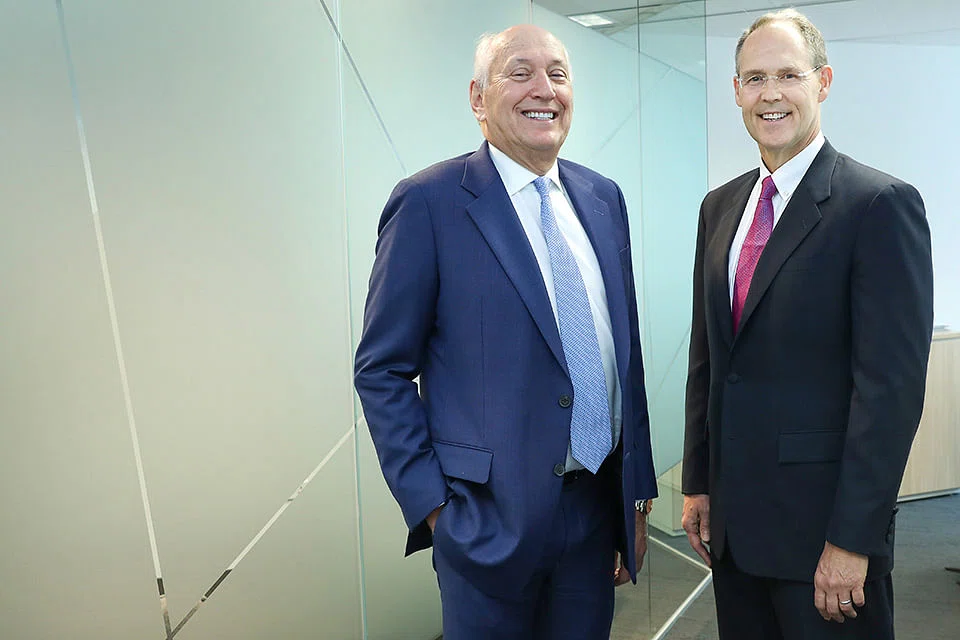
But David Goss, managing director of UOB Global Capital, one of the two owners of the Reit sponsor, does not blame the Reit's bad timing, saying in an interview on Thursday morning: "We are not market timers, but long-term players."
His partner, James Hanson II, president and chief of The Hampshire Companies, which is the other party that owns the remaining 50 per cent of the sponsor, quips that they are "celebrating" instead. "We have been working on this portfolio that we acquired together over a considerable number of years." To him, listing is already a milestone.
United Hampshire US Reit is Asia's first grocery-anchored retail and self-storage Reit. Its decline on its debut began from the very start, with the Reit falling 10 per cent to US$0.72 when it opened for trading after lunchtime. In all, 12.1 million units changed hands.
For measure, the Straits Times Index fell 3.8 per cent to 2,678.64, while the iEdge S-Reit Index ended 5.7 per cent lower at 1,336.61.
The Reit raised gross proceeds of about US$394.6 million in its IPO, with the Singapore public offer 1.4 times subscribed and the international placement 3.4 times subscribed.
Both partners are looking forward to growing the Reit. "We have been focusing our energy to get the listing done, and now we turn our attention to building the pipeline. We want to do it at a measured pace. It's got to fit our criteria," Mr Hanson said.
He noted that with a leverage of about 37 per cent, the Reit has debt headroom to acquire more assets. The capitalisation rate for US grocery-anchored shopping centres at 7 per cent or so is also favourable and accretive to its distribution per unit, to meet its projected yield of 7.4 per cent for 2020 and 7.6 per cent for 2021.
The partnership between UOB Global Capital and The Hampshire Companies began over a decade ago - oddly, in similar circumstances to the yield-starved environment today. The market was recovering from the global financial crisis then, with the threat of a recession still hanging over it. Their decision at the time to invest in grocery-anchored shopping centres and self-storage facilities was inspired by their defensive nature amid the recessionary environment.
"One of the reasons is because it's needs-based. In good and bad times, you have to eat. And typically in a recession, when people are downsizing, they use self storage," Mr Hanson said. The long weighted average lease expiries of the assets are an added bonus.
"Typical lease terms for grocery stores are 20 years, and there are no termination rights . . . Typically, grocery stores tend to have another 20 or even 40 years worth of option to extend," he says. This is because of the symbiotic relationship between the grocer as an anchor tenant which depends on the location of the centre for its business, and the landlord who wants the security of a long-term lease to get long-term financing.
The sponsor acquires most of its retail space, while developing its own self-storage facilities because of the "aggressive pricing" for existing portfolios. For the former, it tends to consider "high barrier entry markets" where there is no greenfield for development, with competition already present.
The sponsor does not have a clear right of first refusal (ROFR) policy for its Reit to ensure a steady pipeline for acquisition because there are other parties invested in their existing assets whose approval they require before they can sell. Still, Mr Hanson assured: "From this moment forward, every grocery-anchored space that we source for (from the open market) is going to the Reit."
As for the four self-storage facilities seeded in the Reit's initial portfolio, they were sold after approval was obtained from the existing investors. The Hampshire Companies has 17 other self-storage facilities and he expects that "some or a major portion of that will, on exit, come into the Reit, subject to the board's approval".
"In addition, for any acquisition in future, we'd have a ROFR . . . We have two in the pipeline that would be potential ROFR (deals)."
Mr Hanson believes that the Reit's two asset classes will hold value better than others, and impress with good returns in the low-yield environment.
"When you see the US 10-year Treasury yields at below 1 per cent, I remember that when I got into the business in 1983, it was 16 per cent. Right now, obviously fear is gripping the markets . . . With the coronavirus, people are starting to ask where they can find yield. We believe that these are haven assets."