Unmanned stores one way to beat retail manpower crunch
Three solutions unveiled at Singapore Retail Industry Conference and Exhibition 2019 show how this can be achieved
Singapore
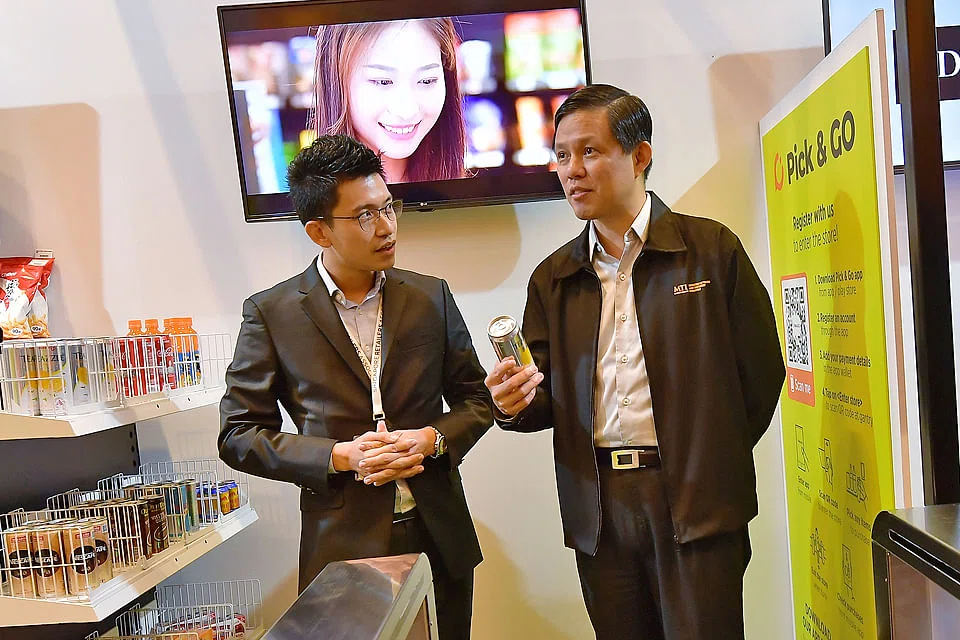
SINGAPORE retailers must evolve and adopt technology solutions to compete effectively in a difficult economic environment; and unmanned store concepts are one way in which some local enterprises are doing just that, said Minister for Trade and Industry Chan Chun Sing on Friday.
Speaking at the Singapore Retail Industry Conference and Exhibition (SRIC.E) 2019, Mr Chan said he was encouraged that the solutions unveiled at the exhibition by three local retailers show how the industry is "not just wallowing in all the difficulties" but instead re-inventing itself.
"Even in difficult times, and perhaps more so in difficult times, we are still constantly innovating and trying out new solutions. That gives me confidence that this sector will be in good shape," he said.
In all three solutions, customers have to set up accounts and scan Quick Response (QR) codes or their palms (at Octobox) to enter the store.
Two of the unmanned store solutions employ radio-frequency identification (RFID) tagging. Items are scanned instantly when placed in a payment kiosk at OMO Store, or when customers enter a checkout room or area at Octobox.
Customers do not even have to go through a checkout process at Pick & Go. A system of artificial intelligence (AI), cameras and customised smart shelves tracks their movements around the store and notes the items that they pick up. Once they exit the store, those items are automatically charged to their accounts.
Toh Hong Aik, managing director of OMO Store, said operational costs will be reduced by about 15 per cent as scanning the RFID tags reduces stock-taking time, and the stores can operate around the clock.
Mr Toh, who is also managing director of the Umart mini-mart chain, said more OMO Stores will be opened progressively, but the decision to convert any existing Umart stores to unmanned stores will lie with the current franchisees.
Pick & Go director Alex Ng shared that its technology originates from one of the startup's partners in China, where such solutions are already widely used. "As the economy progresses and changes, we are looking for more efficiency especially as the labour market is pretty tight and ageing as well. We want to bring in retraining to have the workforce focus on higher-value work."
Octobox is making the most of its solution by incorporating it into smart kiosks, which are designed like fridges rather than vending machines, and can stock even fragile items like eggs. These can be deployed in places where stores might not be suitable, and unlocked using palm scans as well.
"For kiosks, we are looking at easily 500 to 1,000 deployed around Singapore by next year," said Octobox executive director Ng Kiat Seng. "They need not stock just food or snacks, but can be adjusted for stationery and personal care items."
Alan Yeo, director for the retail and design division at Enterprise Singapore, said: "While convenience store operators are leading the adoption of the unmanned store format, we see potential for such retail formats to be successfully adopted by retailers. Enterprise Singapore will continue supporting retailers to adopt such new retail formats, allowing the creation of more immersive and differentiated retail experiences for customers."