UOB expects fee income to be bright spot as loans stay muted, costs catch up


Michelle Zhu &
Tan Nai Lun
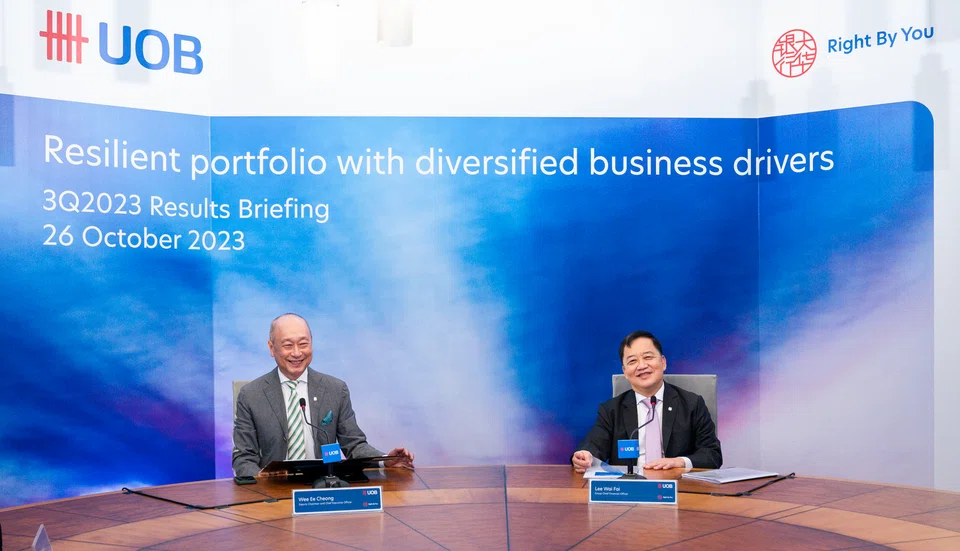
FEE income will be a bright spot for UOB ahead as the bank expects loans to stay muted while costs continue to catch up.
UOB is guiding a double-digit fee growth for 2024, compared to the high single-digit growth guidance for 2023, underscoring confidence in its fees business.
Meanwhile, it expects to see a mid single-digit loan growth in 2024, and for credit costs to hover around 25 to 30 basis points, said UOB deputy chairman and chief executive Wee Ee Cheong on Thursday (Oct 26).
On Thursday, the lender reported net profit of S$1.38 billion for the third quarter ended September.
This is down 1 per cent from S$1.4 billion a year earlier, after accounting for one-off expenses related to its acquisition of Citigroup’s Malaysia, Thailand and Vietnam consumer banking business.
Notwithstanding the one-off expenses, core net profit was S$1.5 billion or 5 per cent higher, in line with Bloomberg consensus estimates.
Wee expects the bank’s strong balance sheets and diversified revenue drivers to help smoothen the bumpy operating environment ahead.
He noted that the bank has invested heavily – S$800 million over the past eight years – to build its regional payments, trade and cash networks; and it has started to see results from its investments.
“Five years ago, UOB depended a lot on loan growth. But today, given our investments to build our capabilities, fee income has become very important… We don’t just focus on one single loan (segment),” he said.
In Q3, net interest income was up 9 per cent on the year to S$2.4 billion, from S$2.2 billion previously. It was relatively unchanged from Q2, as the wider loan margin was offset by lower margins on excess funds deployed.
Net interest margin (NIM) rose to 2.09 per cent, up 14 basis points from the previous year, though moderating from Q2’s NIM of 2.12 per cent.
Meanwhile, net fee income for Q3 rose 14 per cent on the year to S$591 million from S$519 million previously.
This was led by strong loan-related fees and credit card fees, of which the latter hit a new record at S$104 million.
Customer confidence in the Asean region remains upbeat, evident from record credit card fees, said group chief financial officer Lee Wai Fai.
He noted that the acquired Citi portfolio, being strong in unsecured lending, had boosted UOB’s retail business and allowed it to broaden lifestyle offerings.
Wee cited examples such as the bank becoming an official partner for pop stars Taylor Swift and Ed Sheeran, for the South-east Asian legs of their respective world tours.
“As a result of (the regional expansion), you can see there are many international marketing agents approaching us to capture our customer base… This is something that I believe we have a competitive advantage in, and that we should take advantage of,” Wee said.
Wee is “not overly concerned” about loan growth, given that margins are market driven, and good quality customers will likely pay more in a high interest rate environment.
But the lender is also taking some defensive steps to protect its balance sheets and liquidity to weather the uncertainty ahead.
“Prudent management is our hallmark. And we prefer to take a long-term view in all that,” Wee said.
For Q3, allowance for credit and other losses more than doubled to S$235 million from S$104 million in Q3 FY2022, as total credit cost on loans increased to 19 basis points on higher specific allowance, offset partially by the write-back of general allowance.
Nevertheless, Lee noted that the overall asset quality of the bank’s portfolio remains resilient.
Non-performing loans ratio stood at 1.6 per cent, up 0.1 percentage point from 1.5 per cent in Q3 FY2022, but unchanged from Q2 2023.
New non-performing assets formation also declined to S$267 million, from S$364 million a quarter ago.
UOB’s Common Equity Tier 1 ratio, which measures a bank’s core equity capital compared with its total risk-weighted assets ratio, stood at 13 per cent.
This was up from 12.8 per cent in the same period a year earlier, but lower than the 13.6 per cent reported in the previous quarter.
Speaking on competition in the mortgage loans space, Lee said the bank will aim to remain relevant, although he will put priority on managing its cost of funding.
“We will remain disciplined, to make sure that I have the long-term stability of funding to match Casa (current and savings account) levels,” he said.
The bank’s current and savings accounts to fixed deposits ratio as at end-September stood at 48.2 per cent, down 1.6 percentage points from 49.8 per cent in the same period last year.
Including the one-off Citi integration costs, the bank’s cost-to-income ratio stood at 44.4 per cent as opposed to 42.6 per cent the previous year.
Wee said he expects the one-off Citi integration costs to “substantially roll off” to result in a stable cost-to-income ratio next year.
UOB is the first among the three local banks to report its Q3 financials this year. The counter was down 1.7 per cent or S$0.46 to S$27.26 as at the midday break on Thursday.