UOB expects overseas business to account for half of revenue by 2021
It plans to capture greater connectivity flows between Asean and Greater China, especially amid mounting trade tensions between the US and China
Singapore
UOB expects to have half of its revenue coming from outside Singapore by 2021, up from about 40 per cent currently, saying that the market may have underestimated the network potential from its Asean exposure.
The bank on Wednesday said it plans to capture greater connectivity flows between Asean and Greater China, especially amid mounting trade tensions between the US and China, with the bulk of its operating profit from outside Singapore already derived from operations in the Asean region and Greater China.
Return on equity (ROE) - a key measure of profitability against bank shareholders' investment - is expected to hit 13 per cent in three to five years, though trade tensions may create a "short-term disruption" to that target, UOB's group chief financial officer, Lee Wai Fai, told The Business Times at the sidelines of the bank's annual corporate day event. Its ROE reported in Q1 this year stood at 11.4 per cent.
"People have underestimated the network that we have," said Mr Lee, referring to UOB's Asean network, which remains the largest of the three Singapore banks.
He added that the bank is modest in its revenue growth projections, noting that margins might not expand as according to market expectations.
"This doesn't take in margin expansion. If it comes in, it'll be a pleasant surprise."
Cross-border market revenue potential in Asia is expected to hit around S$40 billion in 2020, UOB said. To add new business flows into South-east Asia is "very likely", given the escalation in global trade tensions, the bank said.
More businesses are also expected to diversify their supply chains into Asean, with local suppliers standing to benefit from that shift of orders into the region, said UOB.
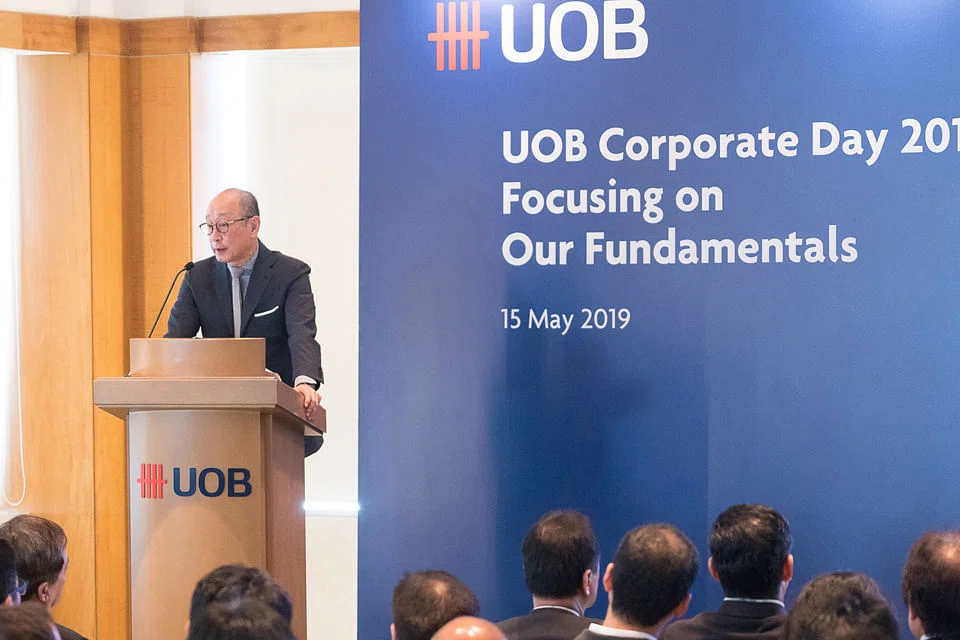
UOB's chief executive officer, Wee Ee Cheong, said in his keynote address that of all the group's operating profit derived from outside of Singapore, close to 80 per cent comes from the bank's operations in Asean and Greater China.
Mr Wee added: "We expect these numbers to go up as we strengthen our regional connectivity, collaborate in win-win partnerships to tap intra-regional flows and the region's rising affluence for growth."
Data from UOB showed that of the entire group's wholesale banking income, a quarter of that reflected cross-border income in 2018. This cross-border income amount is also up 15 per cent from 2017.
Mr Wee said that in 2018, the bank worked with more than 500 companies to "realise their expansion ambitions across the region through UOB's extensive network".
He also flagged risks on the back of rising global trade tensions and concerns over a synchronised global slowdown.
"In such an environment, it is even more important that we focus on the fundamentals and not lose sight of our main objective which is to continue to achieve long-term growth that is balanced with stability," he said.
"Throughout Asean, we are strengthening our capabilities across our network, broadening our impact by building ecosystems and helping our customers seize opportunities across the region. As we sharpen our customer-centric focus, we see a greater multiplier or network effect across our franchise."
The use of technology should also help to drive productivity higher, with cost-to-income ratio for the bank expected to hit about 42 per cent by 2021, said Mr Lee. The cost-to-income ratio now stands at about 44 per cent.