UOB hits a fresh high, with Singapore’s STI reaching yet another record
At the open, the counter edges up 1.3 per cent or S$0.50 to an all-time high of S$39.15

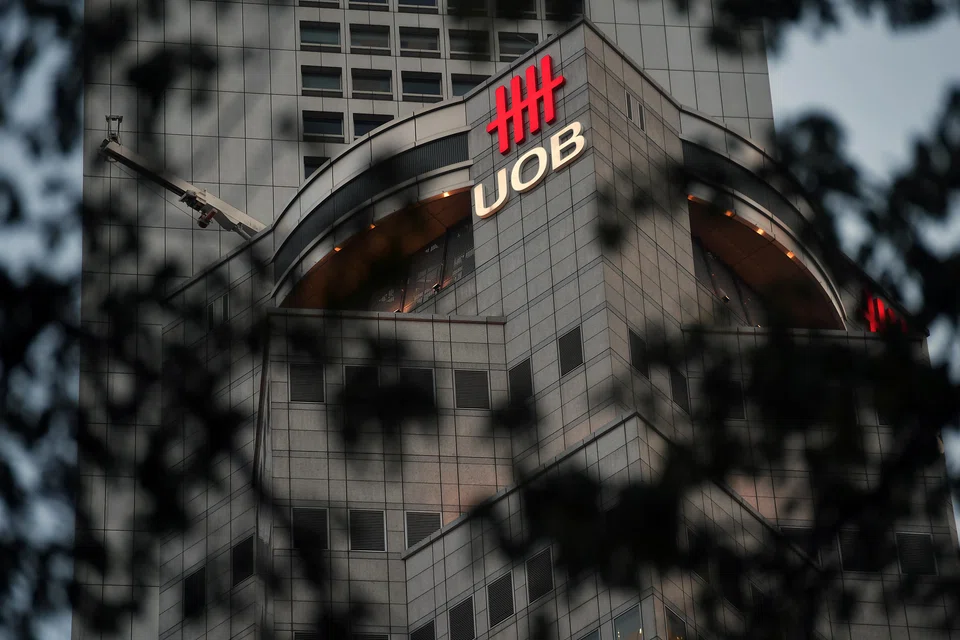
SHARES of UOB rose to a new high on Wednesday (Feb 19) morning, after it announced the establishment of a S$3 billion capital distribution package in tandem with its fourth-quarter results.
At the open, the counter edged up 1.3 per cent or S$0.50 to an all-time high of S$39.15.
Shares of UOB’s peers rose as well shortly after the market opened. As at 9.30 am, DBS was up 0.4 per cent or S$0.20 to S$46, and OCBC gained 0.6 per cent or S$0.10 to S$17.86.
As banks gained in the morning, Singapore’s Straits Times Index (STI) also broke through to a new record, trading as high as 3,943.23 just after the open.
Before the market opened on Wednesday, UOB posted a net profit of S$1.52 billion for Q4 ended December, up 8.6 per cent from S$1.4 billion in the previous corresponding period.
This included S$17 million in one-off expenses from the lender’s Citigroup integration costs after taxes, which was 81.9 per cent lower than the S$94 million recorded in the same period the previous year.
The earnings beat the S$1.48 billion consensus forecast in a Bloomberg survey of six analysts.
The lender has proposed a higher final dividend of S$0.92 per share for the half-year period, from S$0.85 the year before. This brings the full-year dividend to S$1.80 per share, representing a payout ratio of about 50 per cent.
As part of the bank’s capital distribution strategy, the board has announced a S$3 billion package to distribute surplus capital over the next three years. The package comprises special dividends and share buybacks.
The special dividend of S$0.50 per share, which represents a payout of S$800 million of UOB’s surplus capital, will be issued over two tranches in 2025.
UOB will introduce a S$2 billion share buyback programme, where shares will be acquired from the open market and cancelled.
The package is estimated to optimise UOB group’s Common Equity Tier 1 capital adequacy ratio by one percentage point, based on its capital position as at Dec 31, 2024. UOB’s Common Equity Tier 1 capital adequacy ratio stood at 15.5 per cent in Q4.
STI rises to new high
JPMorgan analysts have upgraded Singapore equities to “overweight” in Asean and Asia, excluding Japan.
Their new rating was driven by inexpensive valuation, lower volatility compared to its regional peers, decent earnings expansion, high dividend yields, government initiatives to revive the local bourse, monetary policy easing, as well as a stable currency.
They expect STI to hit 4,200, which implies a 6.5 per cent upside from its Wednesday morning high.
“Even at 4,200, the STI still offers 4.5 per cent dividend yield (consensus estimate), which is higher than most Asia ex-Japan markets,” said the analysts.
The analysts also continue to prefer banks and industrial stocks while staying selective in real estate investment trusts (Reit).
Their top picks are DBS, UOB, Singapore Technologies Engineering, Singtel, CapitaLand Integrated Commercial Trust (CICT) and Keppel DC Reit.
The analysts believe that initiatives and policies announced in Budget 2025 on Tuesday will be a positive for property, as no new cooling measures were announced and tax concessions were extended and enhanced for Singapore Reits (S-Reit).
The government has extended the tax exemption on S-Reit qualifying foreign income and concessionary withholding tax of 10 per cent to 2030 from 2025.
Tax transparency treatment will also be expanded to co-location and co-working income from July 2025. Extensions were also granted for tax concessions on Reit exchange-traded funds, as well as for goods and services tax remissions for S-Reits.
“We expect the extension of tax concessions to continue to enhance the attractiveness of Singapore as a regional Reit listing hub,” they said.
The analysts also believe that CapitaLand Ascendas Reit’s (Clar) existing research and development (R&D) facilities in one-north will be enhanced.
This comes amid the government’s S$1 billion injection for a new national semiconductor R&D fabrication facility, as well as a refresh of the city-state’s public biosciences and medical technology research infrastructures in one-north.
Retail landlords such as Frasers Centrepoint Trust and CICT should also benefit from increased supermarket spending, thanks to the SG60 and Community Development Council vouchers, they added.
Meanwhile, Macquarie Equity Research’s top picks are DBS, UOB, Singtel, Clar, Seatrium, ComfortDelGro, DFI and Keppel DC Reit. The analysts also see an 11 per cent upside to their year-end 4,000 STI target.
They believe that retailers such as DFI and Sheng Siong will benefit from the additional household support.
The analysts are also positive on Sembcorp Industries’ role in the development of Singapore’s energy sector.
In his Budget speech, Finance Minister Lawrence Wong said the government will proactively study the potential development of nuclear power in Singapore, and take further steps to systematically build up its capabilities in the area.
Macquarie analysts, therefore, think Sembcorp could “champion nuclear operating capabilities”, which aligns with the company’s strategy to grow its clean energy business.
ComfortDelGro is also a stock to watch, noted Macquarie analysts, as they believe the companies’ electric charging business could benefit from the government’s more-than-S$60 billion injection to expand rail network.
This is likely to present more rail tender opportunities for incumbents like ComfortDelGro, said the analysts.