Share buybacks, more dividends among options to deploy capital: UOB chief Wee Ee Cheong
The bank is open to investing it in growth, or returning it to shareholders through share buybacks or more dividends, he says

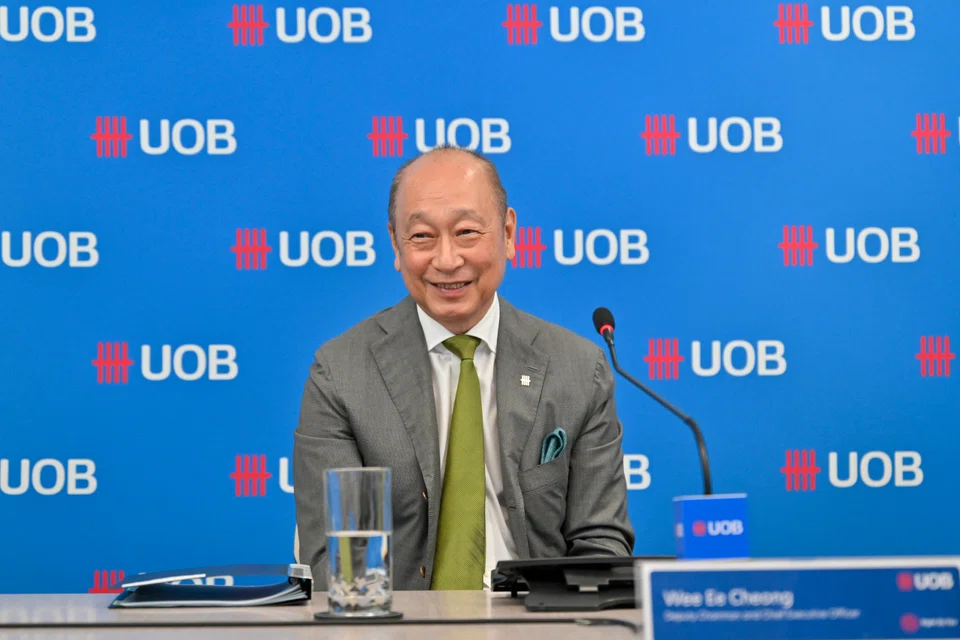
UOB is actively looking to manage its capital, and hopes it can find ways to take “full advantage” of the excess by the end of this year, its chief executive Wee Ee Cheong said on Friday (Nov 8).
With around S$2 billion to S$2.5 billion in excess capital from Basel IV reforms, the bank is open to investing it in growth, or returning it to shareholders, whether through share buybacks or more dividends, he said at a briefing for UOB’s third-quarter 2024 results.
Chief financial officer Lee Wai Fai said: “We’re looking at all options, because if we can’t utilise the capital for growth, we have to find some way to return it to shareholders.”
UOB’s Common Equity Tier-1 (CET-1) ratio stood at 15.5 per cent as at end-September 2024, up from 13.4 per cent as at end-June, as a result of changes to international standards for bank capital requirements under Basel IV. Fully loaded, the CET-1 ratio would be 15.2 per cent.
Lee noted that the lender has “always been comfortable” about the ratio being in the 13.5 to 14 per cent range. To use the excess, it has to consider the different views of its wide range of shareholders.
“This is something that is still premature to discuss… But we are in a good position to talk,” Wee said.
Beating forecast
On Friday, UOB reported a 16 per cent rise in Q3 net profit to S$1.61 billion, from S$1.38 billion a year earlier.
The record quarterly net profit beat the S$1.51 billion consensus forecast among four analysts polled by Bloomberg.
The results were driven by record highs in net fee income and trading and investment income.
Wee noted strong momentum across Asean – healthy demand across sectors and geographies boosted UOB’s loan books, driven by Asean’s role as a trade hub and related trade financing opportunities from the digital economy.
Following US rate cuts in September, there were positive consumer sentiments in the lender’s Asean markets, he added.
Net fee income for the quarter rose 7 per cent on year to a record S$630 million, driven by growth in wealth management fees. The group observed healthy trade and wealth demand, on top of a pick-up in card fees.
The lender’s Q3 assets under management rose 9 per cent on the year to S$185 billion, and added around S$4 billion in net new money inflows in the quarter, Lee said.
He noted that a bulk of the growth is in the consumer space, and not private banking. Flows were also more focused in Asean than North Asia.
“The consumer space of our Asean franchise is very strong, and this also gives testimony to the cross-sell that we are trying to do in the region,” he said.
“So we are quite hopeful of the momentum that’s coming out of the Asean region,” he added.
Trading and investment income rose 82 per cent to S$709 million, bringing other non-interest income up 70 per cent to S$744 million.
This came as customer flow treasury income reached an all-time high in addition to “exceptional” performance from trading and liquidity management activities, said the group.
Meanwhile, net interest income for the quarter grew 1 per cent to S$2.46 billion from S$2.43 billion in the year before.
Net interest margin (NIM) was down four basis points on year, but stable on quarter at 2.05 per cent, as loan margin widened on proactive deposit cost management.
Speaking about the impact of the US elections and movement of the US 10-year Treasury yields, Lee said the bank has to keep watch as it is “still early days in the US”.
The lender has reduced its sensitivity to rate movements in anticipation of rate cuts, although it will still benefit if cuts were not as deep.
“The market has always moved ahead of the economy, and for all you know, it will come back next month. So we can’t use the market, but we are watching that,” he said.
Nevertheless, given that the yields are attractive, the lender has started to extend some of its books, especially in the liquid-asset portfolio, to capture opportunities.
Wee noted that stability is a key area for UOB, and that it would still benefit when interest rates are down, as loan growth will pick up thereafter.
Gross customer loans grew 5 per cent on year to S$334 billion in Q3, amid broad-based wholesale growth and mortgages.
As for asset quality, Wee said the lender remains resilient, with the non-performing loan ratio unchanged at 1.5 per cent.
While there was new individual non-performing asset formation in the quarter, largely due to UOB’s retail operations in Thailand, recoveries and write-offs more than offset that.
Wee noted that the delinquencies in its Thailand unsecured book have peaked and are normalising, with the business intact and revenues picking up.
Outlook
Wee is forecasting higher total income for 2025.
This includes loan growth in the high single digits, and double-digit fee growth led by cards, wealth, trade and loan-related fees.
He also expects the cost-to-income ratio to be between 41 and 42 per cent, and total credit cost at 25 to 30 basis points.
“Globally, there are renewed uncertainties, and we are watching developments closely. As an Asean focus player, we see the region being resilient,” Wee said.
Shares of UOB were up 7.5 per cent or S$2.50 at S$35.80 at the midday break on Friday.