

UOB plans to move some back, middle-office functions to Malaysia; aims to sustain ROE at 14% by 2026
Laying out the bank’s medium-term goals by 2026, group CFO Lee Wai Fai expects more contributions from around Asean

[KUALA LUMPUR] UOB will move some of its back and middle-office functions to Malaysia, mainly in capital city Kuala Lumpur (KL), as it looks to maintain its cost-to-income ratio at 40 per cent by 2026, said group chief financial officer Lee Wai Fai.
This will help the lender sustain its return on equity (ROE) at around 14 per cent by 2026, together with increased contributions from around Asean and a higher mix of non-interest income, he said.
“Our first phase of offshoring will continue to be in KL, as it has a good hinterland of people that can supply the quality of staff that we want,” said Lee at the lender’s corporate day event in KL on Wednesday (Aug 14).
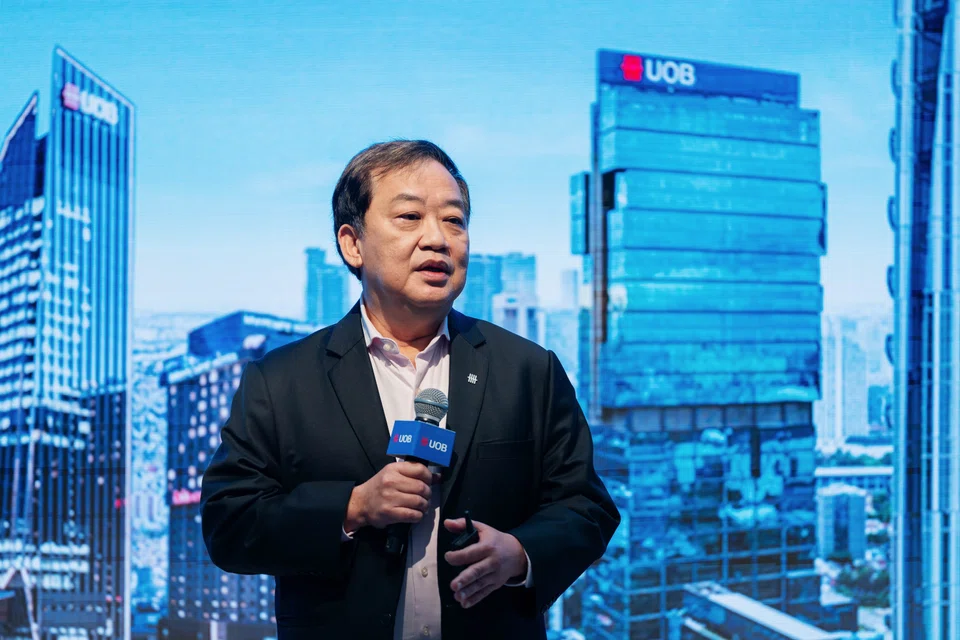
UOB’s corporate day was held in Malaysia for the first time since 2014, with investors, analysts and regional media in attendance. Speakers for 2024’s event included chief executive Wee Ee Cheong, Lee, as well as younger management staff across its wholesale and retail banking and tech pillars.
Offshoring is always an option because of the high cost in Singapore, although the lender is also mindful of the quality of labour supply, Lee said.
He noted that the lender has already started offshoring its operations some years ago, and it will accelerate the move, which includes centralising its card centres.
It will also look at other areas, such as compliance, where UOB can create models in Singapore and be run out of KL for operational efficiencies.
But Lee noted that restructuring the organisation and improving the efficiency of its business processes are equally important.
This means investing in people and technology, as the cost mix shifts from staff towards tech, he said.
Laying out the bank’s medium-term goals by 2026, Lee expects more contributions from around Asean.
He expects income from UOB’s businesses in four key markets – Indonesia, Malaysia, Thailand and Vietnam – to reach 30 per cent, from 26 per cent in 2023, while the bank also maintains at least 50 per cent of its income from Singapore.
He also expects non-interest income to contribute 37 per cent of income by 2026, from 2023’s 31 per cent, amid its growth engines in wealth, trade and customer treasury.
Lee said the bank’s wholesale business is pivoting towards trade, cash management and treasury, as it captures connectivity flows and enhanced product platforms.
He expects to see trade loans double, with loans contributed by its business in the four Asean markets reaching around 20 per cent by 2026, from 14 per cent in 2023.
Income contributed by these markets should rise to 25 per cent from 21 per cent as well.
Lee is also forecasting a high single-digit growth in its current and savings account (Casa) balance from 2023 to 2026, with support from cost-efficient Casa funding amid the current rate environment.
Meanwhile, Lee noted that UOB’s retail business – enlarged by its acquisition of Citi’s retail franchise in the four Asean markets – is able to capture rising wealth in the region.
He predicts around 40 per cent of the retail income will come from the four Asean markets by 2026, from 33 per cent in 2023.
Retail Casa ratio should also rise to more than 55 per cent from 47 per cent, while 50 per cent of retail income will be driven by wealth and cards by 2026.
Lee also expects to double assets under management (AUM) of private banking customers.
UOB’s AUM stood at S$176 billion as at the end of 2023, of which around S$88 billion is from private-banking customers.
Citi acquisition
Speaking on the Citi portfolio that UOB bought, Lee said the acquisition accelerates its moves to scale up regionally – it would have taken the lender “anywhere within five to 10 years” if they were done organically.
UOB is looking to serve around 10 million retail customers from around the region in the next three years, boosted by the acquisition. It currently has around eight million customers.
Noting changes in interest rate expectations, Lee said the gradual decline in rates is beneficial for commercial banks such as UOB.
UOB assumed 10 rate cuts by 2026, but Lee said the lender will watch recent market volatility and risks of US recession for any changes to the forecasts.
While margins may be affected slightly, it also reduces pressure on exchange rates in the region, especially for economics that have not hiked rates significantly, he said.
“Don’t forget, we are a commercial bank. Rate cuts and cycles are nothing new to us,” Lee said in his closing remarks for the event.
He expects margin pressures will be offset by growth in volume and fee activities – lower interest rates should support domestic activities, while the bank is also accelerating growth in its franchise in the areas of wealth, trade and treasury.
Lee noted that if rate cuts accelerate, it would mean a deep recession in the US, but added this view is unsupported by current economic data.
Meanwhile, Asean economies are still growing, he added.
“With rates normalising gradually, we believe that it is good for the economy, and we believe in the resilience of Asean.”
TRENDING NOW

ComfortDelGro appoints two new independent directors

Once staunchly pro-China, Malaysian Chinese businesses are now distancing themselves from Beijing

NoonTalk needs continued financial support from CEO Dasmond Koh, auditors warn

DP Architects sets the benchmark for sustainability disclosure and design

