UOB positive on net interest margin growth, posts 27% rise in Q2 profit

Tan Nai Lun &
Vivienne Tay
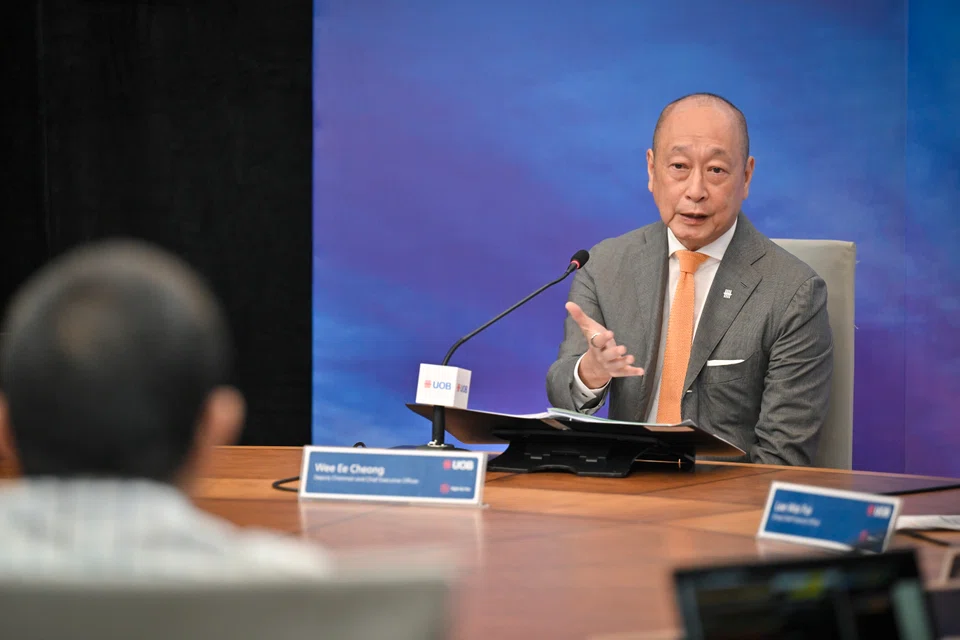
UOB is keeping a positive outlook on its net interest margin (NIM), particularly after the latest round of interest rate hikes by the US Federal Reserve, said group chief financial officer Lee Wai Fai.
NIM for the lender’s second quarter ended Jun 30 stood at 2.12 per cent, down from 2.14 per cent a quarter earlier. But Lee said this was because liquidity surplus was deployed into high quality, lower yielding assets.
In fact, its loan margin held up at 2.62 per cent, from 2.61 per cent last quarter, signalling some strength.
“We expect margins to stabilise in the short term, and maybe with some upward biasness with the Fed hike,” he said at a media briefing for UOB’s Q2 results on Thursday (Jul 27).
The lender posted a 27 per cent rise in its Q2 net profit to S$1.4 billion, from S$1.1 billion a year earlier, on higher net interest income (NII) and trading and investment income.
Excluding one-off expenses related to the integration of the retail portfolio it acquired from Citi, net profit would have been S$1.5 billion – 35 per cent higher on the year.
The earnings were in line with a S$1.4 billion consensus forecast in a Bloomberg survey of six analysts.
While the global growth outlook continues to be uncertain, the South-east Asia region will likely stay relatively resilient due to a more moderate rates environment, a pickup in tourism and supply chain diversification, said UOB chief executive Wee Ee Cheong.
“Companies and individuals are diversifying their assets overseas, including to Singapore, amid a flight to quality. I believe UOB is well positioned to capture some of these flows with our extensive regional footprint,” Wee said.
NII for the quarter was 31 per cent higher on the year at S$2.4 billion, as NII from loans grew by 26.6 per cent to S$2 billion.
Other non-interest income also rose 112.8 per cent to S$581 million, due to a rise in customer-related treasury income, and a stronger showing from trading and liquidity management activities.
Trading and investment income hit a new high, rising 123 per cent to S$478 million.
But net fee income was down 8 per cent to S$524 million, as loan and trade-related fees dropped due to a slowdown in lending activities.
Lee noted that loan growth momentum was hit in Q2, but he was hopeful of a stronger second half of 2023, although that will depend highly on the recovery of China, and the stability of the interest rates environment.
Wee added that he was “still very confident” in China in the medium and longer term, despite some short-term volatility amid weakness in consumer spending and business confidence.
Meanwhile, cautious investor sentiments had hampered a recovery in wealth fees, even as the declines were partially offset by an increase in card fees on the year.
Regardless, Lee was positive that the bank’s wealth segment will propel future growth, especially after a recent refocus. “Although we are behind the market, we are confident we will have a catch-up… In the next phase of growth, we are looking at our (wealth segment).”
UOB registered new net money inflows of S$12 billion for the quarter, bringing its total assets under management to S$165 billion.
Lee noted some inflows from a rising focus in family offices in Singapore, while new relationship managers in the bank are also bringing in more active clients.
Nevertheless, the lender lowered its guidance for its fee growth to a high single-digit, from a double-digit growth in its Q1 guidance.
While the growth in credit-card fees is good, Wee expects persistent uncertainty in the market and the bank’s philosophy of not pushing products on customers will weigh on its wealth segment.
He said: “If they don’t invest in products, wealth fees will come down. But as a long-term player, I’m happy with (that scenario), because the market is uncertain. The last thing I want is for my customers to invest and lose their money.”
Wee also highlighted that the bank’s current and savings account (Casa) levels held up on the quarter despite higher interest rates, with the Casa ratio stable at 47.6 per cent.
Meanwhile, total allowance on loans rose 37.6 per cent to S$238 million for the quarter.
General allowance was set aside pre-emptively to “maintain prudent provisioning level”, although Wee said there were no broader systemic concerns.
Specific allowances rose mainly due to a major Thailand corporate account.
As a result, total credit costs on loans for Q2 increased to 30 basis points (bps), from 25 bps in Q1.
Lee said the bank will stick to its credit cost guidance of around 25 bps for the rest of this year, however, as it brings it “back to normal” in the next two quarters.
In Q2, UOB maintained its non-performing loans ratio at 1.6 per cent, and its Common Equity Tier-1 ratio was also steady at 13.6 per cent.
The bank declared an interim dividend of S$0.85 per share for the first half of its financial year, which represents a payout ratio of 49 per cent.
Wee expects the one-time costs from its Citi acquisition will substantially roll off by the year-end.
He added that the bank will continue to keep a close watch on its asset quality in an increasingly uncertain market.
TRENDING NOW
Grab CEO’s wife Chloe Tong on life with Anthony Tan and finding her purpose
Stocks to watch: DBS, DFI Retail, Frasers Property, Clint, ESR-Reit, Centurion, Coliwoo
DFI Retail to bag US$340 million, Starbucks business in Asia in deal with Maxim’s Caterers
Green fuels, autonomous ships: How Singapore is future-proofing its shipping industry