

UOB positive on Asean despite pandemic; Q2 net profit up 43%
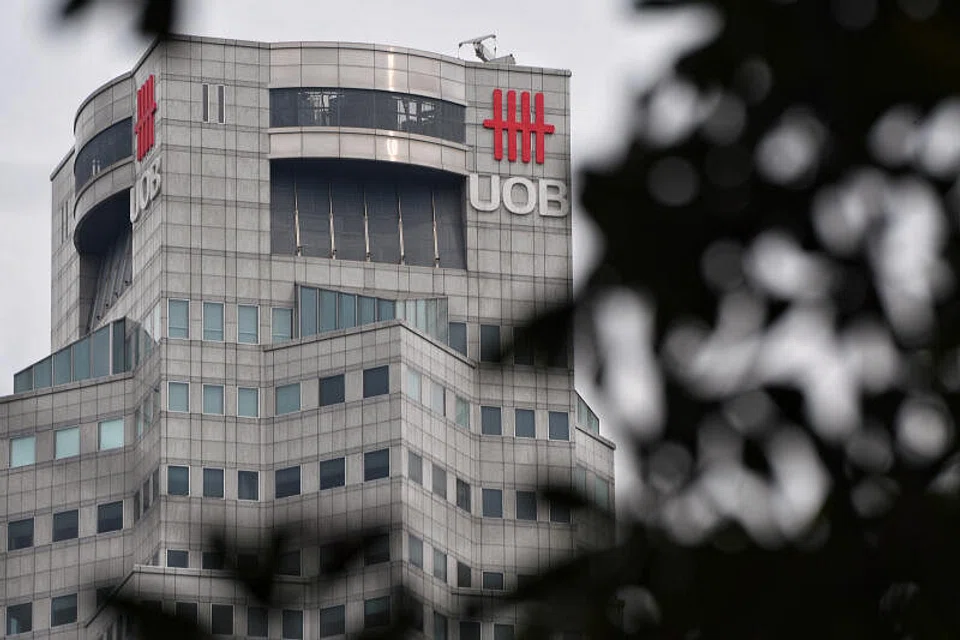
UOB struck a positive note on growth in Asean, even as the Covid-19 pandemic continues to ravage key markets, but stopped short of writing back provisions in line with global banks as uncertainties remain.
In its half-year results briefing, UOB's chief executive and deputy chairman Wee Ee Cheong told the media that with vaccination rates picking up in the region, there are "limited downsides, and more upsides now" for the bank. He added that UOB is still fairly optimistic for the next 12 months.
On Wednesday, UOB's net profit for its second quarter rose 43 per cent, as more economies reopened and as it posted lower credit allowance.
Following the lifting of dividend caps, the bank declared an interim dividend of 60 cents per ordinary share, up from 39 cents for the same period a year ago. This translates to a dividend payout ratio of 50 per cent, bringing it back to pre-pandemic levels. It is also higher compared with peer OCBC, which also released its second-quarter results on Wednesday. OCBC announced a payout ratio of 42 per cent.
MAS in late July this year lifted its dividend cap on locally-incorporated banks and finance companies based in Singapore. It joins other central banks that have recently eased dividend restrictions imposed on banks last year, as the global economy rebounds amid gradual re-openings and rapid vaccine rollouts.
UOB's dividend will be paid in cash on Aug 27, with the bank suspending its scrip dividend scheme.
Net profit for the three months ended June 30, 2021 stood at S$1.0 billion, compared with S$703 million from the year-ago period. The earnings beat the S$968 million consensus forecast in a Bloomberg survey of five analysts.
When asked by the media on what justifies the bank's optimism in Asean, Mr Wee said that it is due to a combination of reasons.
"First of all, this (Covid-19) is a health crisis, this is not an economic crisis," he said. "Secondly, I think the selection of customer base is equally important."
While he acknowledged that Asean is still in the thick of the crisis, he noted that the respective central banks and government relief programmes have helped ease the pain.
UOB has also stepped in to help customers with repayments, with a restructuring unit created within the bank for that very purpose.
In addition, the loan book in the region is "very well-collateralised", he added.
The bank revealed during the briefing that it has supported more than 20,000 SME customers either through restructuring of loans or through additional working capital in the region.
Loans under relief make up about 6 per cent of UOB's total loans, amounting to about S$17.5 billion. This is roughly the same as the previous quarter, which was at S$18 billion.
In comparison, chief financial officer Lee Wai Fai was more cautious on Asean, saying that there are worries whether the increasing Covid-19 cases in the region could drag down SMEs.
He flagged that of the 20,000 SME customers which the bank has supported, less than 2 per cent of them has turned bad.
However, Mr Lee is confident that the S$3 billion of general provisions that the bank has in its balance sheet is "more than adequate" should there be a delay in recovery in the region.
UOB's total allowance more than halved to S$182 million, as much of the pre-emptive general allowance was taken last year. The non-performing loan (NPL) ratio of 1.5 per cent was unchanged from the previous quarter, and below the 1.6 per cent NPL that was posted a year ago.
In the second quarter, growth was driven by both interest income and fee income.
Net interest income increased 8 per cent to S$1.58 billion, led by robust loan growth of 6 per cent and an 8-basis point increase in net interest margin to 1.56 per cent.
Net fee and commission income grew 34 per cent to S$595 million, driven by strong growth in wealth management, loan-related and fund management fees. Other non-interest income declined 32 per cent to S$243 million, mainly from a drop in non-customer-related gains.
During the briefing, Mr Wee said that the bank is keen to look at Citi's assets in the region that are up for sale, as long as it is within its risk appetite and if the "price is right". But when pressed to ask if the bank has put in a bid, CFO Mr Lee said that UOB is still in the process and that it is still too early to comment.
Citi had earlier said that it would exit 13 consumer markets, with many of them in Asia.
On developments in the digital assets space, Mr Wee said that the bank has set up a unit to look into this. But at the same time, while it is closely watching this space, he noted that there are many other initiatives that are of higher priority and that the bank wishes to be prudent.
"We should try to avoid some of these things, because they can be quite speculative in nature," he added.
Mr Lee elaborated that the bank is studying two key areas in digital assets that have a greater implication to banking itself, namely central bank digital currencies and the application of distributed ledger technology especially on cross-border trade.
Even with the bank's optimistic outlook, Mr Lee said that it is not the time to write back general provisions. This comes as Covid-19 and general economic conditions have not improved to the extent that he will consider doing so, he explained.
Furthermore, the Covid-19 crisis remains challenging in the Asean region, with economic recovery potentially coming in at a "lower pace" and towards next year, added Mr Lee.
For this year, the bank is maintaining its projections of high single-digit loan growth and double-digit growth in non-interest income. It also expects lower credit costs of below 25 basis points, on the back of improved credit quality.
Shares of UOB closed up S$0.46, or 1.78 per cent, to S$26.31 on Wednesday. DBS will report its second-quarter results on Thursday.
READ MORE:
TRENDING NOW

He built the Vingroup empire. Now South-east Asia’s richest man is handing some key roles to his sons
Quarter of Singtel special discounted shares sold ahead of CPF Board transfer

Why Tan Aik Keong of digital solutions specialist Agmo wants to make himself less indispensable

Asia needs new energy security architecture

