

UOB posts 1% lower Q3 net profit of S$1.4 billion on acquisition expenses

Michelle Zhu
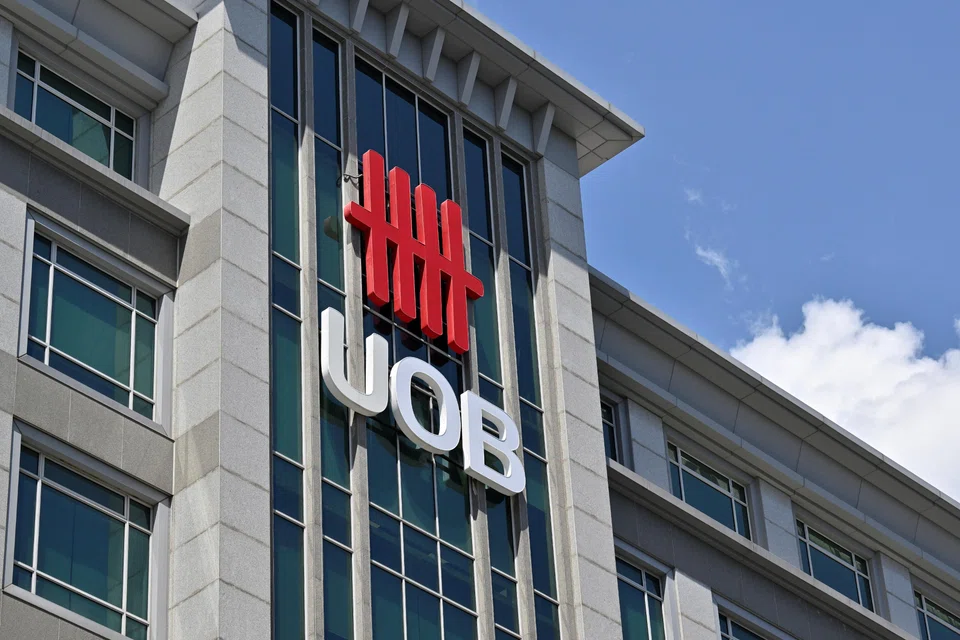
UOB reported net profit of S$1.38 billion for the third quarter ended September, down 1 per cent from S$1.4 billion in Q3 FY2022, after accounting for one-off expenses related to the acquisition of Citigroup’s Malaysia, Thailand and Vietnam consumer banking business. On Thursday (Oct 26), the bank said notwithstanding the one-off expenses, core net profit was S$1.5 billion or 5 per cent higher, in line with Bloomberg consensus estimates. Annualised earnings per share for the quarter stood at S$3.23, down from S$3.30 in the same period a year earlier. Net interest income was up 9 per cent on the year to S$2.4 billion from S$2.2 billion previously. Net interest margin (NIM) rose to 2.09 per cent, up 14 basis points from the previous year, though moderating from Q2’s NIM of 2.12 per cent.
Net fee income for the quarter rose 14 per cent on the year to S$591 million from S$519 million previously. This was led by strong loan-related fees and credit card fees, which the bank said hit a new record at S$104 million.
Allowance for credit and other losses more than doubled to S$235 million from S$104 million in Q3 FY2022, as total credit cost on loans increased to 19 basis points on higher specific allowance, offset partially by the write-back of general allowance.
The bank’s non-performing loans ratio stood at 1.6 per cent, up 0.1 percentage point from 1.5 per cent in Q3 FY2022.
UOB’s Common Equity Tier 1 ratio, which measures a bank’s core equity capital compared with its total risk-weighted assets ratio, stood at 13 per cent. This was up from 12.8 per cent in the same period a year earlier, but lower than the 13.6 per cent reported in the previous quarter.
The bank’s current and savings accounts to fixed deposits ratio as at end-September stood at 48.2 per cent, down 1.6 percentage points from 49.8 per cent in the same period last year.
Including the one-off Citi integration costs, the bank’s cost-to-income ratio stood at 44.4 per cent as opposed to 42.6 per cent the previous year.
UOB deputy chairman and chief executive Wee Ee Cheong said he expects the one-off Citi integration costs to “substantially roll off” to result in a stable cost-to-income ratio next year.
He also anticipates the bank to achieve mid-single-digit loan growth, as well as double-digit fee growth in 2024.


UOB is the first among the three local banks to report its Q3 financials this year. The counter ended Wednesday S$0.06 or 0.2 per cent higher at S$27.72.
Decoding Asia newsletter: your guide to navigating Asia in a new global order. Sign up here to get Decoding Asia newsletter. Delivered to your inbox. Free.
Copyright SPH Media. All rights reserved.






