UOB Q4 profit rises 48%; proposes S$0.60 final dividend


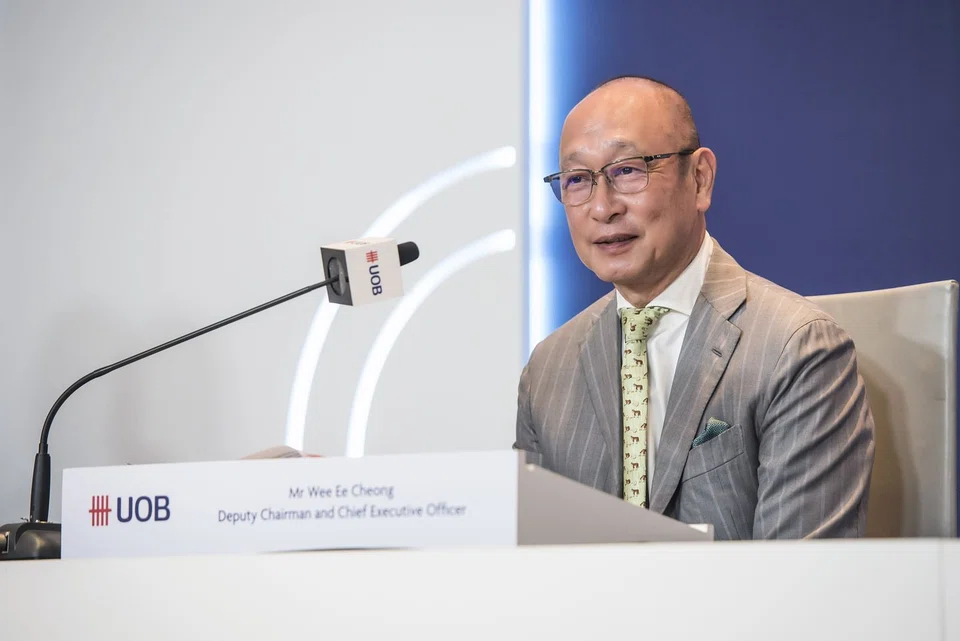
With UOB's U11 fourth quarter net profit up 48 per cent on strong loan growth and the bank logging record-high fee income for the year, its chief executive Wee Ee Cheong has sounded an optimistic note on the long-term potential of his bank's business in Asean.
"We believe the worst is behind us. In Singapore, we see market recovery and improving consumer sentiment. In South-east Asia, green shoots of recovery are strengthening," said Wee at a media conference following UOB's release of its quarterly and full-year results on Wednesday (Feb 16).
The bank also noted that impending interest rate hikes will likely bode well for earnings in the coming quarters. It believes that the rate increases will be gradual and that credit quality will not be significantly affected.
UOB's net profit for the 3 months ended Dec 31, 2021 stood at S$1.02 billion compared to S$688 million in Q4 FY2020, beating the average estimate of S$986 million based on 4 analysts polled by Refinitiv.
However, this was down 3 per cent from S$1.05 billion in the previous quarter due to lower trading and investment income despite higher margins and lower credit allowances.
Its board has recommended a final dividend of S$0.60. Together with an interim dividend of the same amount, this brings the total dividend for the fiscal year to S$1.20 per share, representing a payout ratio of about 49 per cent.
Net interest income for the quarter grew 11 per cent year on year to S$1.67 billion, led by loan growth of 10 per cent. The bank attributed to a stable net interest margin, which stood at 1.56 per cent - a marginal 1 basis point down from 1.57 per cent in the year-ago period. Net interest margin for Q4 held steady due to a low interest rate environment and proactive balance sheet management, UOB said.
Net fee and commission income came in at S$589 million, 13 per cent higher than that of Q4 FY2020 due to growth in loan-related fees and credit card fees. For the full-year, fee income rose to a record high of S$2.4 billion, up 21 per cent from FY2020. Loans and trade-related income surpassed S$1 billion for the first time.
Other non-interest income fell 22 per cent to S$168 million from S$214 million in the same period the previous year, mainly due to lower non-customer treasury income.
Chief financial officer Lee Wai Fai said the retail segment "did especially well", with assets under management and wealth management income at record levels, offsetting thinner margins. Wholesale growth was led by demand for financing advice, structuring and funding opportunities from large corporates.
UOB's sustainability financing portfolio reached S$17 billion in FY21. It has raised its target for the portfolio to S$30 billion by 2025, up from the initial S$15 billion by 2023.
Wee highlighted the timeliness of his bank's recent acquisition of Citigroup's consumer banking assets in Malaysia, Thailand, Indonesia and Vietnam, given that foreign direct investments surpassed pre-pandemic levels last year, with significant flows into Asean. Working with the Citi team will be a key focus for the bank in the coming months, he added.
In particular, the fee-generating businesses in Malaysia and Thailand should be able to bring in immediate benefits, he said. With the acquisition, which is still subject to regulatory approval, UOB will be the second and third largest card issuer in the Malaysian and Thai market, respectively.
When asked about the bank's stance on emerging blockchain technologies, Wee said UOB is working with the Monetary Authority of Singapore as well as several regional central banks on the possible use of CBDCs, or central bank digital currencies. The bank is also exploring the use of blockchain in trade finance and the supply chain, which it believes it has an edge in because of its regional cash management system. "The question is how to convince customers to be more active users," he said.
Where cryptocurrencies are concerned, the bank will continue monitoring the space, as it is "quite speculative", Wee said.
On whether rising rates could affect the upward trend of CASA (current account saving account) ratios, Lee said the bank believes CASA is "less rate sensitive" as the bulk of depositors would regard their accounts as primary accounts, even as some might withdraw funds for other investments to take advantage of the higher interest rates. "There might be 1 or 2 quarters of drag if we are not careful. But generally, (the impact of rising rates) is positive (for us)," he said.
Based on the bank's observations over the years, growth in its wealth business also does not "cannibalise" deposits, he added. UOB's CASA ratio rose to a new high of 56.2 per cent in the fourth quarter.
UOB's total allowance for Q4 fell 72 per cent on-year to S$112 million compared to S$396 million in Q4 FY2020, largely due to lower general allowance.
Non-performing loans ratio for the quarter stood at 1.6 per cent, unchanged year on year but rising marginally from the previous quarters. There are ongoing concerns on some countries that have extended their Covid-19 relief programmes, but the bank believes that the impact on credit costs and non-performing assets formation will not be significant, Lee said. "Our general allowance set aside is more than adequate to absorb the losses, should they materialise," he said.
For the coming year, UOB is expecting mid to high single-digit loan growth backed by a pipeline of corporate and institutional loans, as well as mortgages. It has guided for a 4 to 5 basis points upside in relation to margins, and double digit growth in non-interest income, driven by loan-related wealth and credit card fees.
It expects credit costs to normalise back to about 25 basis points and cost-to-income ratio to remain stable.
UOB shares ended Wednesday up 0.21 per cent or S$0.07 at S$32.75.
READ MORE:
- UOB snares Citi's consumer units in 4 Asean markets for almost S$5b, double retail base to 5.3m
- Brokers' take: Analysts largely positive on UOB's purchase of Citi assets
- Hot stock: UOB shares hit all-time high of S$32.86
- Hours-long UOB mobile app disruption fixed; breach ruled out, probe under way