

UOB sets sights on being No. 1 in cross-border trade needs in Asean

Tay Peck Gek
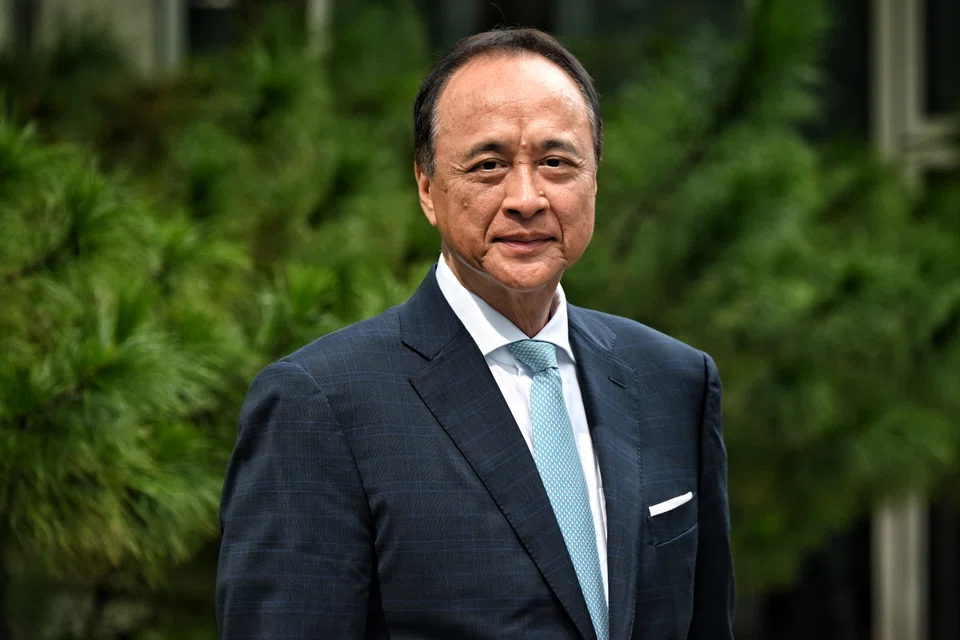
FREDERICK Chin, head of group wholesale and global markets at United Overseas Bank (UOB) is not afraid of competition from upstart digital financial platforms.
The 61-year-old banker told The Business Times that UOB has been approached by many platform operators about potential partnerships.
“They don’t have clients. They can’t commercialise because people don’t trust money with them. That’s why they keep approaching the bank (to ask): ‘Why don’t you partner with me?’” Chin said.
He is in no hurry to say yes.
“We are building a platform; we don’t need to partner,” Chin said.
UOB is investing about S$500 million to build regional platforms for cash management, supply chain management and payments, as it aims to be the No 1 bank for cross-border trade in South-east Asia. It is targeting S$7 billion in top line for its wholesale banking segment by 2025.
These targets follow a review conducted 6 years ago, Chin said, when the bank identified 3 trends to capitalise on: tighter regulations in the wake of the 2008 global financial crisis, technology disruptions from startups, and de-globalisation due to the strained trade relations between the United States and China.
As China replaces the US as the economic engine of South-east Asia, new opportunities will arise for UOB. China-Asean trade is valued at about US$650 billion and intra-Asean at US$650 billion, adding up to US$1.3 trillion, Chin said. Not to mention US$30 billion of projected foreign direct investment (FDI) into Asean, and another US$500 billion in trade for Asean with the US and Europe.
UOB intends to focus on 8 sectors driving about 70 per cent of Greater China and Asean FDI and trade flows: real estate and hospitality; technology, media and telecommunications; banks and non-bank financials; construction and infrastructure; consumer goods; healthcare; industrials; and oil, gas and chemicals.
It hopes to be among the top 3 players in each sector, and its platforms are expected to help it achieve that goal.
Platforms to establish an ecosystem
Over the last decade, the wholesale and global markets Chin oversees have doubled their revenues. Wholesale banking contributes 60 per cent of UOB’s annual revenue – or about S$6 billion – and global markets 10 per cent. The wholesale portfolio is evenly split between Singapore and overseas.
Retail banking accounts for some 30 per cent of revenue. UOB will maintain this mix to achieve a return on equity of 12-13 per cent, said Chin.
The wholesale banking segment offers clients loans, trade services, cash management, capital markets solutions, and advisory and treasury products, among others.
As for global markets, the unit sells a suite of treasury products and services across multiple asset classes – foreign exchange, interest rate swaps, commodities, equities and structured investment products, for instance – to help customers manage market risks and volatility.
UOB’s cash management platform, which helps companies handle cash needs for operations, is available in Malaysia, Singapore, Vietnam, mainland China and Hong Kong, with an Indonesia entry planned for later this year.
The platform gives the bank access to low-cost funds, from balances in the accounts, as well as fee income. This income is sticky, predictable and does not use much of the bank’s capital, said Chin.
The supply chain management platform replaces the long-time use of letters of credit among buyers, suppliers and distributors together. The bank takes care of issues related to payment and trust, while generating income from cash, trade, and foreign exchange services. This platform has been piloted in Hong Kong and Singapore.
The payment landscape has perhaps seen the most competition. UOB is establishing its own ecosystem to support domestic payment platforms that serve smaller-value transactions at lower costs.
“Yes, they will be disrupting a bit; they will pick some of the low-hanging fruit,” Chin said of the payment startups. Nevertheless, he is confident UOB has the upper hand, thanks to its trusted status.
Offering advisory services
UOB is also leveraging its FDI Advisory Unit that was established in 2011 to help foreign corporations setting up operations in the region. Working with investment agencies and trade bodies in various countries, as well as professional services providers, the unit helps foreign corporate investors navigate the different tax, accounting, legal and regulatory systems in the region.
“There are a lot of opportunities from mid-sized companies which are less familiar with this region. We clearly saw no Chinese banks (in this space). Even when they’re here, they’re not quite ready to serve their own clients,” Chin said.
Thanks to this unit, UOB gets to have the first look at a client’s operations and gains opportunities to cross-sell other offerings. The unit has 10 clusters in Asia, and has since helped over 3,500 companies invest into the region – half of them from China.
“The West has no issue buying our products (made) in this region. China has no issues buying our products either. So you have the best of both worlds. And Singapore provides a platform to connect the east and the west, and the east to the east,” Chin said.
In a survey of its clients, UOB found 80 per cent said they would use their factories in China to serve the domestic market while setting up capacity elsewhere for exports to the US.
But Asian suppliers are unlikely to set up plants in the US because of the very high costs involved, despite calls for re-shoring amid supply chain disruptions.
Vietnam is already benefiting from these trends, Chin said while pointing out that UOB is the only Singapore bank with a licence there.
Also, geopolitical tensions ratcheting up in North Asia would benefit Singapore. “We have already seen inquiries… So you will see Singapore will become increasingly important as a regional financial centre and procurement centre.”
Looking for the right partner
Chin is not averse to an eventual partnership, with the right entity: ”I have to be patient to make sure, if I can’t build (it) myself, I partner with the right person.”
He sees UOB as having the better position at the negotiating table because it already has customers, whereas its new rivals now realise that commercialising their offerings is not as straightforward. Meanwhile, their investors are losing patience and regulators are tightening the screws.
“That might give us an opportunity. People who have a platform, maybe with a good customer base but cannot provide the financing, might start talking to us more for potential partnership. And they are more realistic as to what to expect.
“We’ve been approached; I cannot disclose (by whom). Because of our regional footprint, people are seeing it’s easier to talk to 1 bank with a common platform with a common management, with a common thinking, to strike a long term partnership.”
He nevertheless sees his digital competitors as having “their role to play”. “I think it is very hard for them to get to the scale to compete with us. But in a way, I encourage it; because it keeps us on our toes,” he said. “They do change the market ecosystem.”
TRENDING NOW
Easy to rent out, hard to sell: Are buyers losing interest in Singapore’s one-bedroom condos?

GovTech retrenches another 38 staff in second round of layoffs

Stocks to watch: Seatrium, CapitaLand Investment, Keppel DC Reit, Suntec Reit, CLCT, TSH Resources

World’s largest offshore wind platform by Seatrium consortium on track to be completed by 2028

