

UOB’s Q2 earnings up 11% to S$1.1b; CEO Wee expects Asean economies to stay resilient

Vivienne Tay
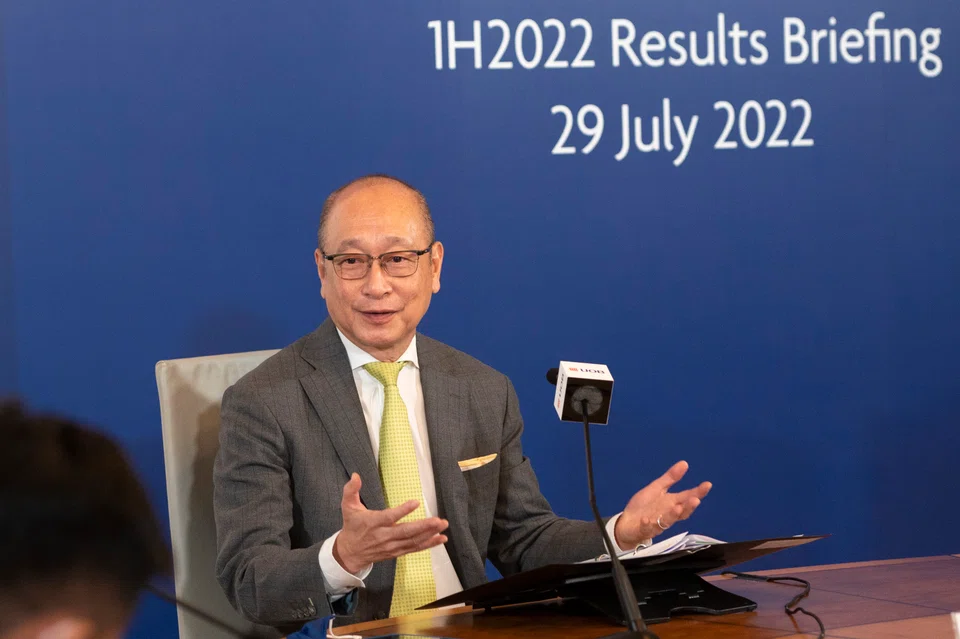
FEARS may be brewing over possible recessions in the United States and Europe, but UOB expects the Asean economies to be relatively resilient — especially the markets where the Singapore bank has a footprint.
It also expects its bottom line to benefit from the US Federal Reserve’s interest rate hikes, with higher contributions from net interest income able to more than offset any dip in wealth management fee income.
Chief executive Wee Ee Cheong stated at a media briefing following the release of the bank’s second-quarter financial results on Friday (Jul 29): “At UOB, our base case is we do not expect a recession in our key markets; though growth may slow.”
Wee said increases in interest rates would be manageable for borrowers, and added that Asean’s economic fundamentals including employment levels are still strong — with most countries being net exporters of commodities. Commodity prices have risen in recent times.
“I believe there will be a slight slowdown, but I don’t think it will be significant to affect us,” noted Wee, who is also the bank’s deputy chairman.
He guided for loan growth this year to be in the mid-single-digit percentages, and for fee growth at a low single-digit rate. The bank’s cost-to-income ratio is expected to be stable at about 45 per cent, and credit costs at 25 basis points for the 2022 financial year.
Chief financial officer Lee Wai Fai stated the bank expects net interest margin to further rise to about 1.9 per cent by the end of the year.
Hence, even if the stock market conditions remain volatile and keep some investors away, Lee expects the increase in interest income would be able to outstrip the drop in fee income.
UOB benefited from rising interest rates in the quarter to June. Earnings rose 11 per cent year on year to S$1.1 billion, on improved margins driven by higher-than-expected net interest income as well as trading and investment income recovery. Its earnings were in line with the consensus forecast in a Bloomberg survey of 4 analysts.
Net interest income for the quarter rose 18 per cent year on year to S$1.9 billion, from S$1.6 billion. Net interest margins rose 11 basis points to 1.67 per cent, while loans grew at a “healthy pace” of 8 per cent.
Net fee and commission income was 3 per cent lower, as record credit card and loan-related fees were more than offset by lower wealth and fund management fees. Other non-interest income was up 6 per cent on-year to S$273 million, from S$257 million in the year-ago period, due to higher customer-related treasury income.
Total allowances fell to S$137 million for the quarter on lower general allowances.
UOB’s overall non-performing loan ratio inched up to 1.7 per cent as of Q2 from 1.5 per cent a year ago, due to one large non-performing loan.
Lee also said a customer accounted for the lion’s share of UOB’s loan exposure in mainland China.
He did not disclose the customer’s identity, but Bloomberg reported on Jul 28 that UOB has sued Chinese property developer Shimao Group Holdings and 4 related entities for allegedly breaching loan and security agreements by reallocating loans and allotting shares among the entities without the Singapore lender’s consent.
UOB’s exposure to sectors of concern within the mainland Chinese market is about S$3 billion, or 1 per cent of its loan book.
UOB’s total credit costs stood at 22 basis points, up 2 basis points year on year, as of Q2.
In the 6 months to June, net profit was flat at S$2 billion. The bank saw strong net interest income growth with “stable credit allowance” during this period, but the growth was offset by lower gains from investment securities amid market volatilities.
The bank has declared an interim dividend of S$0.60 for the financial year, which represents a payout ratio of 50 per cent. It will be paid on Aug 22.
The common equity tier 1 (CET-1) ratio — which measures a bank’s core equity capital compared with its total risk-weighted assets ratio — stood at 13.1 per cent, or 1.1 percentage points lower year on year.
UOB was the first among the local banking trio to release their quarterly results. OCBC will report its earnings on Aug 3, and DBS on Aug 4.
UOB shares closed 2.5 per cent or S$0.71 lower at S$27.55 — in line with declines in the Straits Times Index and its 2 peers — on Friday.
TRENDING NOW

‘We don’t want to stay as we are’: CEO Patrick Ng builds a more resilient Huationg
URA to review guidelines on floor space to give developers more design flexibility: Chee Hong Tat

He built the Vingroup empire. Now South-east Asia’s richest man is handing some key roles to his sons

32 companies, 6 individuals bag accolades at Singapore Corporate Awards 2026

