US-dollar bonds winning larger share of Singapore's debt financing pie
More competitive credit spread in US bond market makes it cheaper for Singapore-listed entities to raise money

Singapore
LISTED companies in Singapore are increasingly tapping the US dollar (USD) bond market as they raise funds to strengthen their balance sheets amid the Covid-19 outbreak.
Companies commonly turn to debt capital markets to raise money in uncertain times, investor appetite permitting. The entities listed on the Singapore Exchange (SGX) have predominantly issued bonds denominated in Singapore dollars (SGD).
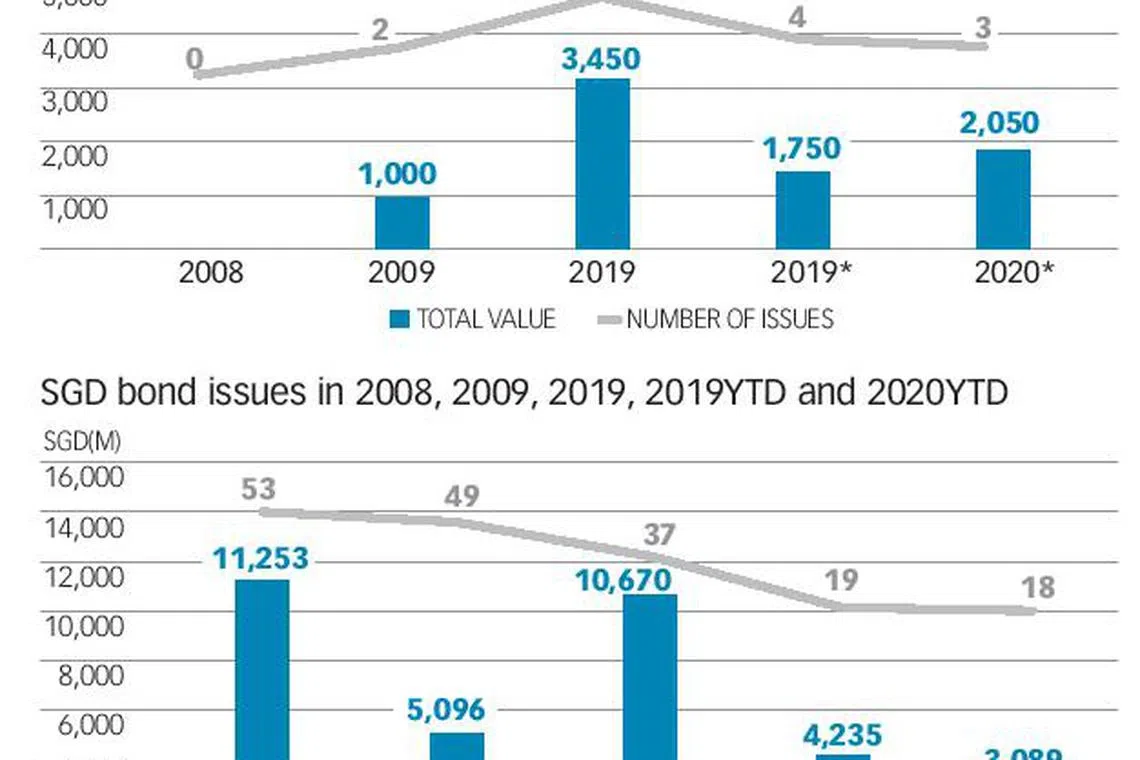
In 2008, when the global financial crisis (GFC) hit, SGX-listed companies and real estate investment trusts (Reits) completed 53 SGD bond issues to raise a total of S$11.3 billion, data from DBS and Bloomberg showed. The number of issues was still substantial in 2009 at 49, although the sum raised was lower at S$5.1 billion.
There were no USD bond issues by Singapore firms in 2008. This was because the primary market, affected by the GFC, was closed for a long period of time.
There were only two USD bond issues by SGX-listed firms in 2009, raising US$1 billion.
Since then, however, USD bond issues have gained traction among locally listed entities.
Last year, there were eight USD bond issues, raising US$3.5 billion, against 37 SGD bond issues, which raised S$10.7 billion. Although there were fewer USD issues, each issue was larger in size on average.
For the year to May, SGD bond issues have fallen in terms of numbers and amount raised. On the other hand, USD bond issues have increased in terms of value raised.
The first five months of this year saw 18 SGD bonds issued by Singapore listed companies and Reits, raising a total of S$3 billion. This was one issue fewer against the corresponding period last year, but the amount raised was about 27 per cent lower than the S$4.2 billion raised in the earlier period.
Clifford Lee, global head of fixed income at DBS Bank, attributed the poorer showing in the SGD bond market partially to the more attractive pricing in the USD bond market.
The difference in yield between US Treasury bonds and corporate bonds - also referred to as the credit spread - in the US bond market is more competitive, and has made it cheaper for Singapore-listed entities to raise money from USD bonds vis-a-vis SGD issues.
Credit spreads this year following the financial turmoil in March had widened from 2019 levels, both in the USD and the SGD bond markets. These spreads have begun to tighten again after Asian markets started reopening in April.
Kenneth Yeoh, head of bond origination for capital markets at OCBC Bank, noted that the five-year US Treasury is presently at 0.40 per cent versus about 1.6 per cent in January, while the five-year SGD swap offer rate (SOR) is at 0.68 per cent versus 1.5 per cent in January.
The narrower spread would motivate stronger investment-grade names to tap into the USD market even if they need SGD, Mr Lee said.
"They will definitely get cheaper funding in the US dollar bond market, even after you swapped it back to Singdollar," he said. "So, from a practical standpoint, it's not logical for them to tap the Singdollar market."
There were three bond issues by SGX-listed firms totalling about US$2 billion in the first five months of this year, compared with four issues worth US$1.8 billion for the corresponding period a year ago.
Edmund Leong, head of group investment banking at United Overseas Bank (UOB) told The Business Times that bond issuers, especially the rated ones, find the USD bond market attractive as they are able to achieve larger deal sizes.
For instance, DBS Group Holdings and ST Engineering issued US$1 billion and US$750 million worth of bonds respectively, in February and April. In comparison, the largest deal by SGX-listed issuer in the SGD bond market from January to May was worth S$500 million, by Singapore Press Holdings, which publishes BT.
OCBC's Mr Yeoh said there has been an improvement in bond market sentiment since April. He expects the issuance pipeline to continue to be active for the rest of the year, barring any further adverse developments in the Covid-19 situation and its economic impact.
UOB's Mr Leong also expects to see continued activity among listed companies tapping the SGD and USD bond markets, particularly for periods of more than five years, as interest rates remain low.
He added: "The majority of bond issuers were listed companies as they are favoured by fixed income investors, due to the availability of credit information on the firm."
DBS' Mr Lee, however, said that listed companies with strong names are still well supported by the banks. Unlike the GFC, which badly affected the financial sector, banks in Asia are well capitalised this time round.
By sector, Mr Lee said real estate companies make up a large number of SGX-listed issuers in the SGD bond market. Among those that have raised funds are GuocoLand, Oxley Holdings and Suntec Reit. Most of these deals were for refinancing, with just a small portion for acquisitions, he said.