

US dollar hovers near two-month low after jobs jolt; RBNZ boosts kiwi
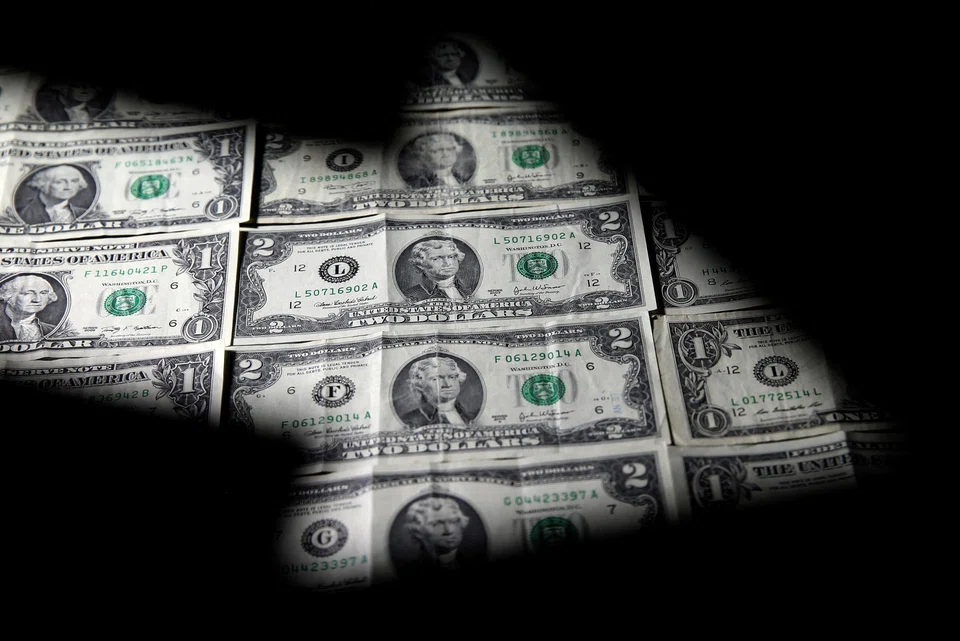
THE US dollar held near two-month low on Wednesday (Apr 5) after weak data supported the view that the Federal Reserve (Fed) may not need to raise rates much further, while the New Zealand dollar hit two-month highs after a larger-than-expected rate hike.
With the all-important US monthly employment report just two days away, activity across the market was a little more subdued than it has been in recent weeks.
On Wednesday, private sector employment data for March was due at 1215 GMT. The ADP National Employment report is expected to show private payrolls rose by 200,000 last March, while Friday’s broader non-farm payrolls are forecast to have risen by 240,000.
The Reserve Bank of New Zealand (RBNZ) unexpectedly raised interest rates by 50 basis points (bps) to a more than 14-year high of 5.25 per cent. In a Reuters poll, 22 of 24 economists had forecast just a 25 bps hike.
The kiwi rallied by as much as 1.1 per cent to a two-month high of US$0.6383 after the decision, before retreating. It was last down 0.2 per cent at US$0.62965.
“The outperformance of the kiwi overnight – the RBNZ never failing to surprise to the hawkish side – that really is the main theme, other than everything is trading in a range, which is what we’d expect a few days before a key US data release,” Adam Cole, chief currency strategist at RBC Capital Markets, said.
New Zealand now has the highest interest rates among the G10, surpassing both the US, where rates are at 4.75 per cent-5 per cent, and Canada, where they are at 4.50 per cent.
In theory, this creates an opportunity for traders to borrow in a low-yielding currency such as the yen to fund lending in a higher-yielder, a play known as “carry”, which could directly benefit the kiwi.
“We kind of like the idea that carry is coming into play a little bit going forward,” Cole said. “We’re seeing a degree of rate dispersion in the G10 that we haven’t seen since the financial crisis and more rate dispersion would mean carry should start to matter a bit more going forward,” he added.
As other central banks catch up with the Fed, the US dollar will most likely lose a lot of its interest-rate advantage over other currencies and weaken this year, according to a Reuters poll of foreign exchange strategists on Wednesday.
The US dollar index, which measures the performance of the US currency against six others, hit a two-month low of 101.43. It was last up 0.2 per cent at 101.74, having fallen 0.5 per cent the previous day.
Jolted by jobs
Data on Tuesday showed US job openings dropped to their lowest level in nearly two years in February, suggesting higher rates were starting to squeeze the labour market.
The monthly Job Openings and Labor Turnover Survey (Jolts) report showed job openings, a measure of labour demand, fell 632,000 to 9.9 million on the last day of February, below forecasts for a reading of 10.4 million.
“The Jolts data yesterday could be the first signs of weakness in the US labour market and that is huge,” Oanda strategist Craig Erlam said.
“Without it, the Fed will find it very hard to make the argument that it is pausing the tightening cycle. Now it needs to be backed up and the jobs report on Friday could start that process,” he added.
The US dollar has been on a steady decline since September, but in the last week, the pace has picked up. The US currency has fallen in 16 out of the last 25 trading sessions. Up days haven’t been outnumbered this consistently by down days in a five-week period since around July 2020, according to Refinitiv data.
Markets are now pricing in a 59 per cent chance of the Fed leaving rates unchanged at its next policy meeting in May, up from a 43 per cent chance a day earlier.
Cleveland Fed president Loretta Mester said on Tuesday the economy appears to be slowing, but the central bank likely has more room to raise rates.
Beyond the kiwi, other major currencies were a lot less volatile.
The euro was down 0.2 per cent at US$1.09385, below Tuesday’s two-month peak, while sterling eased 0.3 per cent to US$1.2495, having clocked a 10-month high the day before.
The US dollar headed for a third daily loss against the Japanese yen, falling 0.1 per cent to 131.70, while the Australian dollar fell 1.1 per cent to US$0.667, a day after the central bank left rates unchanged at 3.6 per cent following 10 straight hikes, saying it needed more time to assess the impact of past increases. REUTERS
Decoding Asia newsletter: your guide to navigating Asia in a new global order. Sign up here to get Decoding Asia newsletter. Delivered to your inbox. Free.
Share with us your feedback on BT's products and services
TRENDING NOW

World’s largest offshore wind platform by Seatrium consortium on track to be completed by 2028

Is stamp collecting enjoying an analogue revival or are its best days over?

GovTech retrenches another 38 staff in second round of layoffs

MBS adjusted property Ebitda falls 20.6% in Q3 with fewer high-roller visits, weaker hold

