

US dollar set for longest weekly winning streak since 2014, yuan plumbs 2007 low
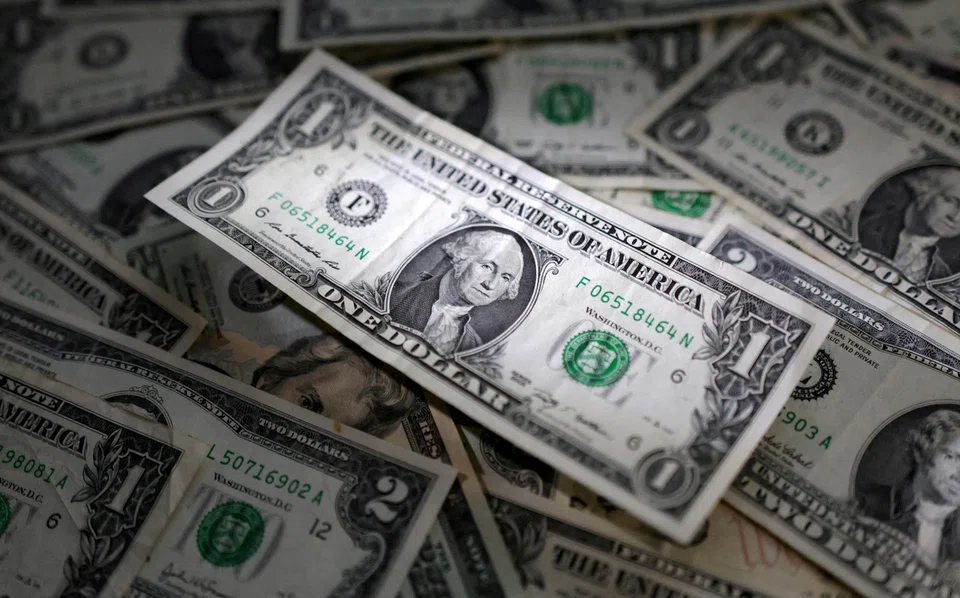
THE US dollar headed on Friday (Sep 8) for its longest weekly winning streak in nine years, bolstered by a resilient run of US economic data that has put the end of the Federal Reserve’s aggressive rate-increase cycle into question.
China’s onshore yuan meanwhile ended its domestic session at the weakest since 2007, as it battles capital outflow pressures and a widening yield gap with major economies.
The US dollar index, which measures the greenback against major peers, was last 0.05 per cent lower at 105 but remained not far from the previous session’s six-month high of 105.15.
The index was on track to extend its gains into an eighth straight week, and is up 0.7 per cent thus far.
The euro, the largest component in the US dollar index, was staring at eight straight weeks of losses, with the single currency last gaining 0.08 per cent to stand at US$1.0704, having fallen to a three-month low of US$1.0686 on Thursday.
“The relative divergence of the US and European economy is a key topic again and the weaker US dollar story has just faded away,” said Dane Cekov, senior macro and FX strategist at Nordea Markets.
Data out this week showed the US services sector unexpectedly gained steam in August and that jobless claims last week hit their lowest level since February, while in the eurozone, industrial production in Germany, Europe’s largest economy, fell by slightly more than expected in July.
“The US economic data is still robust and in Europe it’s flattening out. The US dollar usually does well when the US economy outperforms peers and at the moment the US is the bright spot,” said Nordea’s Cekov.
Sterling edged away from Thursday’s three-month low and last bought US$1.2480, though was still set to clock a weekly loss of more than 0.8 per cent.

The onshore yuan opened at 7.3400 per US dollar on Friday and touched its weakest level since December 2007 at 7.3510, while its offshore counterpart sank to a 10-month low of 7.3621 per US dollar.
China’s currency has depreciated steadily since February as the faltering post-pandemic economic recovery and widening yield gap with other economies, particularly the US, affected capital flows and trade.
The onshore yuan has fallen roughly 6 per cent against the US dollar so far this year and has become one of the worst-performing Asian currencies alongside its offshore counterpart.
“The travails of a stumbling (yuan) ... reveals the complexity and profusion of China’s underlying economic stress points amid confidence deficit,” said Vishnu Varathan, head of economics and strategy at Mizuho Bank.
The yuan’s rapid decline has prompted authorities to step in to slow the pace of its depreciation.
Also on trader radars was a struggling yen, which steadied at 147.39 per US dollar but remained on the weaker side of the key 145 level that prompted intervention by Japanese authorities last year.
Japanese Finance Minister Shunichi Suzuki said on Friday rapid currency moves were undesirable and that authorities wouldn’t rule out any options against excessive swings, in a fresh warning to investors trying to sell the yen.
The Bank of Japan is the only major central bank yet to raise interest rates in the current global tightening cycle, although analysts expect a move could come this year.
“It’s understandable why the Bank of Japan is moving in tiny steps after 30 years of very low rates,” Nordea’s Cekov said.
“If you rock the boat you may get undesired consequences and the yen is collateral damage from that perception.”
The Australian dollar was last 0.28 per cent higher at US$0.6395, but eyed a weekly loss of over 0.8 per cent.
The New Zealand dollar similarly was on track to lose roughly 0.5 per cent for the week and last bought US$0.5910. REUTERS
Decoding Asia newsletter: your guide to navigating Asia in a new global order. Sign up here to get Decoding Asia newsletter. Delivered to your inbox. Free.
Share with us your feedback on BT's products and services
TRENDING NOW

KKR founders among investors buying 42% of Peter Lim’s Valencia; club valued at US$1.4 billion

Singapore’s central gas buyer affirms Indonesia’s role as ‘important partner’ amid export review warning

Why the biggest business decision about AI isn’t which model to choose

NEA issues notices to 10 Singapore-based companies, including Wilmar and APP, over haze

