Fed’s rate cut brings ‘relief’ to Asian markets with STI hitting 17-year high, but long-term uncertainty under Trump remains
Observers expect volatility in the markets until there is greater clarity on the new president’s policies

THE latest rate cut by the US Federal Reserve is expected to bring “some relief” to Asian and Singapore equity markets, with upsides for the property and consumer sectors.
However, the longer-term outlook for markets in view of a Donald Trump presidency remains uncertain, said analysts on Friday (Nov 8).
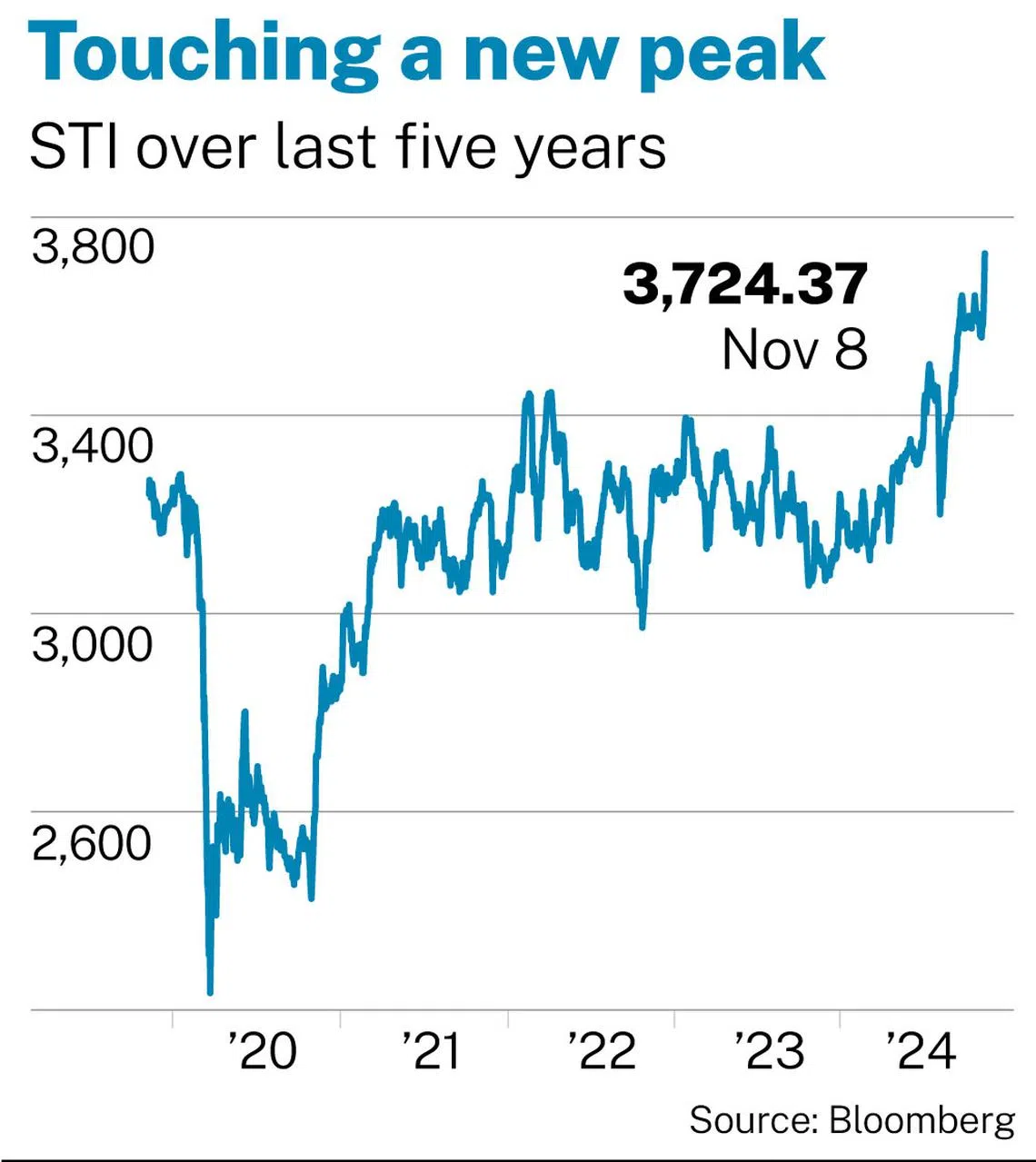
The benchmark Straits Times Index climbed 1.4 per cent to end at 3,724.37. The last time it had closed at this level was in October 2007, just before it hit an all-time high of 3,906.16 that same month.
The STI has been buoyed by the three local banks hitting new highs after posting strong third-quarter results. DBS crossed S$40 for the first time on Thursday.
Other indices in the region were also up. Australia’s ASX 200 rose 0.8 per cent, while Japan’s Nikkei gained 0.3 per cent. However, other indices ended lower. FTSE Bursa Malaysia KLCI was down 0.1 per cent while Hong Kong’s Hang Seng Index was down 1.1 per cent.
The Fed cut interest rates by a quarter of a percentage point on Thursday, bringing its benchmark overnight interest rate to the 4.5 to 4.75 per cent range.
The Fed’s policymakers noted that the US job market has “generally eased”, and that inflation continues to move towards the central bank’s target of 2 per cent.
This is the Fed’s second interest rate cut since its last cut in September. It also comes a few days after Donald Trump, who has advocated for inflationary policies, won a second term in the US presidential office.
Uncertain monetary policy ahead
Analysts said that the rate cut of 25 basis points (bps) this time around came as no surprise, given that the Fed had already signalled a cautious approach to rate cuts.
“The Fed has been signalling a more cautious approach to rate cuts as inflation trends closer to its target of 2 per cent, and the market was pricing this cut with near certainty,” said trader Simon Ree, who is also the founder of online trading academy Tao of Trading.
He added that the rate cut would provide some relief to markets that were initially rattled by uncertainty surrounding Trump’s election victory.
While the US Fed is expected to stay the course for its monetary policy until year-end, analysts said that rate cuts could slow under the newly elected Trump administration in 2025.
Noting that Fed chairman Jerome Powell had been dovish on the US’ inflation outlook, James McCann, deputy chief economist of investment company abrdn, expects the Fed to support another rate cut in December before slowing down the pace of cuts to 25 bps every quarter for 2025.
“However, the risk is tilted towards slower or less easing (of rate cuts) should Trump follow through on the more inflationary aspects of his agenda,” said McCann.
Similarly, Kerry Craig, global market strategist at JPMorgan Asset Management, also felt that the rate cut trajectory next year will be complicated by potentially inflationary policies under Trump.
Greenback to weaken
The latest cuts will bring short-term upside to Asian markets, said observers.
Ree said lower US interest rates tend to weaken the greenback, which could benefit Asian currencies and attract foreign capital into regional markets.
Lower rates will also promote an environment where investors are optimistic and more willing to take risks in their portfolio, said Jonathan Woo, a senior research analyst at Phillip Securities Research.
In the Singapore market, both Woo and Ree agreed that Singapore-listed real estate investment trusts, or S-Reits, stand to gain from the latest rate cuts.
Ree said that S-Reits will likely perform well due to lower financing costs and their appeal as income-generating assets in a low-rate environment, although there could be some volatility in the sector due to concerns over Trump’s inflationary policies.
Noting that interest rates are still at their highest in almost two decades, Woo added that the recovery of S-Reits is likely to be more gradual under a Trump administration.
Meanwhile, sectors such as logistics, retail and hospitality, which are sensitive to consumer spending and economic growth, are also poised to benefit from increased consumption driven by lower interest rates, said Ree. Technology and industrial sectors could see gains as lower rates reduce financing costs for capital-intensive projects.
However, he noted that an incoming Trump administration could affect sectors that rely heavily on exports to the US such as manufacturing, and companies with significant exposure to China. These sectors could face challenges if trade tensions escalate under Trump.
In the light of uncertainty surrounding the incoming Trump administration’s policies, Woo expects markets to give less importance to rate cuts down the road and more to policies that could affect the dynamics of the overall US economy. “It is also likely that we could see more volatility in Asian markets until there is more clarity on such policies, and markets are able to recalibrate expectations,” he added.
Higher-for-longer bond yields
If slower rate cuts pan out next year, bond yields in Asia could stay higher-for-longer, added market watchers.
With the latest cut, Asia and Singapore markets can expect a rally in fixed-income assets such as government bonds and high-quality corporate bonds, said Ree.
Lower interest rates reduce borrowing costs for governments and corporations alike, making existing bonds with higher yields more attractive. He suggested that investors consider longer-duration bonds to capitalise on potential capital gains as rates continue to fall over time.
In the case of Singapore Treasury bills, the higher-for-longer inflation environment could slow the decline of their yields, said Stephanie Leung, chief investment officer of online investment platform StashAway.
“Overall, an inflationary growth environment in 2025 – where we see continued economic expansion and higher inflation – would bode well for equities and gold, though less positively for longer-duration bonds,” she added.